
WESTFIELD — Last year, in conjunction with Advance Manufacturing and the Amati family, students in manufacturing technology at Westfield Technical Academy were given the opportunity to create parts for the American Bobsled Team. The parts were programmed, set up and manufactured by students using stock donated by Advance Manufacturing.
Ron Nadeau, lead instructor of manufacturing technology, said the project was time sensitive. “Upon completion, all of the parts were inspected and presented back to Advance Mfg., where they were used in a bunch of sleds.”
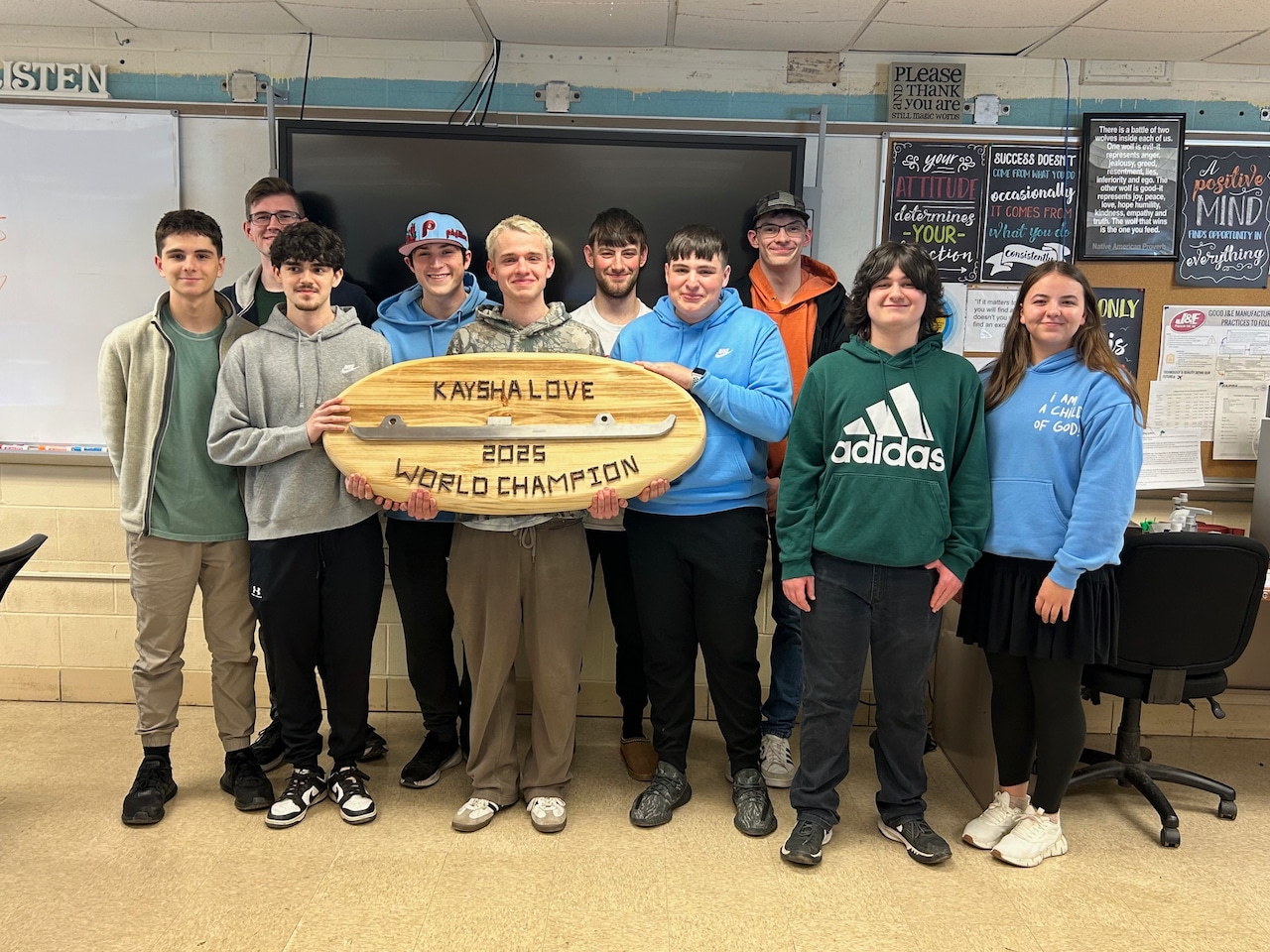
The result was that team member Kaysha Love won a world championship on a monobob using parts created by Westfield Technical Academy students. Recently, Nadeau was at Advance Manufacturing when the team came to the company, and an award was presented to them that was shared with the students.
“All the students that worked on it are now in co-op,” Nadeau said. He said the students are seniors and in their second year of computer aided manufacturing (CAM).
Two of the students that worked on the project, seniors Micah Reimann and Owen Carpenter, talked about the experience.
“It was very different than what we were used to,” said Carpenter. “There was more pressure, and we had to be more careful. Everything had to be perfect. There were higher expectations than in the shop.”
Reimann said they used stainless steel 17-4PH for the parts. He said he appreciated the opportunity to make parts for the Bobsled Team using a new medium and new tools. “It’s nice to get a taste of what you’re being thrown into.”
Both Carpenter and Reimann are currently working in co-ops, Carpenter at Advance Manufacturing and Reimann at Bern Optics in Westfield, where he was just accepted for a full-time job as a CNC (computer numerical control) operator and programmer after graduation.
“They make lenses and prisms. Glass is a different medium from metal. There are lots of different uses. The lenses we make are used in the medical field for diagnostic testing,” Reimann said, adding that they have to make sure the equipment is running right.
Reimann said going into WTA he was interested in manufacturing, as he has family in the field, but he kept an open mind. “It’s something that appeals to me — it’s hands-on. Turning nothing into something is satisfying,” he said.
Carpenter said he continues to make the parts at Advance Mfg. on co-op. Next year, he is planning to go to Springfield Technical Community College for mechanical engineering and to play soccer. He said Advance Manufacturing is supportive of his plans.
Carpenter said he also has a lot of family working in the field. “The shop in general has led me on the right way; getting ready for the real world. Even if I don’t pursue it, it’s something to fall back on,” he said, adding that it’s satisfying knowing that the parts that you’re making will be used in submarines and hatches.
“I’m ready — [WTA] taught me a lot. I feel more prepared than almost any of the other kids I met that are also in the field,” he said.
Another outside job recently completed by WTA manufacturing juniors was a real-world engineering challenge from area resident Bill Venezia.
Nadeau said the students were tasked with pairing a 3500-watt generator with a 418 ml diesel engine — all to create a system that generates electricity to charge solar batteries. “And here’s the twist: the engine runs on recycled vegetable oil,” Nadeua said.
“After some serious brainstorming, designing technical drawings, and machining custom parts, the team successfully connected the engine to the generator,” Nadeau said, adding that Venezia was “very excited about it.”
In 2022, manufacturing technology at WTA received a Skills Capital grant of $250,000 for new machinery to incorporate CNC technology into all the milling machines on the underclassmen side, and advanced CNC technology in all of the milling machines on the upperclassmen side, upgrading them from EMX controls to new PhotoTrac KMX controls. Also purchased were three new bandsaws, a VMC2 CNC milling machine, and new TouchView 4K interactive displays for the Computer Aided Design (CAD) laboratory, among other items.
Students begin training halfway through their freshman year. They are introduced to the equipment in their sophomore year, and by halfway through their junior year they learn the CNC, and how to fully set up CNC machines.
Unfortunately, Nadeau said one of the four manufacturing teachers is among the cuts in the fiscal year 2026 district budget, which he said will slow down getting the curriculum up and running for a couple of the new machines.
“All of these projects come at the cost of having educators to (teach the skills). We’re all about teaching the kids as much as we can,” Nadeau said.