
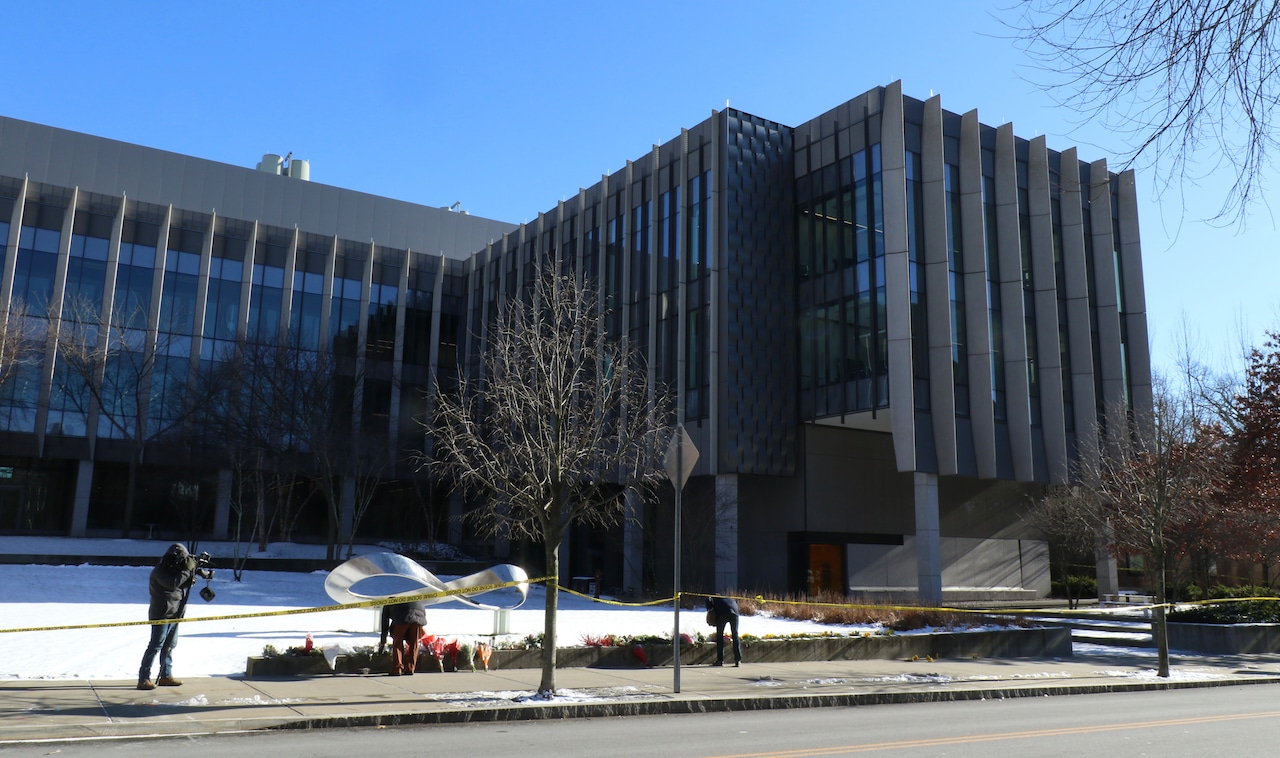
Brown University announced that it had placed the chief of its campus police force on leave on Monday as the fallout from the deadly Dec. 13 mass shooting continued.
Though the emergency response of Brown’s public safety department on the day of the shooting may be the most high-profile controversy to involve Rodney Chatman —the university’s police chief — it is far from the first.
But Chatman has also been the recipient of high praise from law enforcement and university officials — particularly for his focus on community policing. Additionally, a previous investigation into misconduct allegations against the university police chief ended with a district attorney’s office clearing him of wrongdoing.
Neither Chatman nor Brown University responded to a request for comment Tuesday evening.
Chatman’s roots in campus policing
Chatman first served as a police officer in Hamilton County, Ohio, according to Brown University’s 2021 hiring announcement. His LinkedIn profile does not include this experience, but both the announcement and profile indicate that he became a police officer at the University of Cincinnati in 2005, and that he later became a department captain.
Chatman served on the University of Cincinnati’s police force until 2016 when he became the chief of police at the University of Dayton. During his four years leading the department, he was lauded for deepening connections and increasing trust between the police force and the university’s students and staff, according to Brown’s hiring announcement.
Chatman was also the head of the University of Dayton Police Department during the mass shooting in the Ohio city in August 2019 that took the lives of nine people. The university’s police force was among the local law enforcement agencies that aided the city’s police department in the wake of the shooting, Dayton’s then-police chief said at the time.
Brown’s hiring announcement for Chatman includes glowing commendations from University of Dayton President Eric Spina and then-Yale University Police Chief Ronnell Higgins, who now serves as the Commissioner of the Connecticut Department of Emergency Services and Public Protection.
“Rodney is an innovator — someone who thinks outside the box not only about how to improve services within public safety, but also about the downstream impact that changes will have on the community,” Higgins said.
A turn for the worse in Utah
Chatman’s troubles as a university police chief began shortly after he left Dayton to lead the University of Utah’s police force in January 2020. He was selected over 49 other applicants and promised to repair the relationship between the institution’s students and police officers, KUTV reported at the time.
The University of Utah community was reeling from the death of student-athlete Lauren McCluskey in October 2018, according to the Salt Lake Tribune. McCluskey was killed on campus by a man she’d briefly dated, who took his own life shortly after hers.
After McCluskey’s death, reports revealed that she’d reported her killer to University of Utah police for stalking, harassing and even extorting her, according to the Tribune. But far from thoroughly investigating her claims, the officer assigned to her case showed intimate photos she’d provided for the investigation to at least three other male officers not aiding in the investigation.
In December 2020, less than a year after Chatman took over as the head of University of Utah police, the university placed him on leave. The decision was a response to a report by a university police union alleging that Chatman had performed law enforcement duties before receiving his police certification in Utah, according to the Tribune.
At the time, Chatman claimed to the newspaper that the union was lashing out at him for firing three officers, criticizing others and trying to reform the police department in the wake of the McCluskey case.
Six months later, the Salt Lake County District Attorney’s Office cleared Chatman of any wrongdoing, the Tribune reported. Despite this, the University of Utah never reinstated him.
A month later, in July 2021, Chatman accepted Brown University’s job offer.
Chatman’s troubles continue at Brown
In January, Brown University’s student newspaper, The Brown Daily Herald, published an investigation into the university police department’s workplace culture. Reports from anonymous current and former Brown public safety staff alleged that sexual harassment of officers was tolerated by leadership, and that the department’s deputy chief was “toxic” and “vindictive” towards those he oversaw.
In April, the student newspaper published another investigation, this time focusing on reports that Chatman and the university had inadequately responded to a bomb threat in 2021 and a threat of a shooting in 2023.
A former Brown University police officer told The Providence Journal that, in both instances, Chatman and Brown were slow to alert Providence police of the threats to the campus and were covering up having broken the police department’s own policies.
Later that month, Brown launched an investigation into the department’s workplace culture, according to the Journal. But questions over who would lead it lingered, and at one point, the embattled deputy chief was selected.
In August, a union representing Brown University police sergeants issued a vote of no-confidence in Chatman, according to the Daily Herald. In October, the department’s patrolman’s union followed suit.
The unions voiced numerous concerns, including that Chatman was funding new administrative positions at the cost of keeping field officers trained and on duty, the Daily Herald and Providence Journal reported. The Journal also spoke to a union official who claimed Chatman had established traffic ticket quotas despite this being illegal in Rhode Island.
Additionally, both newspapers reported low morale and a “deteriorating work climate” at Brown University’s police department. Brown also confirmed to the Journal that the department had the highest turnover rate at the university.
Finally, at the end of October, The Brown Daily Herald’s Editorial Board called on the university to take action to resolve the ongoing discontent within the Brown police department. It is unclear if university leadership took any action in response.
Rising stakes for Brown University
On Monday, U.S. Education Department officials announced the opening of an investigation into Brown University’s overall security, as well as its emergency response to the Dec. 13 mass shooting. If the university is found to have broken federal law mandating minimum safety and security standards for campuses, it could lose government-funded student aid.
The investigation announcement came on the same day that Brown University President Christina Paxson shared news that Chatman had been placed on leave. Former Providence Police Chief Hugh Clements will serve as interim police chief, assuming day-to-day leadership of the university’s police department and reporting directly to Paxson, she announced.
The university president also detailed plans for immediate security improvements for the campus and two external reviews. One assessment will analyze the Brown University Public Safety Department’s emergency response to the mass shooting, while the other will evaluate campus safety and security, she said.
Brown’s plans for campus security improvements came less than a week after police found 48-year-old Portugese national Claudio Neves Valente — the gunman responsible for the mass shooting — dead in a storage unit in Salem, New Hampshire.
In searching for Neves Valente, police connected him to the fatal shooting of MIT physics professor Nuno Loureiro at his Brookline apartment complex. Loureiro, who is also from Portugal and crossed paths with Neves Valente in decades past, was killed two days after 11 students were struck by gunfire at Brown.
While investigating the mass shooting, police also discovered that a custodian at the university had warned a security guard of a suspicious man on campus weeks before the attack. The suspicious man was later discovered to be Neves Valente.
Brown students and staff have also reported that the university’s emergency notification system was delayed in alerting them to the shooter on Dec. 13, according to federal officials.