
Melissa Hamel worries that in the future, she won’t be able to host gatherings at her home in the summer.
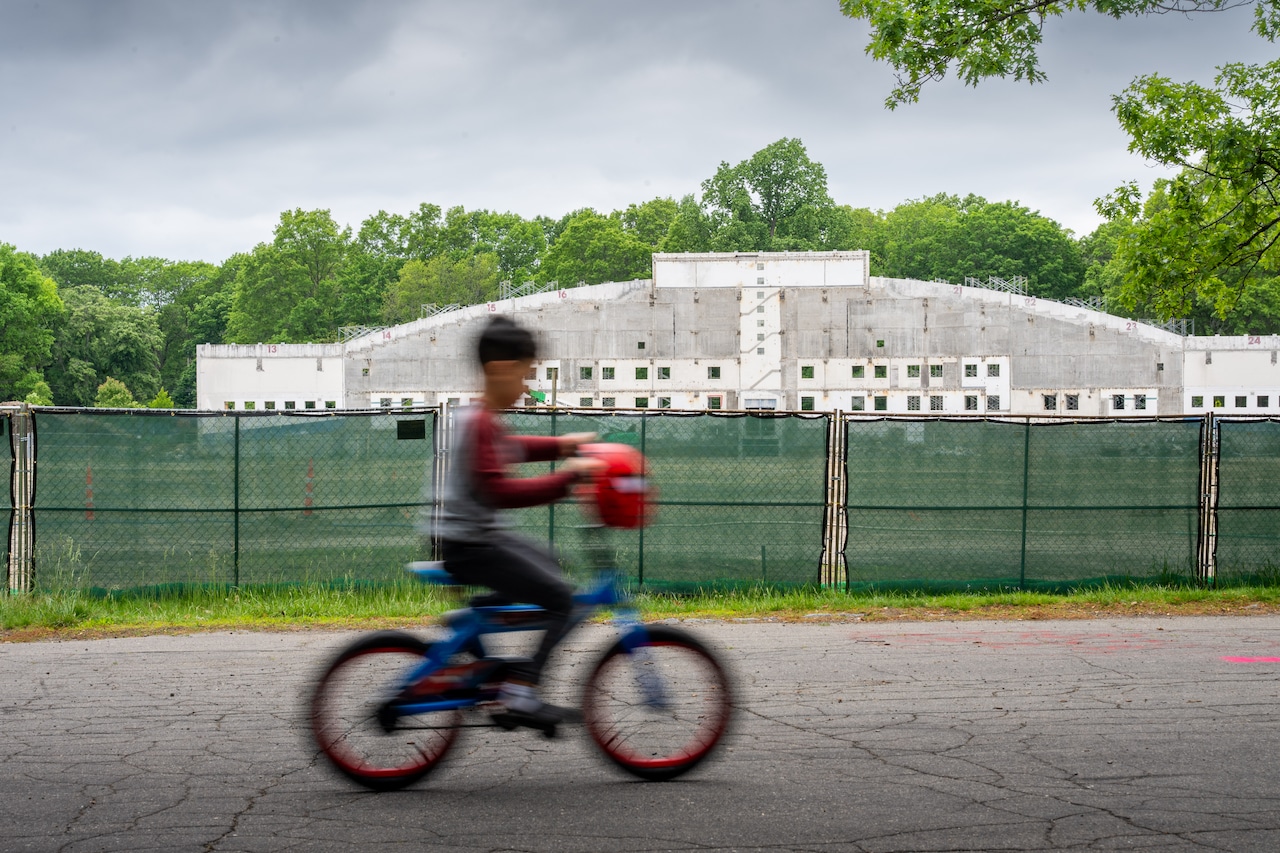
The Jamaica Plain resident lives on Lamartine Street, within walking distance of White Stadium in Franklin Park, which is in the midst of a redevelopment that will eventually make it home to a new professional women’s soccer team.
Hamel and her neighbors expect to be granted free parking permits that give them exclusive access on game days. But she says the one guest pass per household the city has promised won’t always be enough to stop her friends from being ticketed or towed.
What makes planning more difficult is that, despite the ongoing work at the stadium, which has been almost fully demolished except for one exterior wall, the city and soccer team, Boston Legacy FC, have not provided a definitive plan for how they will handle transportation to and from the venue.
“It’s just not workable,” Hamel said. “It seems like another undue burden on an overstressed community. It just doesn’t seem fair.”
Boston Legacy FC, which plays in the National Women’s Soccer League, signed a lease agreement with the city in December. The public school district will retain ownership of the stadium.
The team is expected to play its inaugural 2026 season at Gillette Stadium in Foxborough, after which it will move to White Stadium. The team will have 20 practices and play 20 games at White Stadium each year, under the agreement.
The controversial project has received criticism for its cost and the sharing of a public asset with a private organization.
The Emerald Necklace Conservancy and a group of residents known as the Franklin Park Defenders even sued the city in 2024 to stop the project. Their case was dismissed earlier this year after a three-day trial. They have since appealed that decision.
How the city plans to handle transportation
Though a final transportation plan has not been published, in April, the city released an updated, preliminary plan to gather public input.
On Boston Legacy FC game days, no spectators, staff or players will be permitted to park at the stadium, which does not have a parking lot.
Instead, spectators who drive will be able to park at satellite lots, then ride a free shuttle to and from the venue, according to the draft plan.
The locations of these satellite lots have not yet been identified.
When they purchase tickets, fans will be required to select a transportation method: a shuttle from a satellite lot, a shuttle from the Ruggles, Forest Hills or JFK/UMass MBTA stations, biking or walking, or drop-off by a car or ride-share service.
In the draft plan, officials estimated that 40% of game attendees would drive and park in a satellite lot, 20% would take public transportation and a shuttle from an MBTA station, 20% would walk from an MBTA station, 10% would walk or bike and 10% would be dropped off by a ride-share service.
For designated streets around White Stadium, in the area dubbed the “walkshed,” parking will be limited to residents only from four hours before kickoff to one hour after the game ends.
For Franklin Park visitors, parking will be restricted to those with a “specific scheduled use” such as a golf tee time, admission to the Franklin Park Zoo, or another permitted event within the park, according to the draft plan.
This will be regulated within the existing ParkBoston app from two hours before kickoff to one hour after the game ends.
“This transportation plan is designed to protect and prioritize local residents and everyday users of the park, even during BLFC home matches,” officials wrote.
The plan also includes information about transportation for Boston Public Schools athletics events of varying sizes, though there was no discussion of other cultural events like concerts. For small events, like daily practices or regular-season home games, attendees will be able to park in the nearby lot typically used by the zoo.
For medium-sized events such as championship games and tournaments, other nearby parking lots were also identified as options.
For large-scale events, however, the city has not yet determined how to handle traffic. This includes BPS graduations, which are frequently attended by close to 1,000 people.
“This portion of the plan is being shaped through ongoing outreach to experienced event organizers, Franklin Park operators, and BPS Athletics,” officials wrote. “The goal is to build on best practices while creating a safe, accessible, and coordinated system for all park users.”
Critics say plan is inadequate
Bill Lyons, founder and CEO of planning and design firm Fort Hill Companies, said the April draft plan was “riddled with troubling opacity, internal contradictions, and unsupported assumptions and conclusions” in an analysis he wrote for the Franklin Park Defenders earlier this year.
Lyons said in a recent interview that he disagreed with the city’s estimates of how many people will use each mode of transportation and said not enough analysis or data collection had been conducted to really know what will happen.
One of the biggest challenges he foresaw was a lack of space in the staging area near the stadium for all of the shuttles and ride-share vehicles to drop off and pick up spectators.
Between shuttles from MBTA stations and satellite lots, there would be more than one arriving per minute, each of which would need to remain there until everyone boarded or disembarked, Lyons said.
He also argued that there was no way the city could guarantee that spectators would follow the parking restrictions or have ride-share vehicles drop them off in the designated area. With traffic backed up, drivers would likely end up dropping off passengers at random locations on side streets.
“That’s not good for the pedestrian because now the pedestrians may or may not know how to get to the stadium,” he said. “The drivers are going to be frustrated. They need to get to their next fare. They’re going to do things that are not in the best interest of their passengers.”
He also guessed there would be many more ride-share trips than estimated, particularly after games, when spectators just want to get home as quickly and easily as possible.
The number of pedestrians, too, posed a concern for Lyons.
Especially getting close to the game start time, he said there would likely be a “very heavy flow” of pedestrians fighting for space with the cars and shuttles.
Particularly on Walnut Street, the road that leads to the stadium, that could effectively shut down vehicle traffic, he said, and create a dangerous situation.
“That makes the hair on the back of my traffic engineer neck go up,” Lyons said.
More conversation is needed
Lyons and the Franklin Park Defenders have asked the city to complete an official traffic study to evaluate how the new White Stadium could affect the neighborhood, but so far, that has not happened.
“It kind of drives me crazy that I get held to one standard when I’m permitting through the city … Not only have they not held themselves to the same standard, but they’ve ignored any standards,” he said.
Other critics say the city has not had the discussions it needs to with all stakeholders involved.
State Sen. Nick Collins, D-1st Suffolk, told the MBTA Board of Directors as such at the board’s July 24 meeting, expressing concern that shuttles to and from soccer games would use bus lanes without extensive study of how it could affect MBTA routes.
“Close to 100 private bus trips would be required on game or concert days utilizing MBTA properties, including stations, parking lots and bus lanes,” Collins said, requesting an in-depth public process to “ensure that the MBTA isn’t signing off on something that would have a negative impact on the MBTA, its employees and the people they serve.”
Hamel, the Jamaica Plain resident, said she was upset by what she sees as a lack of concern for the impacts on neighbors. She said she has attended many community meetings with city officials, where she has heard the same concerns raised over and over again with no response.
“They’re not being honest with the community,” she said. “I can’t even begin to imagine what they can do to rectify the situation.”
Neither Mayor Michelle Wu’s office nor Boston Legacy FC immediately responded to requests for comment.
If you purchase a product or register for an account through a link on our site, we may receive compensation. By using this site, you consent to our User Agreement and agree that your clicks, interactions, and personal information may be collected, recorded, and/or stored by us and social media and other third-party partners in accordance with our Privacy Policy.