

AGAWAM – The project manager for a proposed 250-megawatt battery storage facility promised a roomful of skeptical residents Monday his company will follow Agawam’s stringent ordnance governing the controversial new technology.
Rules covering fire safety, monitoring and future decommissioning are the strongest that Longroad Energy’s Chad Allen said he’s seen — and tougher than statewide rules promising an easier path to approval.
But Agawam Mayor Christopher Johnson dimmed hopes at an informational session Monday that anyone would be able to block this or any other battery storage proposal.
“This project is coming to Agawam whether we want it or we don’t,” Johnson said. “This is not a project Agawam went out to attract.”
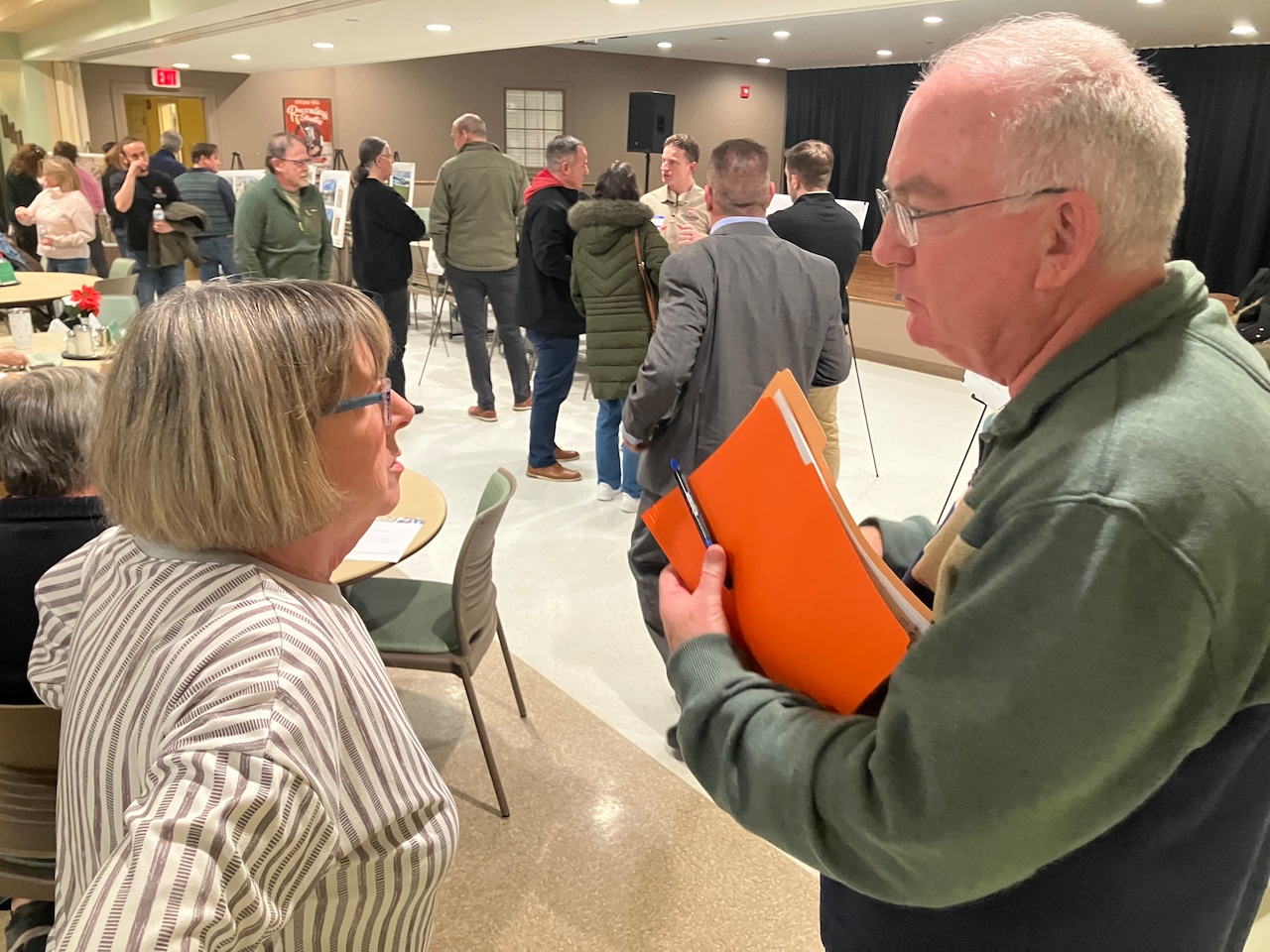
Allen told the crowd of more than 100 people at one of two informational sessions Monday in the Agawam Senior Center that battery storage can provide power for the gird at moments when it’s needed most.
The battery storage facility would buy power from the grid at times when it is plentiful and cheaper and sell electricity back to the grid at times of higher prices and demand.
Longroad Energy proposes a storage facility capable of discharging 250 megawatts of power over four hours, enough to power for 285,000 homes, according to its website.
Power storage makes intermittent power sources – solar and wind – more useful and eliminates the need for polluting “peaker” power plants historically used to meet surges of demand.

Boston-based Longroad expects to start construction on the Agawam project in 2027 and begin operations in 2029.
Allen said he hopes to begin the approval process with Agawam soon. Longroad will also need to go through a review process with the state.
Allen wouldn’t say how much the project would cost, beyond “hundreds of millions of dollars.”
He promised tax revenues for the town.
Johnson said he doesn’t yet know how much the plant will pay in property taxes. But he said he hopes the town will reach a payment-in-lieu-of-taxes agreement with Longroad that would make the plant the town’s second-biggest taxpayer, ahead of the $1.2 million a year paid by Six Flags New England amusement park, but behind what Eversource pays on its infrastructure.
Johnson estimates that Longroad Energy would pay more than Agawam stalwarts like H.P. Hood’s milk plant or OMG, which manufactures roofing hardware.
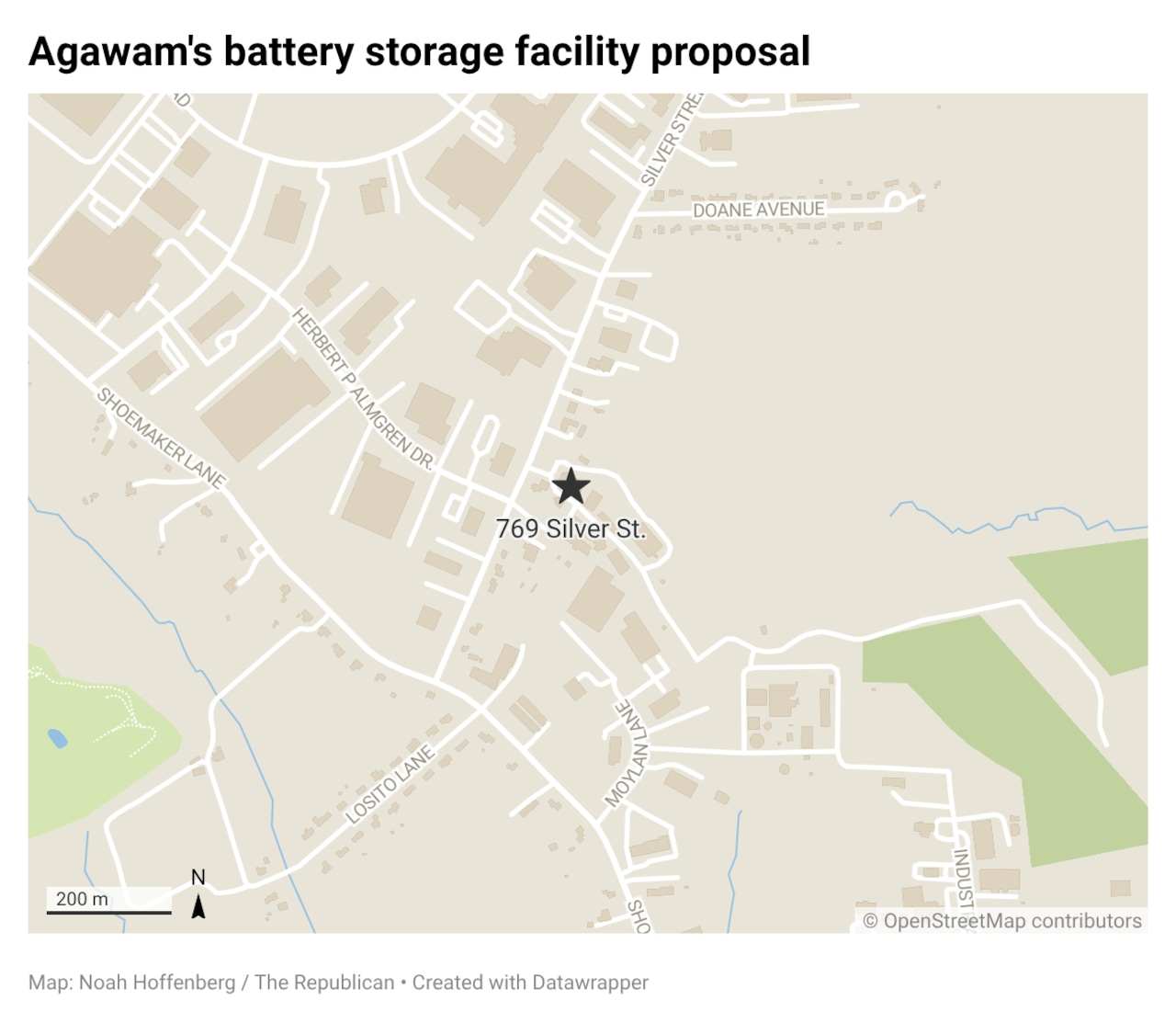
The proposed site is the 17-acre former Lucia Lumber at 769 Silver St.
Residents’ concerns
Many in the afternoon crowd expressed worries about danger posed by battery storage, especially in case of fire. Even more residents were expected to attend a 6 p.m. session.
“I think we’re cooked,” said Terry Galluzzo of Edgewater Road. “I just don’t see the benefit to the people of Agawam. Especially for the risk.”
Karen Sullivan, also of Edgewater Road, said she worries about the possibility of runoff into Silver Lake.
Residents surrounded Agawam Fire Chief Alan Sirois after the meeting, posing questions.
“Do they burn?” people asked, speaking of battery storage plants. “Do they explode?”
Yes, the batteries can burn, Sirois said in response. And if they catch fire, the only thing to do is stop the spread and let it burn out. But that’s the same with a electric vehicle battery.
Agawam’s ordinance lays out what Johnson termed the most stringent safety requirements in the industry from the National Fire Protection Association and Underwriters Laboratories.
Under state green-energy laws, towns and cities cannot ban battery storage. And regulations that are too stringent can invite court challenges.
Each battery in such a facility must be housed in its own container with an independent fire-suppression system under Agawam’s rules.
Johnson said the town’s rules also require a decommissioning bond — money set aside to take the battery storage facility apart if it goes out of business.
This isn’t the only battery-storage project proposed for Agawam. New Leaf Energy has its own proposal nearby at 404 Silver St.
Proposals for battery storage facilities are active in many cities and towns. That includes the former power plant in West Springfield, as part of a solar array in Southampton and in Blandford, Worthington and Plainfield.
Other proposals
There are proposals for battery storage facilities in many cities and towns. That includes the former power plant in West Springfield, as part of a solar array in Southampton and in Blandford, Worthington and Plainfield.
Nearly half of the capacity that green energy developers want to add to New England’s electrical grid would be in the form of battery storage, according to data from ISO New England, which runs the region’s power grid. The most popular type is a lithium-ion battery.
Westfield City Councilor Dan Allie led efforts opposing a since-withdrawn plan for a battery storage plant in Westfield.
He’s since become active in discussions about battery storage in other towns, serving as a clearinghouse for information and as a regional advocate.
“A year ago, none of us understood what any of this was” he said.
But now, residents are well aware of the risk of fire, a risk some say is heightened by the topography of Western Massachusetts, where air tends to pool and not dissipate.
“The pollution is not going to clear out of here,” Allie said.




