

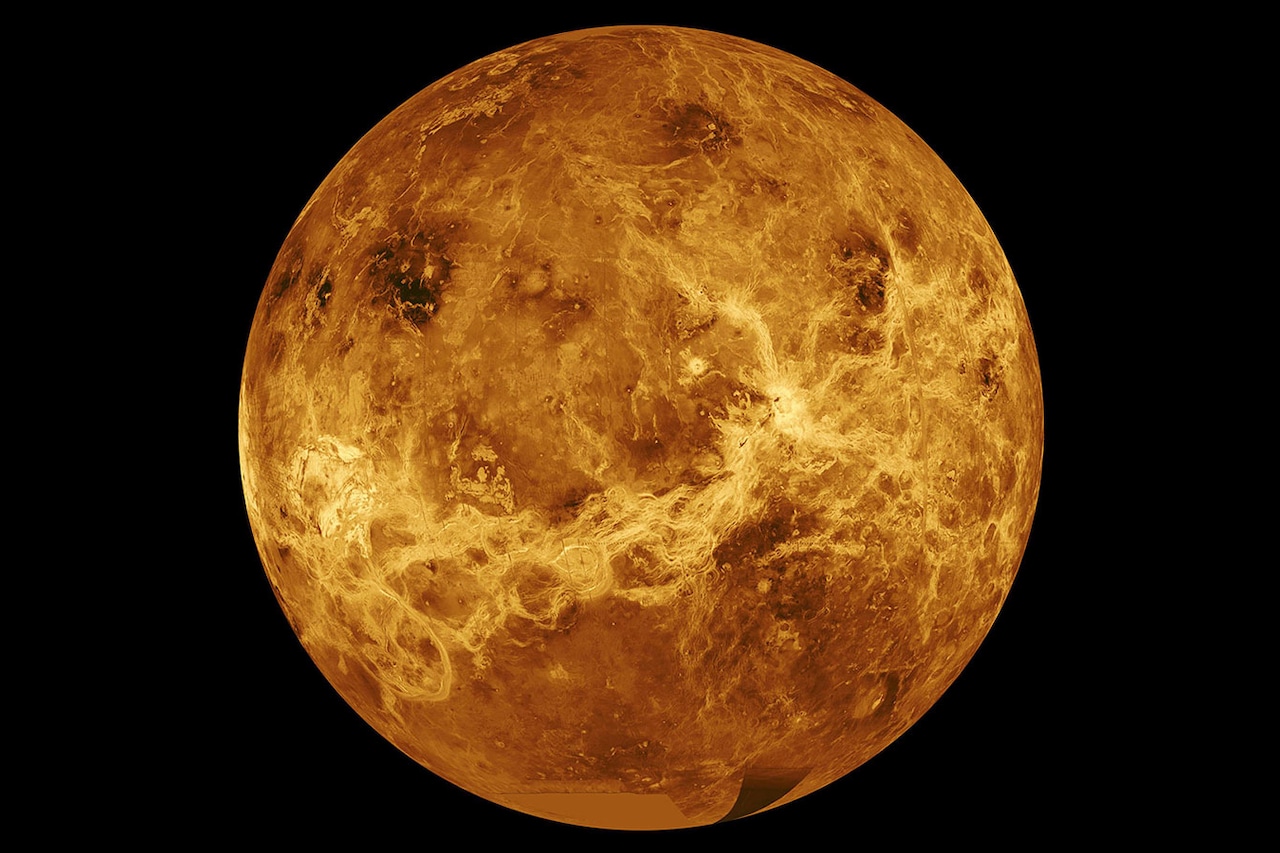
The second-brightest object in the night sky is about to reach its brightest point this year.
Venus, the second planet from the sun and Earth’s neighbor, is typically the first star seen in the evening and the last star seen at night. It’s also the third brightest object in Earth’s night sky, behind the moon and the sun, according to EarthSky.
But on Sunday, Feb. 16, Venus is going to appear at its brightest point at a magnitude -4.6, with only the moon outshining it, the Old Farmer’s Almanac reported.
“When it’s brightest, Venus appears as an eerily eye-catching beacon,“ EarthSky wrote. ”Many mistake it for a UFO. It’s visible not just in a dark sky, but in bright evening twilight as well.”
A celestial object’s stellar magnitude describes how bright that object looks in the night sky, with the brightest stars being seen at a magnitude of 1, EarthSky wrote. Objects with a negative magnitude appear much brighter without the need for a telescope, according to NASA.
The planet becomes exceptionally bright when it gets closer to Earth, EarthSky reported. Venus’ thick clouds also reflect sunlight, which adds to its bright appearance.
After it reaches this bright point on Sunday, Venus is expected to appear exceptionally bright one more time in 2025. Venus will reach peak brightness in the morning sky on April 22, EarthSky wrote.
Venus does not appear at its brightest when fully illuminated, StarWalk wrote. The planet’s brightness depends on both its phase and distance from Earth. When it appears full, Venus is at its farthest point from Earth and looks smaller and less bright. During its crescent phase, Venus is closer to the blue planet and appears much larger.
Sometimes referred to as Earth’s “evil twin,” the size and structure of Venus resemble those of Earth, according to NASA. The planet’s thick clouds trap heat in a runaway greenhouse gas effect, leaving Venus as the hottest planet in the solar system, at roughly 900 degrees Fahrenheit.