
The brand new Vera Rubin telescope is about to begin its 10-year mission to offer the newest cosmic perspective we’ve had in a long time. For Big Picture enthusiasts like myself, such an all-encompassing survey of the heavens is long overdue, and this amazing new telescope is about as close to a dream machine as one could hope for with current technology and funding.
With great observatories like the Hubble Space Telescope and the newer James Webb Space Telescope, along with a host of ground-based installations around the world, some might ask “what’s the big deal?” Quite a bit, it turns out.
There is more that is different about this instrument from most other telescopes than I can hope to convey here, but the closer one looks, the harder it is to imagine any existing corner of astronomy not being affected in important ways when the Vera Rubin telescope officially begins operations.
Right now, the observatory located high in the Andes Mountains of Chile is in the commissioning phase, undergoing calibrations and fine-tuning, but sometime in the next few months should finally begin its survey of almost the entire southern sky.
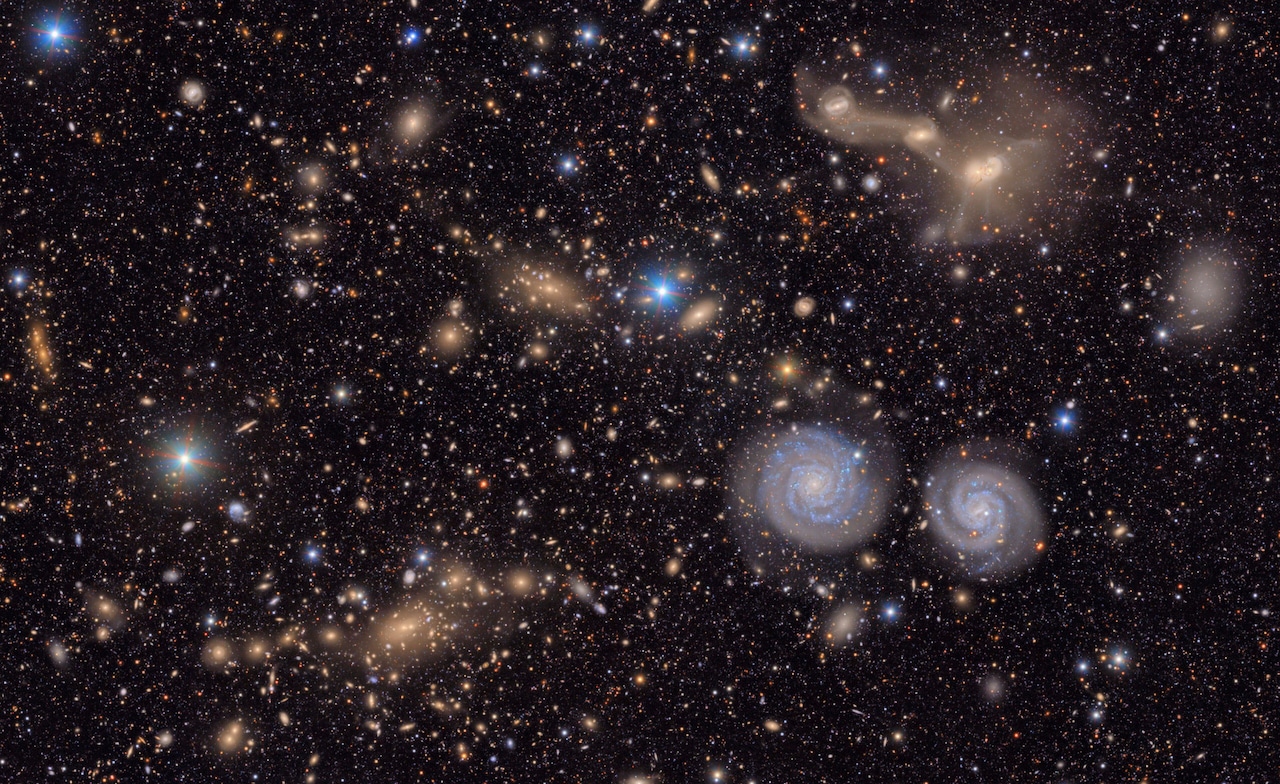
Last week, the Rubin organization released their first images to the public, and they are spectacular. Skywatchers and astronomers everywhere were more than delighted by what they saw — especially those who understand the technical and cultural hurdles that needed to be overcome before these test images could become a reality.
Telescopes have come a long way since Galileo first gazed through the eyepiece of his rudimentary device about 400 years ago. They grew in size and capability, and in the past century, the advantages of letting observations record to film closely followed advances in photography.
Now that digital sensors have replaced film almost everywhere, you’ll find amateurs viewing on electronic monitors even as they sit under the night sky enjoying celestial sights with their own eyes through their telescopes. Telescopes have essentially become powerful cameras.
The Rubin Observatory employs an 8.4-meter (nearly 28 feet) primary mirror to gather light and direct it to the largest digital camera ever built — the car-sized Legacy Survey of Space and Time camera.
As pretty as the published images may appear, do not make the mistake of thinking they fully represent what this telescope is about. First of all, any pictures you see are likely only a tiny portion of any of the LSST’s full 3,200 megapixel images.
As impressive as these are, there are several key differences between these and images from just about every other telescope. Each image captures an area of sky about the size of 45 full moons, or a golf ball held at arm’s length — way more than most telescopes. Compared to Rubin, what the Hubble Space telescope sees is more like looking through a straw.
Also, any image you see is just one in a rapidly accumulating series. Every part of the sky visible to the observatory — will be recorded in high resolution every few nights, or about 800 times over 10 years. Each new exposure will add a single frame, which over time will build an ultra high definition timelapse movie of the entire southern sky. Take a moment to let that sink in.
All scientists in the U.S. and Chile will have immediate access to Rubin data, and anyone anywhere will be able to use Rubin data after two years. Such unprecedented access to vast volumes of data will be a bonanza to citizen scientists as well as researchers around the world for the foreseeable future. You can visit rubinobservatory.org to easily zoom in and explore the released images.
Comparing images of the same areas taken at different times will allow detection of the slightest changes occurring between exposures. The heavy lifting that found 2,000 new asteroids in 10 hours is left to the specially designed algorithms that will automatically issue alerts within 60 seconds for objects that have moved or changed, so scientists around the world can quickly check events with other telescopes.
New asteroids, comets, pulsars (pulsating stars), novae and supernovae (exploding stars), will be found at astonishing rates. Rubin could find minor planets beyond Pluto, and even the long-hypothesized “planet 9” if it exists. An image released last week appears at first glance to show thousands of stars that upon closer examination turn out to be galaxies. In ten years, up to 20 billion never before seen galaxies could be mapped out.
Each night, Rubin will produce 20 terabytes of data, amounting to 60 petabytes of raw image data over 10 years. It will also generate up to 10 million world-public alerts of changes in the night sky.
The simple fact is that we have never had such a capability before, so who knows what unknown phenomena we may have missed? I think the parable of blind men describing an elephant holds some of the most exciting possibilities for the coming years. There could be things are going on that will only become apparent once we gather and process enough of the big picture.
Vera Rubin’s name was chosen for the new observatory because of her pioneering work studying the movement of stars at the outskirts of galaxies. She found that the motions did not follow expectations, but instead moved as though some unobserved force was affecting them — what we call “dark matter.”
Dark matter and dark energy are now believed to make up 95% of the total universe, yet we do not know what they actually are. It is reasonable to assume that the decade-long survey’s large-scale mapping of galaxies and their motions will shed some light on those mysteries.
I have an indirect personal connection with the telescope’s namesake Vera Rubin, who died in 2016. In the 1980s, I worked alongside Vera’s daughter Judith Young at the Five College Radio Astronomy Observatory. Unfortunately, I met Vera only briefly at a memorial for Judy, who passed away in 2014.
Judy conceived of and initiated the construction of the UMass Sunwheel located south of McGuirk Alumni Stadium, just off Rocky Hill Road. I think of this as her own lasting memorial.
– –
Find rise and set times for the sun and moon, and follow ever-changing celestial highlights in the Skywatch section of the Weather Almanac in The Republican and Sunday Republican.
Patrick Rowan has written Skywatch for The Republican since 1987 and has been a Weather Almanac contributor since the mid 1990s. A native of Long Island, Rowan graduated from Northampton High School, studied astronomy at the University of Massachusetts-Amherst in the 1970s and was a research assistant for the Five College Radio Astronomy Observatory. From 1981 to 1994, Rowan worked at the Springfield Science Museum’s Seymour Planetarium, most of that time as planetarium manager. Rowan lives in the Florence section of Northampton with his wife, Clara, and their cats, Eli and Milo.