

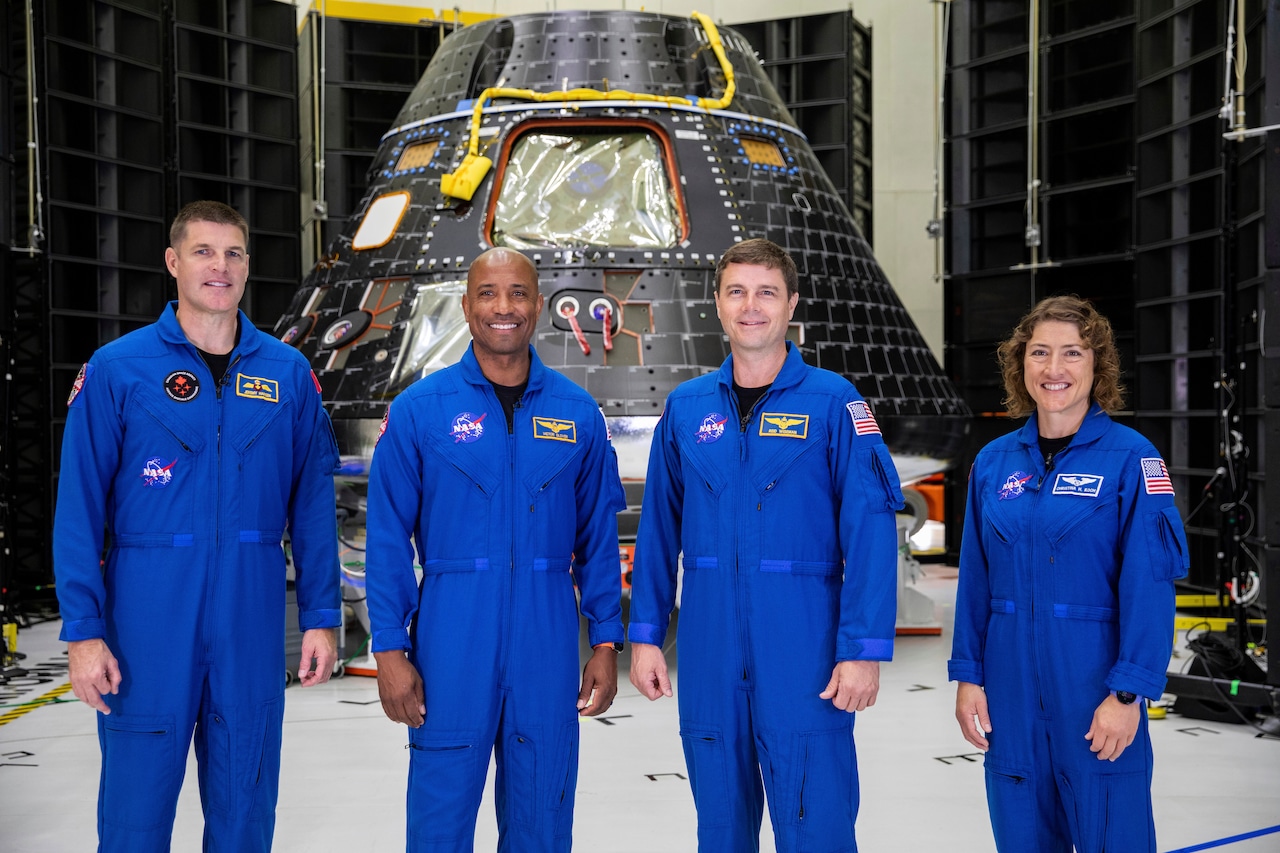
NASA’s Artemis II mission to carry four people around the moon and back could launch as early as this Sunday, Feb. 8. Backup dates keep this launch window open into April if delays occur, but NASA astronauts Reid Wiseman, Victor Glover and Christina Koch, along with Canadian Space Agency astronaut Jeremy Hansen, are anxious to go as soon as possible.
I don’t blame them; they will be the first in more than half a century to experience the moon from close up.
The last was the crew of Apollo 17 (Eugene Cernan, Ronald Evans and Harrison Schmitt). They knew before they got strapped in atop the mighty Saturn V from the Kennedy Space Center in Florida on Dec. 7, 1972, that theirs was the last scheduled moon mission. By all accounts, none of them thought it would take this long to get back.
Unlike the upcoming Artemis II mission, Apollo 17 was a moon landing. Astronaut Evans stayed in orbit while Cernan and Schmitt rode to the surface. In three days, they collected more samples than previous missions, drove their electric Lunar Roving Vehicle over more than 22 miles of rolling lunar hills, and once ventured almost 5 miles from the lunar module — too far to walk back if they broke down.
As Cernan lifted his foot off the lunar surface for the last time, he felt sure that we would return “not too long into the future.” He and Schmitt rejoined Evans in orbit, made the journey back, and splashed down in the Pacific Ocean on Dec. 19, 1972.
Now, after 53 years and several false starts, NASA’s Artemis program (named for Apollo’s twin sister in Greek mythology) appears ready to return humans to the moon. In 2022, Artemis I tested the new Orion capsule in a flight to the moon and back. For the Artemis II mission, Orion will have a crew.
Orion is not designed to land on the moon, but the capsule will carry four people out past the moon, farther from Earth than any human before. With 33% more living space than the Apollo cabins, the crew will ride in relative comfort for their 10-day journey. Even more critical is the addition of an actual zero-G toilet behind a closing door — something the Apollo astronauts could only dream of.
An important lesson was learned early in the Apollo program when the three-man crew of Gus Grissom, Ed White and Roger Chaffee died tragically in a cabin fire during a launch-pad test in 1967. The main culprit, pure oxygen in the cabins, was quickly banned. That and other changes may be why the Apollo program suffered no further losses. Grissom, White and Chaffee were posthumously designated the “Crew of Apollo 1” in honor of their sacrifice.
Apollo 8 circled the moon in December 1968, followed by Apollo 10 in May 1969 — setting the stage for Apollo 11’s landing in July 1969. Of the six moon shots that followed, only Apollo 13 — sometimes called NASA’s most successful failure — didn’t reach the surface. Apollo brought a total of 24 humans to the moon. Of those, 12 walked on its surface.
Since then, all human spaceflight — including the space shuttle and International Space Station — has been stuck in low Earth orbit, no more than a few hundred miles up. Viewed from afar, such flights would hardly appear to have left Earth as they skim the outer atmosphere. Artemis II will lift its crew a thousand times beyond that to reach the moon.
The Apollo program accepted higher risks than the Artemis planners will. Crew safety comes first, so launch dates for the Space Launch Systems rocket carrying the Orion capsule could easily slip.
Most people today were not alive during the Apollo era, so for the majority of Earth’s 9 billion-plus human inhabitants, witnessing this will be an entirely new experience. Enough has changed so that even those who remember the Apollo missions will likely find surprises.
The uncrewed Orion space capsule of the Artemis I mission transmitted high-quality images of Earth floating in the distance as a sun-drenched moon dominated the foreground — amazing views that have me primed for what may come. I am sure the Artemis II crew will want to share shots from handheld cameras. These will have special significance.
Live high definition video and audio feeds will allow us to share this flight with the crew in ways that the grainy black and white video of the Apollo era could not. These will bring the experience of the lunar flyby home to those who pay attention.
The Artemis III and Artemis IV crewed lunar landing are currently slated for 2027-2028 and 2028-2029 respectively, but these dates are widely considered optimistic. Much of the architecture of these missions remains uncertain as NASA must still choose between competing moon landing systems being developed by SpaceX and Blue Origin. There is even talk that some combination of the two may need to be considered.
Artemis V and missions beyond will involve the Lunar Gateway — a way-station for astronauts going to and from the moon. While much hardware has already been built, many hurdles remain that could easily push launch dates well into the 2030s. In the meantime, China appears to be forging ahead, insisting it will land humans on the moon by 2030.
NASA may also scale back its activities on the International Space Station as China expands their own Tiangong space station, which it developed after the U.S. prohibited its participation in the International Space Station. Tiangong is now the second largest man made object orbiting Earth, after the ISS.
My memories of Apollo are more personally significant because I can remember a time before the first artificial satellite orbited Earth. How strange it feels to have witnessed an event that so clearly separates us from the rest of Earth’s 4.5 billion years of existence.
With this perspective, I find our first leap out of low Earth orbit to the moon’s vicinity in more than half a century at least 90% of the achievement, so I’m not waiting for the Artemis III landing to get excited.
You may brush off the Artemis program with the question “why go again?” With hardware far more robust and safe than Apollo’s ‘only what’s necessary’ engineering, the goals are more ambitious, and the perspective we gain may be more important. Orion’s flight beyond the moon may help illustrate that space is not just something “out there,” but the reality of our existence on this fragile, tiny life raft adrift in the cosmic sea.
Perhaps the sole surviving Apollo 17 astronaut, Harrison Schmitt — the only geologist to walk on the moon — will finally get to see our return more than half a century after he left. That would be nice.
Find rise and set times for the sun and moon, and follow ever-changing celestial highlights in the Skywatch section of the Weather Almanac in The Republican and Sunday Republican.
Patrick Rowan has written Skywatch for The Republican since 1987 and has been a Weather Almanac contributor since the mid 1990s. A native of Long Island, Rowan graduated from Northampton High School, studied astronomy at the University of Massachusetts-Amherst in the 1970s and was a research assistant for the Five College Radio Astronomy Observatory. From 1981 to 1994, Rowan worked at the Springfield Science Museum’s Seymour Planetarium, most of that time as planetarium manager. Rowan lives in the Florence section of Northampton with his wife, Clara, and their cats, Eli and Milo.




