The headlines on the state of nuclear weapons in recent days have been dire.
Bulletin of the Atomic Scientists declared at the end of January that its Doomsday Clock, which represents how close humanity stands to global catastrophe, was at 85 seconds to midnight. The scientists cited nuclear war, climate change, and risks from misusing artificial intelligence and biotechnology as reasons to move the hands the closest they’ve ever been to destruction in the clock’s history.
Then, the New START treaty, which placed limits on the number of nuclear weapons held by the U.S. and Russia, expired this week.
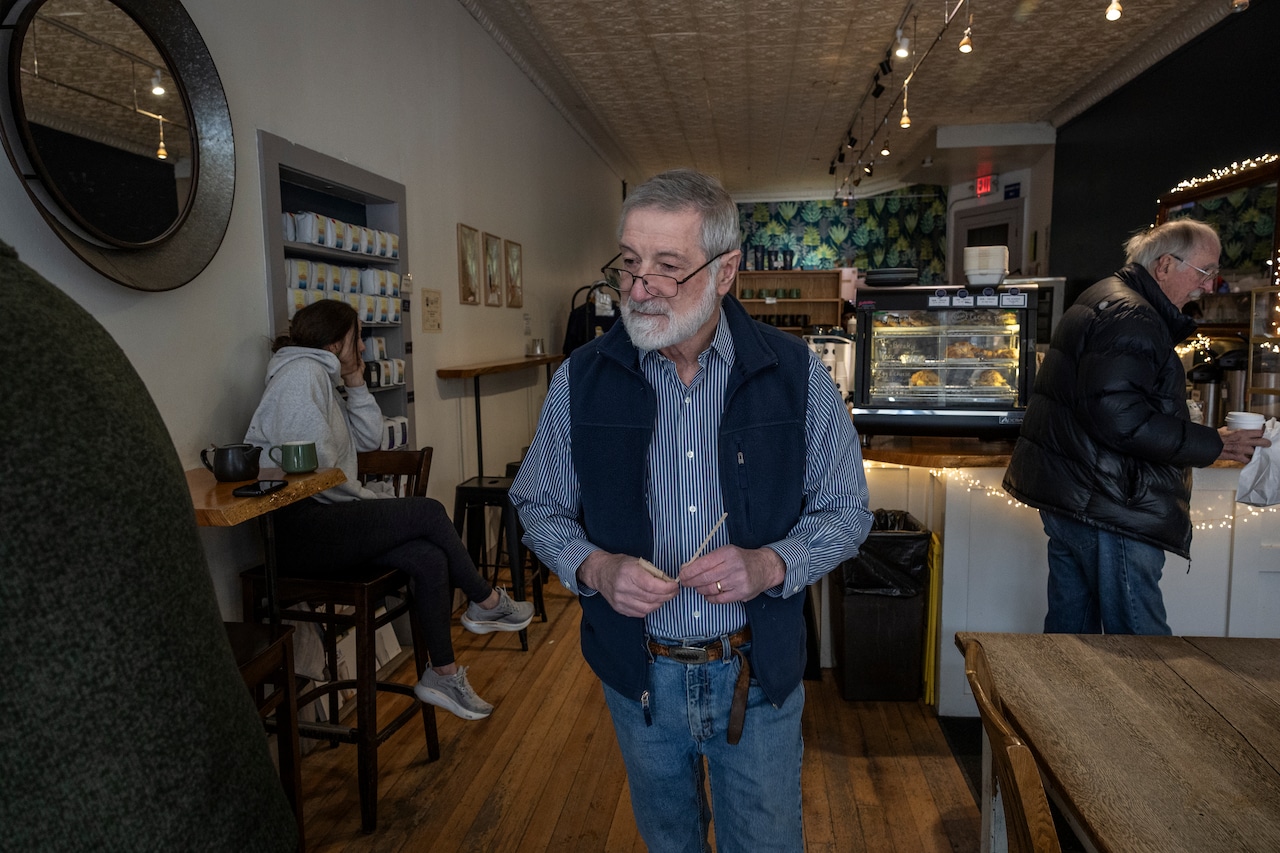
Despite this, Dr. Ira Helfand sees a glimmer of hope. The resident of the Leeds section of Northampton has spent decades advocating for nuclear disarmament.
“The reason that we’re optimistic, despite how dangerous the situation is, is that we know the change can happen very rapidly,” Helfand said, “because it did in the 1980s.”
While a medical intern in Boston, he helped found Physicians for Social Responsibility, a group that argued nuclear war was a medical issue that health providers would be unprepared to address.
“So when you have a disease that you can’t cure, you have to prevent it,” Helfand said.
The group grew rapidly in the early ‘80s, he said, and became an affiliate of the International Physicians for the Prevention of Nuclear War, which won the Nobel Peace Prize in 1985.
“Medicalizing the issue,” Helfand said, helped convince the leaders of the United States and Russia at the time to start reducing their nuclear arsenals.
It wouldn’t be his last brush with the Nobel Peace Prize. Helfand is a member of the International Campaign to Abolish Nuclear Weapons, which was bestowed the prize in 2017 for its work to secure a treaty seeking to prohibit the devices.
Helfand retired from the Family Care Medical Center in Springfield in 2021, and he now volunteers full-time for Back from the Brink, which is advocating for the U.S. to negotiate disarmament with other nuclear powers.
The following conversation between The Republican and Helfand on Friday has been edited for length and clarity.

Q. This week, the last major nuclear treaty between Russia and the U.S. expired. Has that been a step back for the disarmament movement?
Helfand: It’s not a step back for the disarmament movement alone. It’s a step back for the human race. We are in terrible trouble right now. It’s not just the expiration of New START. In the last year, five of the nine countries which have nuclear weapons have been engaged in active warfare. Russia, Israel, the United States, India and Pakistan. And in the case of the last two, they were fighting each other. … It’s an extraordinarily dangerous situation, and the entire world order is undergoing very rapid realignment. … And the resulting instability is really something that I think people are having a lot of trouble getting a handle on and understanding what it means, and how it’s going to play out.
Q. Where does that leave humanity?
Helfand: It leaves us with a very unstable world in which, unfortunately, there is much greater likelihood of significant conflict. The political realignment takes place against the backdrop of a very significantly worsening global environmental crisis. The Earth is a finite system in all ways, except for energy. The flow of energy from the sun is there, and it’s going to be there for a billion or five (billion) years. But everything else on Earth is absolutely finite. And we’re reaching a point where we are outstripping the ability of this planet to support the civilization that we have created. … We’re depleting all the resources that we depend on. … And all this is putting increasing stress on civilization.
Q: Between those two threats of climate change and nuclear war, which are you most worried about?
Helfand: I think they’re both existential threats to human civilization. … They both urgently need to be attended to, and they’re very closely interlinked. The climate crisis is making nuclear war more likely. Nuclear war, if it takes place, will mainly do us in by disrupting the climate, albeit in the opposite direction with global cooling. … I think the really fundamental problem in some ways that underlies all this is our inability to accept the fact that we are in such grave danger. We, all of us, go about our daily lives as though these dangers were not hanging over us. … I think when it comes to nuclear war right now, the denial is massive. And it wasn’t always like this. In the ‘80s, there was widespread understanding of how dangerous the nuclear situation was, and that resulted in millions of people taking action, and that resulted in change in policy. … Today, the message that we are on the brink of nuclear war and need to step back from that brink, I think, is increasingly being heard, although we’ve got a long ways to go to get to where we were in the 1980s.
Q. You wrote recently that political will is the biggest obstacle to disarmament. What’s needed to overcome that?
Helfand: There are lots of other very important problems facing people. There are immediate economic concerns that people have. They have trouble paying their rent, paying their electric bill, sending their kids to school. … Many people feel that democracy in America is in danger, and they see this as an urgent problem requiring attention. There are people who are very concerned about the loss of reproductive rights, especially for women. People who are very concerned about the attack on LGBTQ rights. And all of these are very serious problems. But we have to understand that even as people try to address their concerns on these issues, we have to do something to prevent nuclear war, and we’re not doing it yet. And I shouldn’t say quite so categorically, because we have this campaign Back from the Brink, which we started here in Northampton and Amherst, and it’s now a national campaign which is growing quite significantly. Our strategy was similar to the freeze campaign in the 1980s in that we came up with a prescription for what U.S. nuclear policy should be and tried to get people to sign on to that prescription. And at this point, we’ve gotten over 70 cities and towns across the country. … We’ve gotten resolutions passed in both houses of the California Legislature, both houses of the Rhode Island and Oregon legislatures, in the main Senate in the New Jersey assembly. We have a resolution right now before the Massachusetts Legislature.
Q. What’s the importance of passing these resolutions?
Helfand: It creates a national consensus if enough people do it. That’s what happened with the freeze. When people all around the country passed resolutions supporting the freeze, it became clear that it was a way of demonstrating that there was broad public support for freezing the arms race.
Q. So even as nuclear treaties are evaporating, there’s this grassroots movement?
Helfand: Exactly. … It’s kind of a race who’s going to get there first. And that’s what makes this, I guess you could say, interesting, but really kind of frightening, because it’s not clear if we’re going to be able to build this movement quickly enough. But there is some significant, I think, reason for optimism, because when people hear about the danger, when we’re able to just break through the denial and present information to people about how dangerous the situation is, the reaction is pretty uniform. … In the last 30 years, the media has been terrible on this issue. It has changed recently. … There is the movie on Netflix right now called “A House of Dynamite.”
Q. Has the film affected the nuclear disarmament movement?
Helfand: It definitely kindled some significant interest there. … I think it has helped people to understand the danger that we face. Have you seen the movie “The Day After”? … It was a TV movie in 1983 on ABC, and it had an audience of 106 million people. It was the most watched television program in U.S. history. … It was truly a national event, and it had a huge impact. Yeah, “House of Dynamite” is not having that same impact. … Back in those days there were three networks. … It wasn’t like today.
Q. What does it mean to have a Nobel Peace Prize? Do you consider yourself a Nobel laureate?
Helfand: Well, I’m not personally, but my two organizations are. … This conference that I was just at in Abu Dhabi, I was invited there because of my position within these two organizations.
Q. Having the Nobel Prize, does that change your behavior?
Helfand: Maybe it should, but it doesn’t. I mean, yeah, certainly there’s a responsibility, not so much to the prize as to the mission. We have a very limited amount of time to solve the nuclear problem. We’re either going to get rid of these weapons or they’re going to get rid of us. And I don’t know what the exact time frame is. Nobody does, but I don’t think we have a lot of time. All of the trends at the moment are down, and if we don’t reverse that quickly, we’re going to reach a point where nuclear weapons are used. So it’s that, more than the prize, I think, that sort of conditions my behavior. … The thing about the Nobel Peace Prize is that it gives us a platform to amplify our message, basically. That’s the real significance of winning the prize. It has given us the ability to speak more forcefully the truth that we need to present to people.