

GREENFIELD — For more than a decade, Música Franklin has been quietly reshaping what access to music education looks like in Franklin County, offering free, high-quality instruction rooted as much in equity and community as in technical excellence.
What began as a small, grassroots effort in 2015 has grown into a thriving nonprofit that continues to change the lives of young musicians and their families.
“When Música Franklin started, our founder Vicki Citron and our lead teacher Gloria Matlock were doing all of the instruction and administrative work, largely pro-bono,” said executive director Orice Jenkins in an interview with The Republican. “They had no office or dedicated teaching space, holding classes in residences, schools, and even outside.”
That early improvisation reflected both necessity and determination. Over time, the organization has steadily expanded its capacity.
“Over the years, we have grown to a staff of 10 people,” Jenkins said. “I have been able to hire teachers, assistants, and administrative staff. Now we have an office, and we rent a wonderful classroom space which allows us to serve more students.”
Despite its growth, Jenkins emphasized that Música Franklin’s guiding philosophy has never wavered. “Our core values have never changed: teaching through positive reinforcement, valuing all voices equally, and modeling equitable and just practices,” Jenkins said.
Those values are evident in Música Franklin’s distinctive approach, which intentionally blends rigorous musical training with social justice education. Jenkins said the connection between the two is essential.
“A lot of people may not realize, but racism shows up quite a bit in the musical world, especially when it comes to classical music,” Jenkins explained.
Serving a student body drawn from diverse cultural and socioeconomic backgrounds, the organization aims to prepare young musicians not only to perform, but to lead with empathy and awareness.
“We have a bunch of string students in front of us who all come from diverse backgrounds, and we want them to help shape the next generation of musicians using their own experiences to extend compassion and understanding into their surroundings,” Jenkins said.
The effects of that approach reach far beyond the music itself. “We see them begin to treat each other better and support each other musically,” Jenkins said. “They are able to use music as an emotional outlet when they experience racism in their lives.” In rehearsal rooms and performances, students learn collaboration, confidence, and resilience—skills that translate well beyond the stage.
Access and equity sit at the heart of Música Franklin’s mission, particularly for families who might otherwise view music education as unattainable.
“A lot of families couldn’t even consider music as an option for their children,” Jenkins said. “Not just because of tuition prices, but because many programs have auditions, which would require some form of private training in advance and an instrument to use.”
Transportation, Jenkins added, can be the most significant barrier. “That is probably the most important factor for music instruction—they have to get there!”
To eliminate those obstacles, Música Franklin has built a comprehensive support model. “Now that we are able to provide free transportation to and from the program for all students, in addition to having no auditions, no fees, and free instrument loans, we bear all the financial and logistical burdens so that the families can focus on supporting their child’s musical journey,” Jenkins said.
The long-term impact of that commitment is perhaps best illustrated by the students themselves.
Development and Communications Manager Annierose Klingbeil shared a recent example that captures the organization’s influence. “We recently hired a new classroom assistant who is a former Música Franklin student herself,” Klingbeil said. “She has enjoyed reconnecting with the staff and connecting with the students through their shared experiences as Música Franklin students.” Klingbeil noted that the former student has remained deeply engaged in music. “She’s still an active musician and has continued to seek out musical opportunities since leaving Música Franklin. Seeing a former Música Franklin student continue their musical studies and choose to return as a staff member is a testament to the impact the program has on students.”
Community partnerships have played a critical role in making such outcomes possible. “Before we had a full staff and a space to meet, parents were our volunteer assistants and Sheffield Elementary School in Turners Falls allowed us to use one of their classrooms,” Jenkins said.
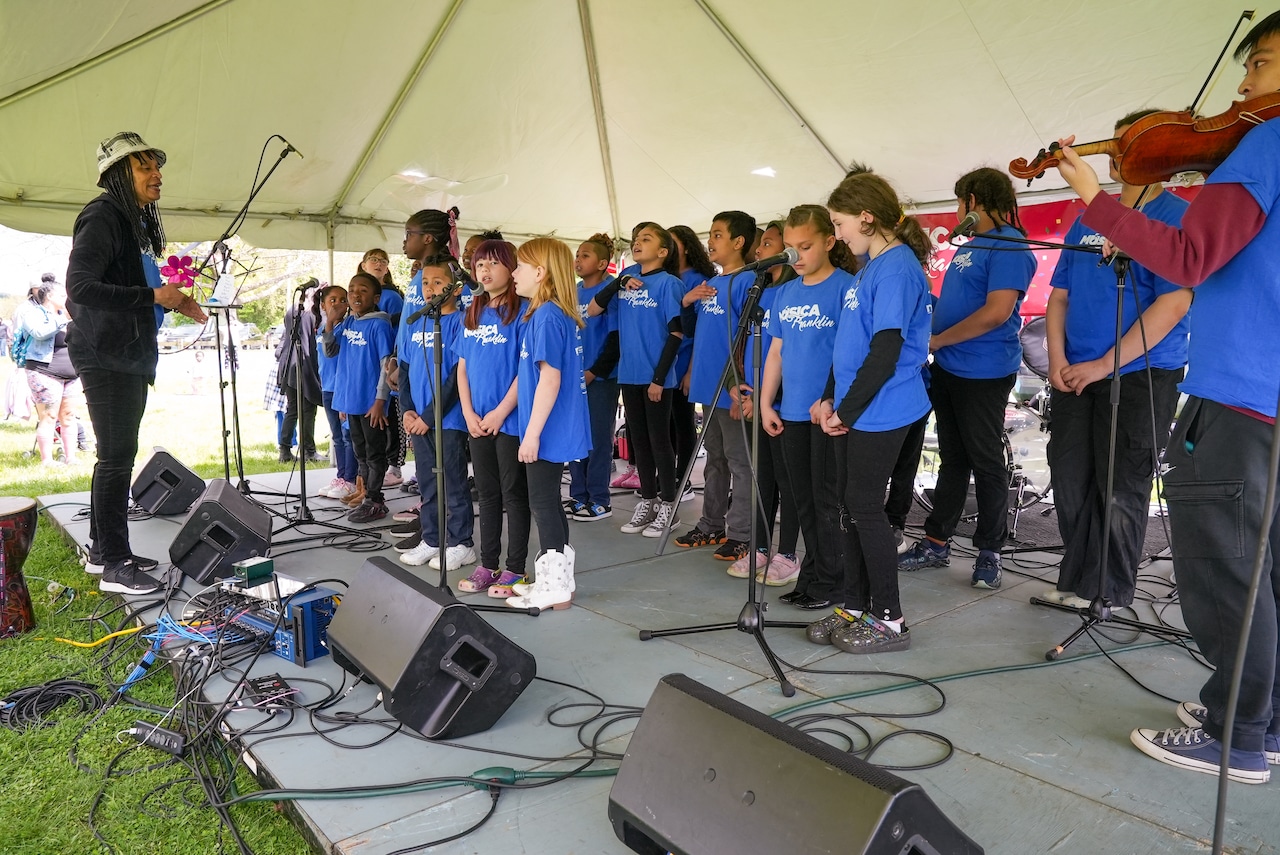
Today, Música Franklin continues to rely on strong local support, with the help of organizations including the Community Foundation of Western Massachusetts and the Massachusetts Cultural Council, as well as local businesses in Greenfield.
Looking ahead, Jenkins sees an opportunity for continued growth for the organization. “We are looking forward to continuing our growth and hopefully offering even more opportunities for youth in the area,” Jenkins said.
That sense of reflection and anticipation comes together each year at the Music Matters Benefit Luncheon, which celebrates Música Franklin’s history and its future.
“This is my favorite part of the luncheon because I get to thank people that have made a difference in our community,” Jenkins said.
After marking the organization’s 10th anniversary in 2025, this year’s event will honor longtime volunteer Aidin Martinez and state Rep. Natalie Blais.
Música Franklin invites the community to celebrate more than a decade of music, education, and local impact at its upcoming Music Matters Benefit Luncheon on Wednesday, Feb. 4, from 11:30 a.m. to 1 p.m. The event will be held at the Greenfield Community College Dining Commons, located at 1 College Dr. in Greenfield, with a snow date scheduled for Feb. 11.
The complimentary luncheon will raise funds to support Música Franklin’s mission of providing free, accessible music education to Franklin County students in grades 1 through 12. All donations will directly support the organization’s work offering rigorous musical training, social justice education, and community outreach for young musicians and their families across the region.
“We would love for folks to come and find out what we do and how they can help us,” Jenkins said.




