

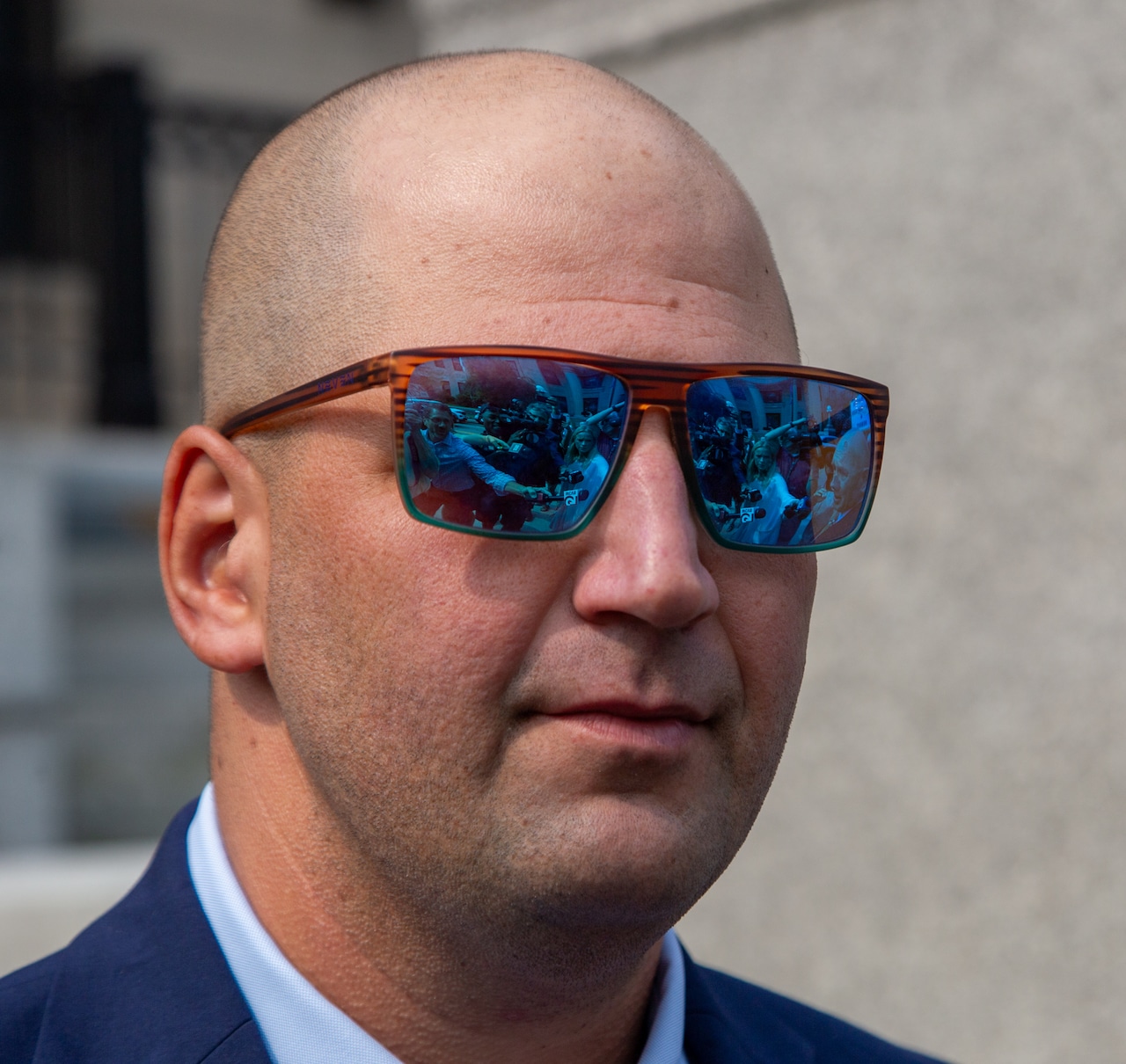
Over two days next week, former Massachusetts State Police trooper Michael Proctor’s fight to get his job back begins in earnest.
Proctor, the lead investigator in the Karen Read case, made headlines for the derogatory text messages he sent about Read during the investigation into the death of her boyfriend, John O’Keefe. He joined the State Police in May 2014 and was assigned to the Norfolk County District Attorney’s office in September 2019.
Proctor was relieved of duty on July 1, 2024 — the same day Read’s first trial ended in a mistrial — and was then suspended without pay a week later. In each of his last two years as a full-time trooper, Proctor earned more than $102,000.
The State Police fired Proctor on March 19 of this year, a decision he quickly appealed to the Civil Service Commission. The full hearing on Proctor’s appeal begins on Aug. 26 and continues on Aug. 27. The hearing will then pick back up in late October.
Here’s what to know ahead of the hearings.
Why was Proctor fired?
A state police trial board determined Proctor violated a pair of department regulations: unsatisfactory performance and alcoholic beverages.
The unsatisfactory performance charge against Proctor was tied directly to the Read case. The trial board, which held three days of hearings on the case against Proctor, determined he sent “derogatory, defamatory, disparaging and/or otherwise inappropriate text messages” about a suspect in a homicide investigation between Jan. 29, 2022, and Aug. 17, 2022.
On a text thread with his superiors, Proctor joked about going through Read’s phone for naked photos. He also repeatedly mocked Read’s medical conditions, telling a group chat of friends from high school she had a “leaky balloon knot.” Proctor also called Read a “whack job [expletive]” and said he wished she would kill herself.
The board also determined Proctor provided “sensitive and/or confidential information about a homicide victim, potential witnesses and/or potential investigative steps” to non-law-enforcement personnel during his investigation.
Proctor “created an image that he was biased in his dealings with a homicide suspect,” the trial board found, adding he brought himself and the state police into disrepute.
In the early stages of his investigation, Proctor told his friends the owner of the home O’Keefe was found outside of wouldn’t “catch [expletive],” noting he was a Boston cop, adding that “there will be some serious charges brought on the girl,” meaning Read.
“Zero chance she skates. She’s (expletive),” Proctor added.
The board also determined Proctor violated State Police regulations when he and Canton Police Detective Kevin Albert got drinks during a cold case investigation on Cape Cod.
Albert’s brother, Brian, owned the home where O’Keefe was found outside in January 2022. The connections between Proctor and the Albert family were highlighted by Read’s lawyers throughout both trials, where they argued Proctor conspired to frame Read.
There was no finding by the trial board that Proctor‘s investigation was compromised.
What is Proctor’s case?
Proctor is pursuing his appeal on two grounds: that State Police did not have just cause to fire him and that he was treated differently from other troopers in a similar situation.
In a filing with the Civil Service Commission obtained by MassLive through a public records request, Daniel Moynihan, one of Proctor’s lawyers, claimed Proctor was kept on “full duty” for months after his superiors learned of the text messages on his personal phone. Proctor testified before a federal grand jury in February 2024, which marked the first time he was confronted with the messages.
Immediately after that, Proctor claims, he told his supervisor, Det. Lt. Brian Tully, about the messages. Tully informed his supervisor, and eventually, Proctor was called into a meeting with the State Police general counsel.
Proctor wasn’t notified he was the subject of an internal affairs investigation until April 2024.
He has also claimed he had a right to privacy for the texts he sent on his personal phone, which included those about the investigative steps and many of his derogatory messages about Read.
“There is no Massachusetts State Police policy, rule or regulation governing the personal cellphones of troopers or any of its employees,” Moynihan wrote in a filing submitted to the commission.
The State Police does not claim that the investigation into Read was compromised, as Read’s defense lawyers did during her trials.
Does Proctor have a chance?
A pair of experts MassLive spoke to both said they saw a path for Proctor to get his job back.
Jack Lu, a retired Superior Court judge, said the State Police caved to public pressure and scapegoated Proctor.
Proctor’s firing “further damages the already-tattered reputation of Massachusetts State Police Discipline,” Lu, an adjunct professor at UMass Lowell, said in March. “This is out of proportion to previous discipline for the same infractions, and suggests to troopers that they are subject to the whim of politics, not a fair discipline process.”
“How can we expect police to be fair to people on the street when they themselves are treated unfairly,” he said.
The State Police never disciplined Proctor before he was relieved of duty in July 2024.
That fact could well aid Proctor in his appeal, said Maureen Boyle, a professor at Stonehill College and a longtime crime reporter.
“If this is a one-and-done, this does not seem like this should be a career-ending situation,” she said.
What Proctor has said
Proctor gave interviews to both “20/20″ and “Dateline,” which aired after Read was acquitted following her retrial, which ended on June 18.
In those interviews, he admitted the texts he sent about Read were “regrettable,” but denied taking part in any kind of conspiracy. Instead, he said he was “caught up in the moment,” investigating the death of a fellow officer, who was roughly his age.
He addressed one message head-on: where he told his sister he wished Read would kill herself, saying in the interview that the comment was “in jest.”
It’s a “figure of speech,” Proctor said, and he didn’t mean it literally.
In the interview with 20/20, Proctor also addressed his dismissal from the State Police. He recalled dropping to his knees and lying on his lawn after hearing the news that he had been relieved of duty on July 1, 2024, the same day Read’s first trial ended with a hung jury.
But he also said he didn’t know of any other trooper “punished for personal texts, let alone fired.”
The civil service hearings
Only the issue of just cause will be raised at the August hearing dates, when State Police will call their first and only witness, Det. Lt. Kevin Dwyer. Dwyer’s direct examination by a lawyer for the State Police will take place on Aug. 26, and Moynihan will cross-examine him the following day, Aug. 27.
Then the case shifts to Proctor on the issue of disparate treatment. It’s not clear how many witnesses Moynihan will call to bolster his case on that issue. Those hearings are set for October 21, 22 and 23.
Each hearing day will be presided over by a hearing officer. In Proctor’s case, civil service commissioner Angela McConney will oversee the hearings.
Thus far, the commission has denied all five discipline and layoff appeals that have come before it in 2025. Since January 2006, 77% of such appeals have been denied, according to the commission.
Most appeals are decided within 15 weeks. In Proctor’s case, that could mean it may well not be until 2026 that a decision is handed down on his future.
If the commission decides Proctor’s termination was unjust, it could award him back pay.
Commission decisions can be appealed in one of two ways: either by filing a motion for reconsideration with the commission or by bringing the appeal to a superior court judge.
If you purchase a product or register for an account through a link on our site, we may receive compensation. By using this site, you consent to our User Agreement and agree that your clicks, interactions, and personal information may be collected, recorded, and/or stored by us and social media and other third-party partners in accordance with our Privacy Policy.




