

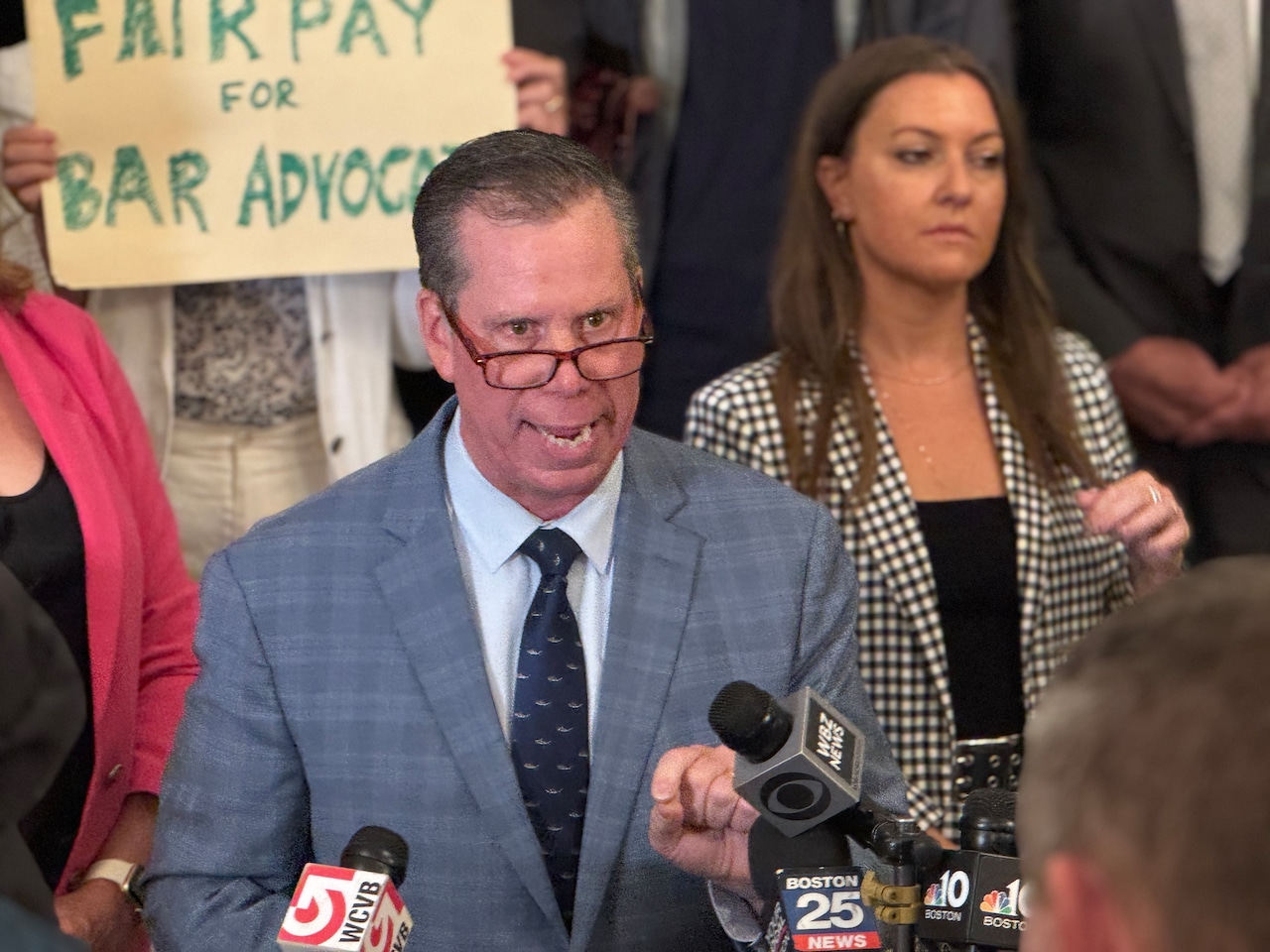
Top state Senate leaders met with bar advocate attorneys last week to discuss the ongoing work stoppage in Massachusetts that is causing a constitutional crisis after legislative action was taken last month without their input.
Coming after months of tension, the hour-long meeting at the state House on Thursday focused heavily on the antitrust language included in the legislation passed July 31, which will ultimately raise bar advocates’ hourly rates by $20 over two years.
Bar advocates say that language, which prevents the advocates from banding together for another work stoppage, would “silence advocates from here to eternity,” and bar advocate Sean Delaney called it the most “alarming” part of the legislation.
“Before we even get to further increases on the pay side — which is necessary — that language needs to be removed, before you see a fair number of bar advocates return to taking cases and duty days,” Delaney said.
Delaney, a bar advocate in Middlesex and Barnstable Counties, attended Thursday’s meeting alongside Jay Carney — a Boston criminal defense lawyer whom Delaney credited with setting up the meeting — and parole attorney Lisa Newman-Polk, who works in parole representation and is both formerly a bar advocate and a Committee for Public Services (CPCS) staff attorney.
They met with representatives from state Senate President Karen Spilka‘s office, including Jacob Blanton, a senior policy advisor and legal counsel for Spilka. The office declined to comment to MassLive on the meeting.
It was the first direct communication bar advocates had with legislative leadership during the ongoing work stoppage, which began Memorial Day after the private defense lawyers stopped taking on new cases to push legislators for a $100 hourly rate to represent clients who can’t afford counsel.
As of August, the stoppage has left thousands of adult criminal defendants — and several dozen children — without a lawyer, causing a constitutional crisis. In response, the Lavallee protocol was imposed for Middlesex and Suffolk counties. Under this court order, adult defendants without lawyers must be released from jail after seven days, and their cases dismissed if they are not appointed a lawyer within 45 days.
Among those released are a man accused of beating a pregnant woman and a woman once listed on the Boston Police Department’s most wanted list. Dismissed cases include allegations of stabbings, public attacks on women and a woman accused of trying to set a family member on fire.
The bill Gov. Maura Healey signed into law earlier this month to address the issue included several key provisions: raising hourly rates from $65 to $75 by 2026 and to $85 by 2027, and allocating $40 million to CPCS to hire over 300 additional staff lawyers to reduce the state public defender agency’s heavy reliance on bar advocates.
It also had language that said bar advocates who refuse to accept new clients because of their pay may constitute a violation of the state’s antitrust laws — words that Delaney previously called “vindictive.” Bar advocates were also dissatisfied with the raise they say doesn’t compare to other New England states’ wages, and felt left out of conversations they had asked to have with the lawmakers.
In Thursday’s meeting, Delaney said the state Senate representatives asked if bar advocates would begin taking on new cases again if the antitrust language was removed from the bill.
Delaney responded that they “couldn’t forget about the pay side of it,” but that the language was “the most alarming to all bar advocates out of everything in that legislation,” and that it’d need to be removed before there was any hope of a mass return to courtrooms.
The discussion was “very lively,” Delaney said, and he hopes it will lead to further conversations that might include Spilka. In the meantime, the bar advocates are looking into forming both a nonprofit organization and a political action committee (PAC), and seeing if union affiliation is possible.
But as the work stoppage wears well into its third month, Delaney said the crisis has started to impact other courtrooms outside of the current jurisdiction of the Lavallee protocol in Middlesex and Suffolk Counties — like in Barnstable County, where 97 people face criminal charges and do not have a lawyer as of Aug. 20.
However, the tone of communication has finally turned from confrontational to collaborative between lawmakers and bar advocates, Delaney said.
“I thanked them and the Senate President for finally recognizing us and giving us a seat at the table. That’s what we had been looking for,” Delaney said.
If you purchase a product or register for an account through a link on our site, we may receive compensation. By using this site, you consent to our User Agreement and agree that your clicks, interactions, and personal information may be collected, recorded, and/or stored by us and social media and other third-party partners in accordance with our Privacy Policy.




