

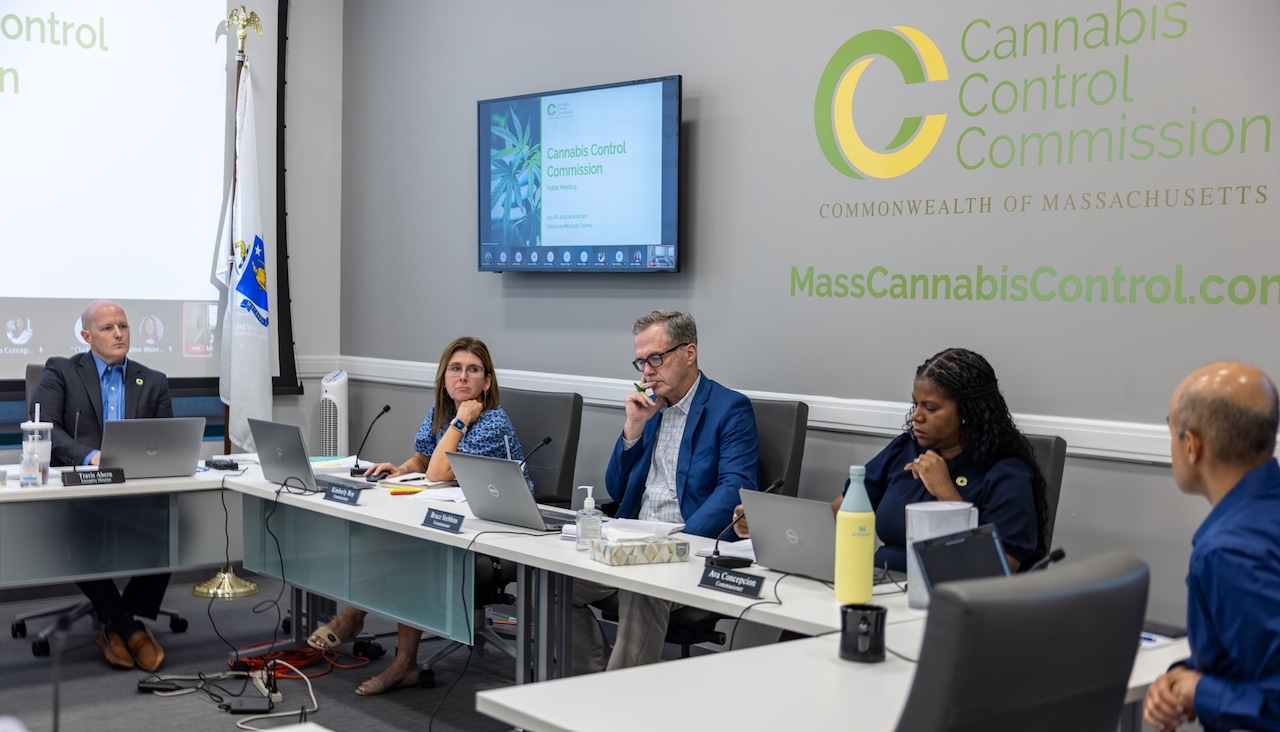
A long-awaited review by State Auditor Diana DiZoglio has found that the Massachusetts cannabis oversight agency displayed a pattern of mismanagement and showed “the appearance of potential favoritism and/or impropriety” in its dealings with some businesses.
The auditor determined the Cannabis Control Commission violated state regulations and mismanaged some of its routine fee collection, resulting in lost revenue.
Its lapses also allowed towns to place restrictions or collect fees from marijuana businesses improperly. This forced some businesses to pay hefty sums for the right to operate, while others inexplicably did not need to do so.
In one such case, a Brookline dispensary was mandated to donate $975,000 to charity as part of its operating agreement with the town, even as another Brookline dispensary faced no such requirement.
“Our audit identified a number of issues that undermine and negatively impact the Cannabis Control Commission’s mission to equitably and effectively oversee the cannabis industry in Massachusetts,” DiZoglio said in a statement.
In a letter to commission leadership, DiZoglio noted the agency’s cooperation throughout the investigation. Her report also included responses from the commission, describing its efforts to correct the issues identified through the audit.
“The Cannabis Control Commission has been working closely with the State Auditor’s Office for almost a year and will review the report released today in furtherance of our shared commitment to government improvement,” a commission spokesperson said in a statement. “Over the course of the audit period and since, the Commission has hired key leaders, made progress to address many of the issues referenced, and begun to move forward in a constructive way.”
‘Procedural inequities,’ failure to collect $1.7M in fees
The audit found that commission managers lacked a consistent, equal process for approving the extension of licenses that all marijuana businesses must hold to operate.
As a result, the commission failed to bill for all fees owed by licensees. The commission also did not maintain sufficient documentation for instances where fees were not collected or waived, creating “procedural inequities” that gave the “appearance of potential impropriety,” the audit found.
In the spring, the state inspector general found the commission failed to collect about $1.7 million in fees between August 2022 and August 2024. While not indicative of fraud, the issue did show “an egregious operational breakdown,” Inspector General Jeffrey S. Shapiro said at the time.
The commission also violated state regulations by failing to promptly assess and collect fines and ensure proper oversight of hearings related to penalties, issues that allowed unresolved compliance gaps at marijuana businesses to linger.
The commission was tasked by state lawmakers in 2022 to review existing agreements between marijuana businesses and municipalities, known as host community agreements. Yet it took months longer than lawmakers mandated to review the numerous agreements.
Issues identified by the audit showed that smaller marijuana businesses with less financial means were likely to suffer more from the commission’s shortcomings than larger multistate companies with deeper pockets.
The auditor found 11 new marijuana businesses that were required to pay significant fees to their municipalities before they could open for business — up to $100,000 in one case. Such practices violate state regulations and give a significant advantage to well-financed marijuana corporations, the auditor said.
The audit also found the commission lacked an established and transparent process for settlement agreements with employees, three of which it reached with staff between 2019 and 2024. One was worth nearly $93,000.
The commission has been without a permanent chair since last year, when Treasurer Deborah Goldberg fired Chair Shannon O’Brien amid complaints that she contributed to a hostile work environment. O’Brien is contesting her dismissal.
Shapiro called last year for the commission to be taken over by the state, declaring it a “rudderless” organization without clear leadership.
In June, the Massachusetts House of Representatives passed legislation that would overhaul the commission, putting it more closely under the watch of the governor. Soon after, the commission released a new charter that it had already been developing to clarify its leadership structure.
The Senate has yet to take up its own version of the House bill.
Audit calls for improved management and fiscal oversight
The audit report called for the commission to improve its overall management structure, institute greater financial oversight, focus on bolstering its staff to effectively police the cannabis industry and improve its transparency.
The commission spokesperson said the agency, by updating its operating procedures, is collecting fees in a timely manner and carrying out new cannabis laws, including its task to review more than 1,000 host community agreements.
“Our first governance charter brings clarity to questions around organizational structure and operations, and budget-dependent, critical software upgrades will enable our infrastructure to grow alongside the booming $8 billion industry,” the spokesperson said, while promising continued work with the auditor’s office, treasurer, attorney general, governor and Legislature in the moments ahead.
If you purchase a product or register for an account through a link on our site, we may receive compensation. By using this site, you consent to our User Agreement and agree that your clicks, interactions, and personal information may be collected, recorded, and/or stored by us and social media and other third-party partners in accordance with our Privacy Policy.




