
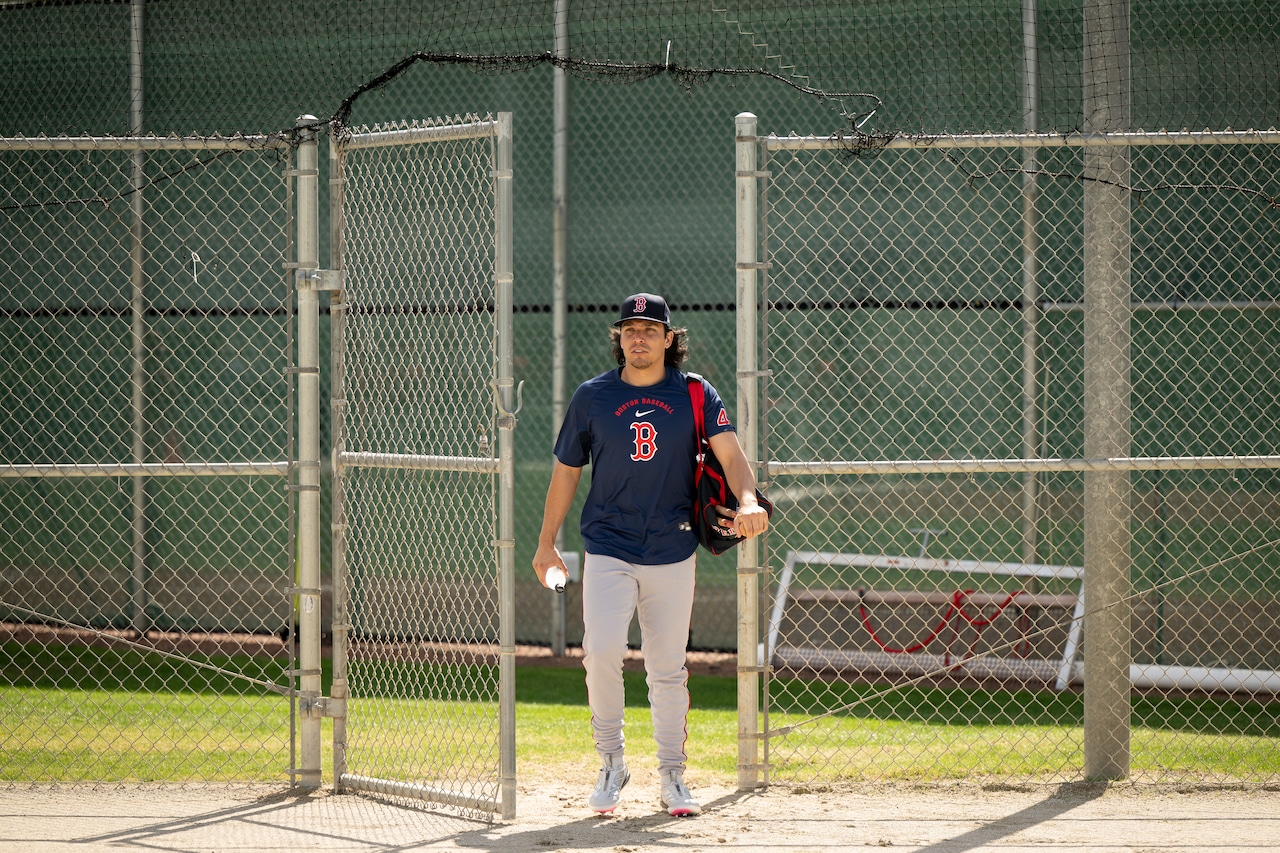
FORT MYERS, Fla. — The official Red Sox website lists only two players, Carlos Narváez and Connor Wong, under its 40-man roster catcher section.
However, there’s a scenario where Boston could have as many as six players who have caught in the majors, including a former Yankees first-round draft pick, on its 26-man roster at one time this season.
First baseman Willson Contreras has started 709 major league games behind the plate. He said he’s willing to catch if Boston needed him there for a few games.
Isiah Kiner-Falefa, a super utility man who Boston signed to a one-year, $6 million contract, has played every position in the big leagues except for first base. That includes 66 starts behind the plate. He also made 78 starts at catcher in the minors. He also said he’d “throw the catcher’s gear on” if needed.
Mickey Gasper, who’s listed as an infielder on the website’s 40-man roster, started 12 games at catcher for the 2025 Minnesota Twins. He has logged 125 starts behind the plate in the minors.
Then there’s Anthony Seigler, who Boston acquired along with Caleb Durbin and Andruw Monasterio in a six-player trade with the Brewers on Feb. 9. The Yankees drafted Seigler in the first round (23rd overall) as a catcher in 2018. He has started 180 games at catcher in the minors and logged an inning there for the Brewers in 2025, when he broke into the majors.
It’s unlikely all six would be on the 26-man roster at the same time. Gasper and Seigler both have two minor league options remaining and likely will spend time at Triple-A Worcester, but there’s always that possibility.
Seigler was considered a plus defensive catcher when New York drafted him. His Baseball America scouting report back then called him “one of the best defenders in the class.” It also noted that “Seigler’s pro future is behind the plate. He is an impressive receiver and has a strong throwing arm, with pop times that hover around 2.00 seconds in-game.”
Why did Seigler transition into a utility player role instead of sticking at catcher full-time?
“That happened in ’23 when I was with the Yankees,” Seigler said. “I feel like there’s a lot of (catching) depth over there in the minor leagues. So I think it was just because of that and they wanted to keep me in there, help me to keep getting at-bats. So they just converted me to a second baseman. They knew I played there in the past. They knew I could. I felt like I could. And so halfway into the ’23 season, they converted me to a second baseman.”
He misses catching full-time.
“Definitely,” he said. “I can’t say I don’t miss it because obviously getting drafted as a catcher and then coming up as a catcher, it’s a lot of fun. I was able to get some innings in last year with (Triple-A) Nashville. I know I’ve still got it in my back pocket, and I’ll be able to use it whenever I want, so just depends on what they want from me.”
Seigler has no regrets about signing with the Yankees out of high school instead of keeping his commitment to play at the University of Florida. After all, most all first-rounders sign and he received a $2.8159 million signing bonus.
But the beginning of his professional career wasn’t easy because of injuries and the pandemic. As Baseball America noted, “A hamstring injury and a concussion limited him to just 24 games in 2018, and a broken left knee cost him all but 30 games at low Class A in 2019.”
He also didn’t play any games in 2020 because the COVID pandemic canceled the minor league season. That’s a lot of development time missed for a high school draft pick and he agrees that it set him back. As Baseball America put it, he “missed out on chances to develop”
“I think the development part could have been a big aspect of it and it could have helped me a lot,” Seigler said. “But there’s a lot of stuff I feel like I could have gone back and done differently or wish I could have done differently. But that’s in the past. I can’t do nothing about it.”
He struggled offensively in the Yankees minor league system from 2021 through 2024.
“I think everything happens for a reason,” Seigler said. “You don’t want it to happen, but it does. I think it definitely benefited me in the long run though, just like mentally, just kind of prepare a little bit better, be a little bit smarter with things that I do.”
What does he regret?
“I think it’s just part of growing up but just a little bit of immaturity at the beginning,” Seigler said. “But I think at the same time, everybody goes through it. You just gotta grow up a little bit and go through tough times. So I think that’s really the main thing.”
He has batted only .230 with a .369 on-base percentage, .370 slugging percentage and .739 OPS in 451 games in the minors. But he had a strong season at Triple-A Nashville last year. In 72 games, he batted .285 with a .414 on-base percentage, .478 slugging percentage, .892 OPS, eight home runs, 16 doubles and four triples (307 plate appearances).
“As a left-handed bat, can hit right-handed pitching and is coming off a really good season in Triple A,” chief baseball officer Craig Breslow said about Seigler. “I think he maybe hasn’t gotten an extended look in the big leagues and a chance to show just how talented he is. But if you look at the pedigree and you look at the season that he just had, it’s pretty easy to get excited about him.”
He’s excited for his opportunity with the Red Sox. He started 16 games at third base for the Brewers last year. He played both second base and third base with Nashville.
“I think they got me here for a reason,” Seigler said. “I don’t know what they’re going to have me do yet. I’m doing a lot of third base, second base, and footwork right now, but I’m definitely excited. I talked to some people already. We have a young core here, a young, talented core. And I think that’s going to carry us a long way. We’re going to be good for a while. So I think just being able to talk to everybody and then just being able to play in Boston, I’ve heard nothing but great things, so I’m really excited about that.”
He said his strength as a catcher is calling a game.
“I feel like I got a really good feel of what my pitchers want to do and how to attack hitters,” Seigler said. “That comes with preparation before the game even starts and then talking with the pitchers and knowing what their strengths are and hitters weaknesses are. But honestly, I think it’s just calling the game and be able to take control of the game. I think that’s what I do a great job at. And then after that I think it’s receiving and then throwing.”