

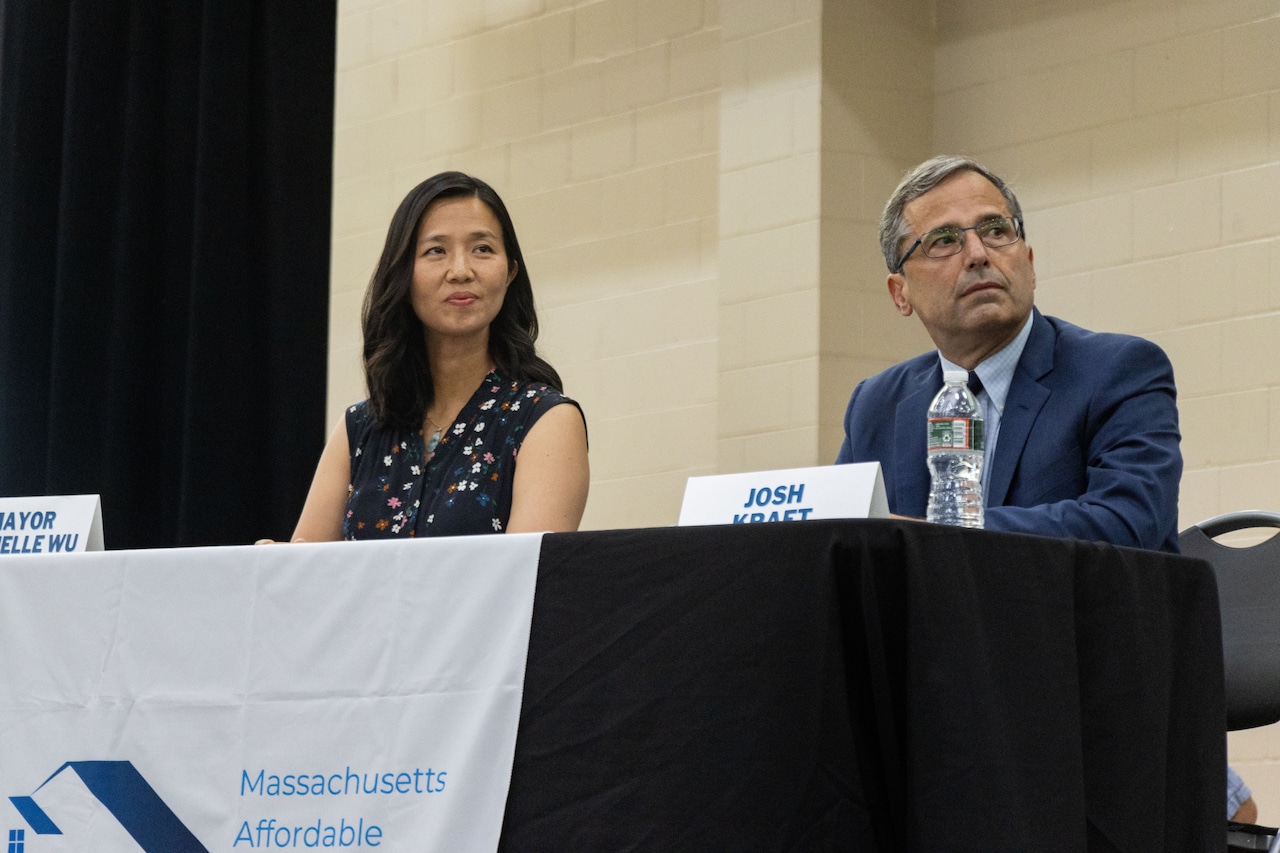
Mayor Michelle Wu and mayoral candidate Josh Kraft butted heads Tuesday over what both said they consider one of the most significant issues of the campaign: the high price of housing in Boston.
During a candidate forum hosted by the Massachusetts Affordable Homeownership Alliance in Roxbury on Tuesday evening, Wu and Kraft shared their respective visions and plans to reduce housing costs. Both candidates agreed that housing is too expensive in the city, but they disagreed on the most effective ways to tackle the problem.
Wu emphasized her track record on housing during her first term as mayor, noting that more than 1,000 first-time homebuyers had purchased homes with city assistance during that time. And more than 20% of affordable homes currently in development are expected to be homeownership units, not rentals.
She said her administration has cut the time it takes for affordable housing developments to get through the permit process in half.
However, Kraft asserted, as he has throughout the campaign, that construction of new housing was currently too slow to address affordability issues in the region. He said repeatedly Tuesday evening that he wanted to lower the cost of construction to help spur development.
By creating more housing, the city will be able to collect more tax dollars to funnel into housing programs such as down payment assistance for first-time homebuyers, Kraft said.
“It’s too expensive to get housing built, and we need to get housing production moving,” he said. “We are going to work with private developers and other people in the housing world to make sure we can get the production of housing and supply of housing moving forward.”
Although both candidates stated they would continue to fund or expand existing housing programs, they disagreed on two sometimes-controversial issues: inclusionary zoning and a transfer fee on luxury real estate sales.
Last year, the city revised its inclusionary zoning policy, which requires new housing projects with seven or more units to set aside 17 to 20% of those units as affordable, depending on the building’s size. Previously, the requirement was 13% affordable units.
The transfer fee, proposed by Wu in 2022, would impose a tax of 1 to 2% on real estate sales exceeding $2 million, with the revenue from the tax allocated toward affordable housing. While the City Council approved the proposal, the city needs approval from the state Legislature to implement the tax, which it has not received.
Kraft said the proposed transfer fee and retaining the current inclusionary zoning requirements would make housing construction more expensive, slowing down development.
“We need housing. That’s the number one issue,” he said. “The number one way to solve a housing emergency is to get more housing built.”
He said if in the future, the city saw an easier economic environment, he would consider the transfer fee.
Wu, however, took issue with her opponent’s characterization of the situation. She compared his view of the inclusionary zoning requirements to changing the channel on an old television, saying it made no sense to keep playing with the antenna “when the TV is unplugged from the wall.”
She said the slowing of housing development had also been seen around the country, not just in Boston, and the inclusionary zoning changes did not cause it. Instead, she attributed it to high interest rates and tariffs imposed by the federal government, which drive up construction costs.
She also pushed back on Kraft’s stance on the transfer fee, saying it made “no sense” to wait until “when it’s good for developers.”
“We hear the same things over and over again, that the same communities just have to wait, and eventually it’ll trickle down. eventually [developers will] make their money and then everyone else will have the benefit,” she said. “It is not the job of the city government or the public sector or the people to subsidize for-profit developers in making their money. It is our job to focus on affordability.”
MAHA will hold a second, virtual candidate forum next month. The preliminary municipal election will be held on Sept. 9, 2025. Polls will be open from 7 a.m. to 8 p.m.
If you purchase a product or register for an account through a link on our site, we may receive compensation. By using this site, you consent to our User Agreement and agree that your clicks, interactions, and personal information may be collected, recorded, and/or stored by us and social media and other third-party partners in accordance with our Privacy Policy.




