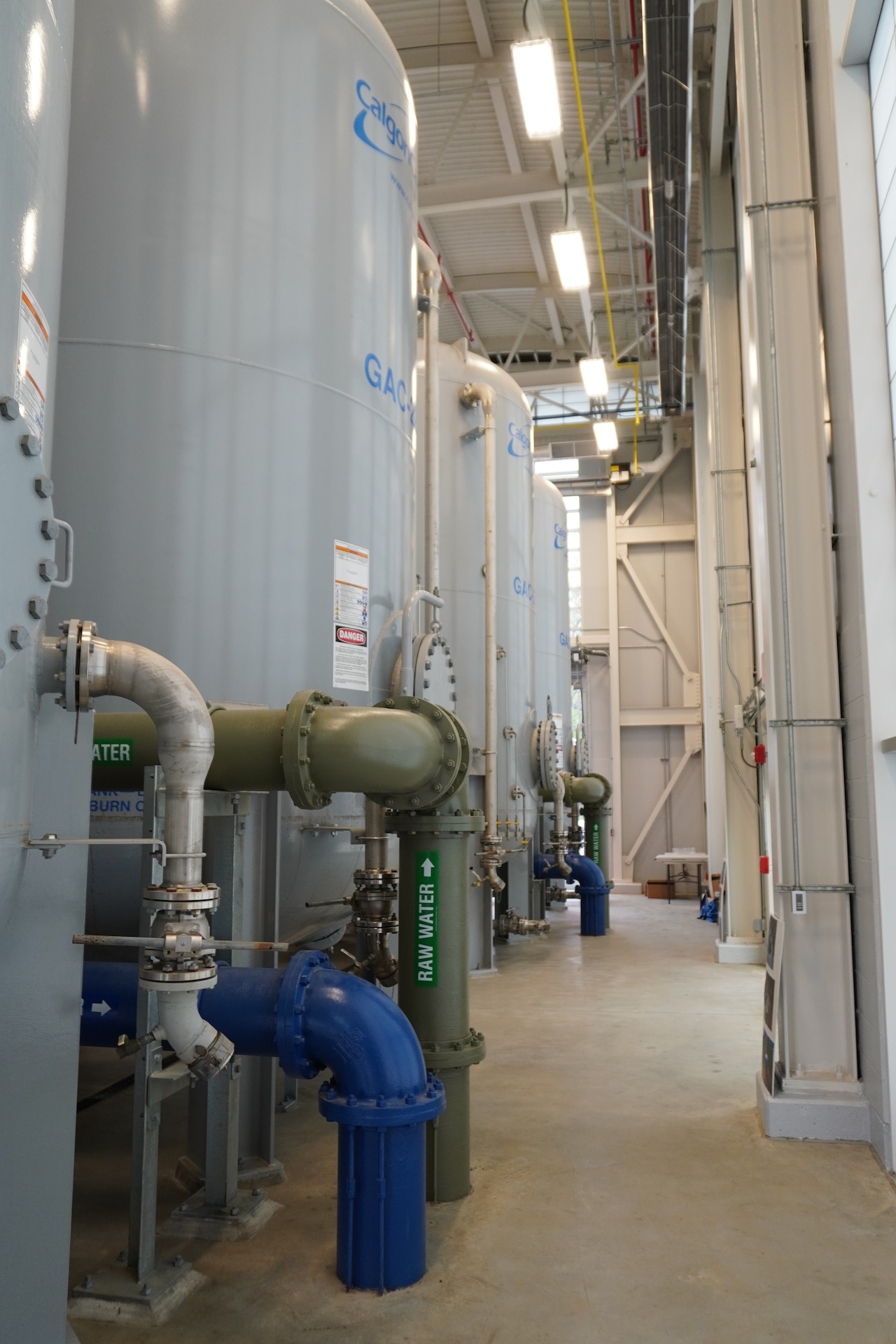
WESTFIELD – A mystery involving the city’s water treatment system that needs solving was the reason it recently received a $50,000 grant from the state.
“Typically, in water treatment plants, there will be some amount of water lost during the treatment process. What we’re seeing is the opposite of that on our meters on the output side,” said Heather Stayton, the city’s water systems engineer.
She explained that the DPW’s Water Department has meters that record how much water is flowing from the city’s groundwater wells and surface water from the Granville Reservoir into the treatment plants and how much is leaving, and it is something of a mystery as to why there is a discrepancy.
All of those meters are regularly calibrated to ensure each remains accurate, and Stayton said all of the meters appear to be functioning as expected.
The only certainty she has discovered after searching for a solution for several years is that it occurs only in some circumstances and only at some times of the year.
“None of those things are real consistent,” she said.
The city operates four water treatment plants — three for groundwater wells and the water treatment plant for water from the Granville Reservoir.
Stayton said only the Granville Reservoir water treatment plant is not indicating a discrepancy in water in and water out.
“So, we have seen it pop up at least to some small extent in each of our three groundwater facilities. We have not seen it at our surface water facility,” she said.
While her only experience as a water systems engineer has been with the city, she’d never heard of a similar situation.
“This is the first time I’ve heard of something like this, so I can’t say how common it would be in the industry. I definitely think it’s certainly an intriguing puzzle,” she said.
She wanted to stress to water customers that there are no issues with water quality.
“This is just about the quantity of water. The quality of the water, based on all of our tests and all of our results, meets all local, state and federal guidelines for drinking water quality,” Stayton said.
In awarding the grant, the state said the city has experienced significant discrepancies between raw and finished water totals ranging from 17–26% in recent years, indicating possible issues with meter calibration, SCADA — Supervisory Control and Data Acquisition — data integrity, and meter installation issues that might be resulting in high percentages of unaccounted for water.
The grant will allow the city to create a Water Efficiency Management Solution for water accounting and leveraging GIS geospatial data for a visualization platform designed to improve water loss control, enhance distribution system resiliency, and strengthen the municipality reporting structure with data-driven water management.
“Digging in, and it’ll be a short term for this project as the state grant is one that gets spent entirely by the end of the fiscal year [June 30]. So, we will hopefully have some answers very soon,” Stayton said.
When asked if solving the mystery would be an opportunity for a research paper detailing how it was found, she said yes.
“I’m sure that there will be folks who want to know how we figured it out and what it ended up being. So, we’ll probably [do something like that], whether it’s a research paper or talking to folks at industry conferences or giving presentations,” she said.
Interestingly, the grant awarded to the city by the Executive Office of Energy & Environmental Affairs was targeted at municipal water systems to help them control water losses within their systems.