

For Jane Peirce, the cataclysmic flooding and massive displacement of thousands of people that turned the Swift River Valley into the Quabbin Reservoir isn’t just a page torn from the history books.
It’s her family’s story, told and retold over the decades, one that is a source of both nostalgia and ongoing pain.
And helping to preserve the Quabbin watershed, which is the source of clean drinking water for millions of people in eastern Massachusetts, is also a part of her life’s work.
“My dad left the town of Prescott with his family and their whole community in 1938,” Peirce told MassLive, referring to one of the four towns that were demolished to make way for the reservoir in the 1930s.
“It was a big deal for people who had to leave the Valley. They left their homes and their families and their communities and everything,” Peirce, a former state Department of Environmental Protection employee who now serves as a member of Orange’s select board, continued.
“And it’s not an uncommon experience out here to find someone like me, who can say, ‘Oh, yeah, my whole family came from there too,” she said.
Now, after 88 years of seeing their growth and development constrained because of the 120,000-acre watershed, and facing a water crisis of their own, the descendants of the people who gave everything so that Boston could have clean water are asking their neighbors to the east to give back.
Earlier this month, local officials from across a dozen Western Massachusetts communities penned an extraordinary open letter, pleading for help.
Across three pages, they outlined the history of the region, its contributions to the growth of the eastern half of the state and the very particular economic and environmental challenges they face.
“The cruel irony is inescapable: Our people cannot drink the Quabbin water that we protect. Private wells throughout our region are dry or are tainted with PFAS, leaving our residents without reliable access to clean water,” the local leaders wrote. “Meanwhile, we are often unable to fully fund our schools, police or fire departments, or maintain our roads, bridges and public buildings.”
The Massachusetts Water Resources Authority, which manages the reservoir on behalf of the state, said it understood the concerns that local officials were raising.
The agency pays what’s known as a “payment in lieu of taxes” for property around the reservoir that’s come off the tax rolls in the affected communities. That payment is based on the highest tax rate in that community.
That means, for instance, that if the commercial property tax rate is higher, then it pays at that level. The agency said it has built in a hold harmless clause, guaranteeing that its payments will never decrease.
The locals say the money isn’t enough to cover what they’ve lost.
The back story
The 412-billion-gallon reservoir, straddling parts of Central and Western Massachusetts, spans 39 square miles. It boasts 181 miles of scenic shoreline that teems with wildlife, providing water to some 2.7 million people in Greater Boston and to four towns in Western Massachusetts.
It takes its name from a Nipmuc word meaning “meeting of the waters,” which is used to describe the Swift River Valley, according to a NASA history of the vanished towns of Dana, Enfield, Greenwich and Prescott.
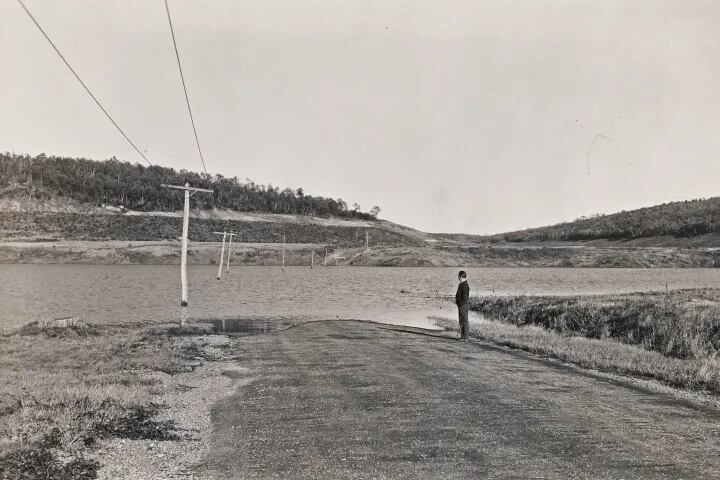
A photo of land that now comprises the Quabbin Reservoir in Western Massachusetts. (NASA photo)
All told, more than 1,100 structures — including 650 homes — were dismantled and 7,600 graves were exhumed to make way for the reservoir.
Workers also tore up 31 miles of north-south railway tracks, The Rabbit Run, which made daily stops on its route between Athol and Springfield.
At street level
Bob Agoglia, the chairperson of Pelham’s select board, lives with the watershed — and its local impact every day.
“One of the things that a town like us is affected by — we have a good amount of land, (there are) many acres that cannot be developed. Our town can’t grow,” he told MassLive.
“Our town in particular is hampered by the lack of developable land within our borders,” he continued. “All kinds of water conditions — wetlands, streams (and) grades, very little developable land. If we have one new house go up every two years, that is a lot.
The letter from the local officials asks eastern Massachusetts residents to contact their state lawmakers to ask them to back companion state House and Senate proposals that would authorize a small surcharge on local water bills to help support the Quabbin communities.
The Senate’s version of the bill, sponsored by Sen. Joanne M. Comerford, D-Hampshire/Franklin/Worcester, cleared the Legislature’s Joint Committee on Environment and Natural Resources last August.
It’s now before the Senate’s Ways and Means Committee, which is typically a bill’s last stop before it’s sent to the Senate floor for a vote.
Comerford met with top committee staff this week to reinforce the fact that the bill remains a priority for her during the Legislature’s current two-year session.
A spokesperson for the committee told MassLive that it is “actively reviewing” the legislation.
The Northampton Democrat, meanwhile, said she was “so deeply inspired by towns organizing themselves to reach their counterparts in Boston.”
“I wish you could have been at some of their meetings. Their appeal is so heartfelt. It is so genuine. They believe that if people understood the consequences of taking four towns and the inequities they face, they would pay more to have water untainted with PFAS and better education,” Comerford continued. “The higher needs are endless when you start to talk to residents and the people who have been stewarding the watershed restrictions for their communities.”
If it eventually wins approval from the state House, which, like the Senate, is controlled by Democrats, the bill will have to get a signature from Gov. Maura Healey.
The MRWA “greatly values the partnership of communities and residents across our watersheds, and appreciates their advocacy,” the agency said in a statement to MassLive. “This collaborative partnership has helped to create and protect the Quabbin and Wachusett Reservoirs – some of Massachusetts most important natural resources.”
Comerford remains optimistic that the bill eventually will be signed into law.
“I really do think this is one of the harms that has been done to Western Mass that must be healed. It must be addressed,” she said. “Otherwise, we will continue to feel that we have this extractive relationship with Boston — we need reciprocity and fair recompense.”
For Peirce, whose family history spans the history of the Quabbin, a rebalancing of the scales is long overdue.
“It’s the equity of it. If people in the east would acknowledge that it’s okay for their water bill to go up by a few cents per, you know, 100 gallons or 100 cubic feet, or whatever their rate is, that money would go back to the communities that are providing the water to them,” she said.




