

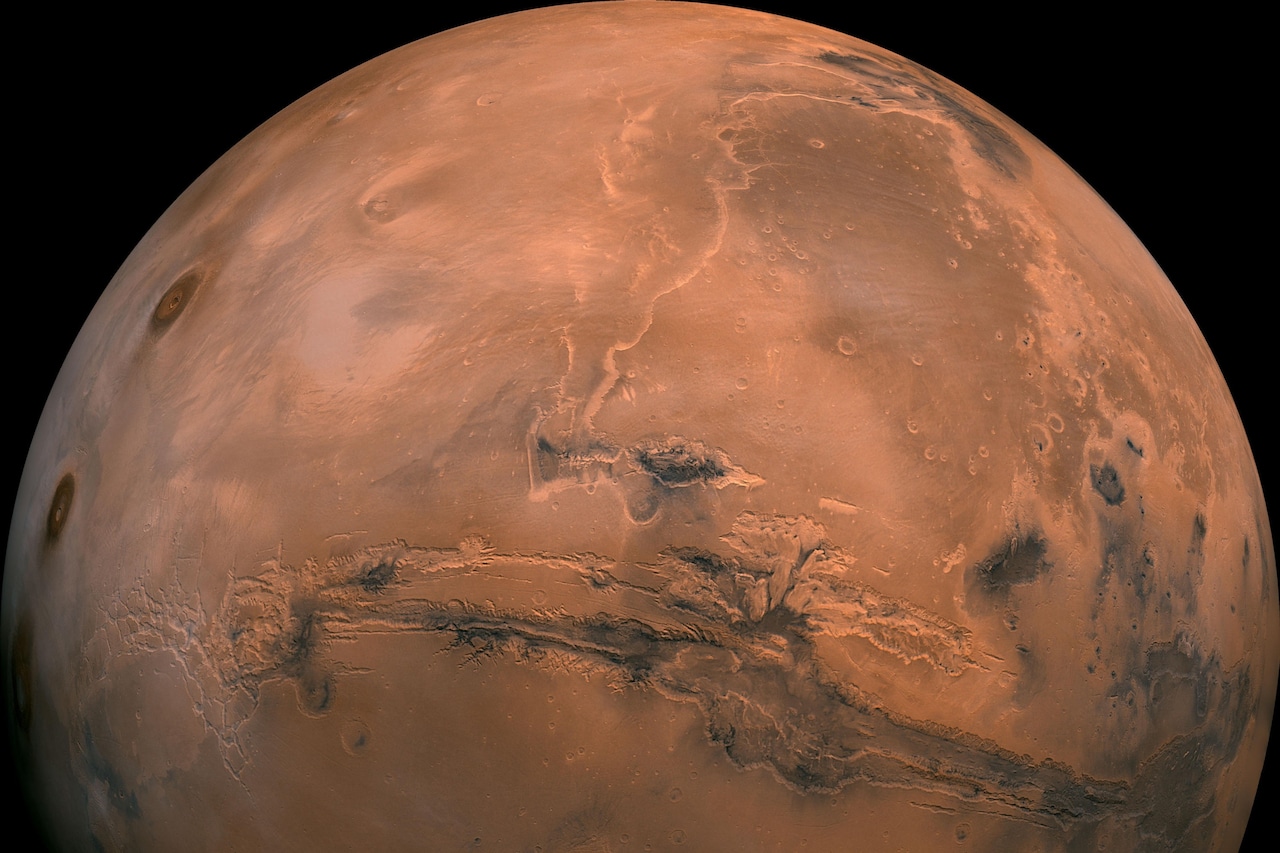
Down on Earth, it is about to look as though a reddish star in the Beehive star cluster is moving. The reality is it’s not a star, it’s Earth’s neighbor, Mars.
Between May 1 and 6, Mars is expected to make its approach through the Beehive star cluster, according to the Old Farmer’s Almanac. Mars infrequently passes through the star cluster once every year, either in the spring or in the fall, as it did in December 2024, BBC Sky at Night reported.
The best night to see Mars make its passage is May 2, two hours after sunset, the space website When the Curves Line Up wrote. The moon’s illumination should be over 30%, which could wash out the naked-eye view of some of the cluster’s stars.
Scientifically designated as Messier 44 and located in the constellation Cancer, the Beehive is made up of around 1,000 stars loosely connected by gravity, NASA stated. It is best seen in the spring night sky and covers a part of space large enough to fit about three full moons.
Mars should be seen making its way through the star cluster with a pair of binoculars, When the Curves Line Up wrote. This star cluster is unique for being positioned along the elliptic, the invisible plane in which all the solar system’s planets line up as they orbit around the sun.
Though Mars resembles a star in the night sky, it’s far closer than the stars that make up the Beehive. The star cluster is 600 light years away, according to NASA, while the space agency reports that Mars is 142 million miles from Earth.
While second-century astronomer Ptolemy noted the cluster as “the nebulous mass in the breast of Cancer,” Galileo made the first telescopic view of the star cluster in 1609, when he counted 40 stars, EarthSky wrote.