

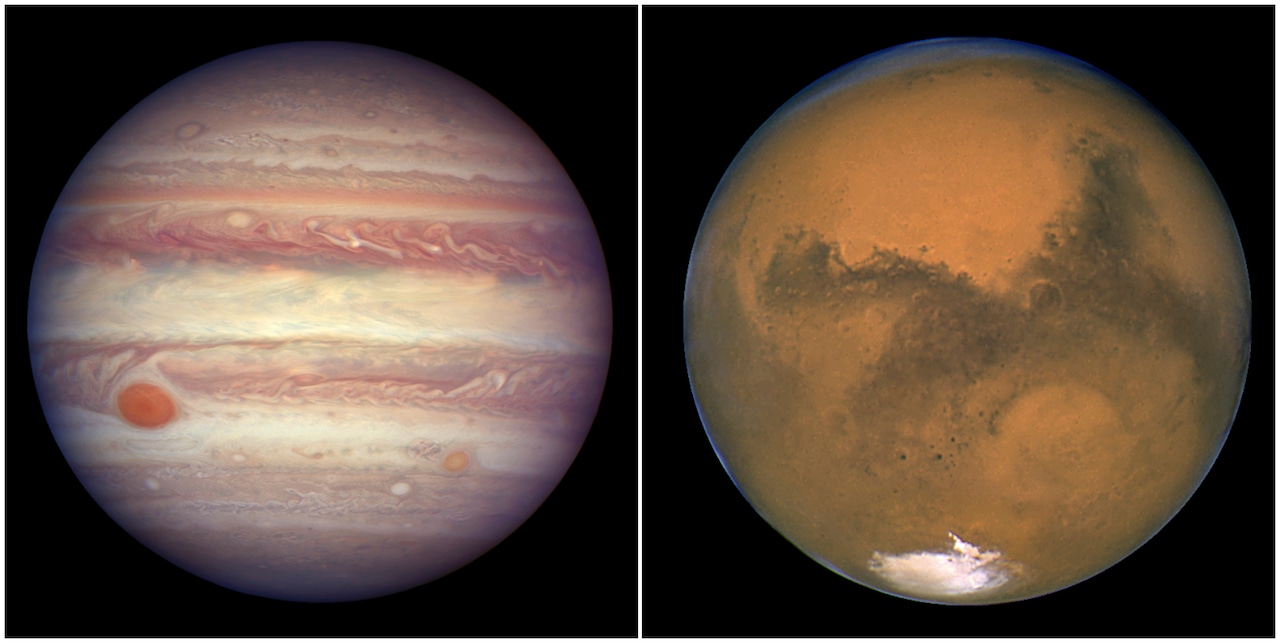
Two planetary neighbors that already appeared close to each other this month are about to look close with Earth’s nearest partner.
Mars and Jupiter joined together for a planetary conjunction on Aug. 14. Both planets appeared “just a third of a degree apart, which is less than the width of the full Moon,” according to NASA.
On Tuesday, Aug. 27, while they will still appear close, the last inner solar system planet and the first out solar system planet will be joined by Earth’s moon in a rare triple-conjunction.
After phasing down from its full blue supermoon between Aug. 19 and Aug. 21, the moon on Tuesday is expected to be in its crescent phase and be 40% illuminated, which should leave Mars and Jupiter bright enough to spot, Wired reported. All three objects should be visible in the western sky one hour before sunrise.
A planetary conjunction occurs when any two astronomical objects appear to be close together in the sky, as seen from Earth, according to London’s Royal Greenwich Museums. These objects can range from planets to moons to asteroids.
Planets in conjunction are also on the far side of the sun from Earth, forming a nearly straight line, according to the Planetary Society. When the innermost planets between Earth and the sun — Mercury and Venus — are on the far side of the sun, it is called a superior conjunction. When they are between Earth and the sun, they are in an inferior conjunction.
“It’s important to note that the planets are never actually close to each other in space,” Public Education Specialist for the Planetary Society Kate Howells wrote. “The orbits of the planets are separated by hundreds of millions of kilometers, so even when two planets are lined up from the perspective of Earth, they are still extremely far apart in space.”
Mars and Jupiter’s initial conjunction was the first between the two since 2018, and it’s expected to not happen again until 2033, according to the Associated Press.
However, they have another role to play this month, along with four of their planetary neighbors. The next day, on Wednesday, Aug. 28, they and Mercury, Uranus, Neptune and Saturn will take part in a planetary parade, or alignment, according to the star-tracking app SkyWalk.
Saturn should be visible in the late evening near the constellation Aquarius and Neptune by the constellation Pisces (the latter with the help of high-powered binoculars), SkyWalk wrote. Uranus should be seen near Taurus, also with binoculars, followed by Jupiter and Mars in the same part of the sky.
Finally, Mercury will creep up at dawn in the direction of the constellation Leo, visible to the naked eye, according to the night sky website.
After Wednesday, the next planetary parade is expected on Jan. 18, 2025, when Mars, Jupiter, Uranus, Neptune, Saturn and Venus should all be visible in the nighttime sky, SkyWalk wrote.