The demo day put on by Techstars Boston used to be a good way to get a glimpse of Boston’s most promising startups. The program launched in 2009, and originally, nearly every startup was based in the Boston area — or at least had moved here to test the waters while participating in the three-month “accelerator” program, which is designed to provide early funding, connections and mentorship to fledgling companies.
But in recent years, the demo day — when company founders deliver short pitches for an audience, hoping to raise additional money — has featured more companies from outside the state than inside it.
That was true on Tuesday afternoon, when seven companies presented. Just two were based locally, but others traveled from California, Utah, and Texas to participate in the program, which offers an investment of $220,000 in the startups that participate, in exchange for a roughly five percent stake.
Techstars managing director Jennifer Davis said that the program selects high-potential startups “that want to leverage the Boston ecosystem,” which could mean connecting with health care or financial services companies here. “There needs to be a ‘why’ for them to be here,” she said. Techstars typically accepts fewer than 1% of the companies that apply. (Harvard’s acceptance rate is about 4%.)
Another recent change: the Techstars Boston program has downshifted from working with two batches of startups each year — one in the spring, and one in the fall — to just one batch in the fall.
Tuesday’s demo day was held at Google’s office in Kendall Square. Before it began, I asked 11 people in the audience — entrepreneurs, technologists, marketing consultants, and so-called “angel” investors who put money into startups — to take notes on the company they thought was most likely to succeed.
Here are the two companies that got the most mentions — both health care-related, and both, as it happens, based in the Boston area:
Accelidea: A software platform that uses artificial intelligence to help teams designing new medical devices get them approved and into the market faster. Founder Rose Huang is a former R&D engineer at a big medical device company, Boehringer Laboratories. The software can automate up to 80% of the manual work involved in product management, engineering, regulatory filings, and quality control, Huang said.
“We’re a team of engineers, operators, and AI experts with deep regulatory expertise, and we’re obsessed with solving this problem,” she said. Accelidea is already working with three early paying customers.
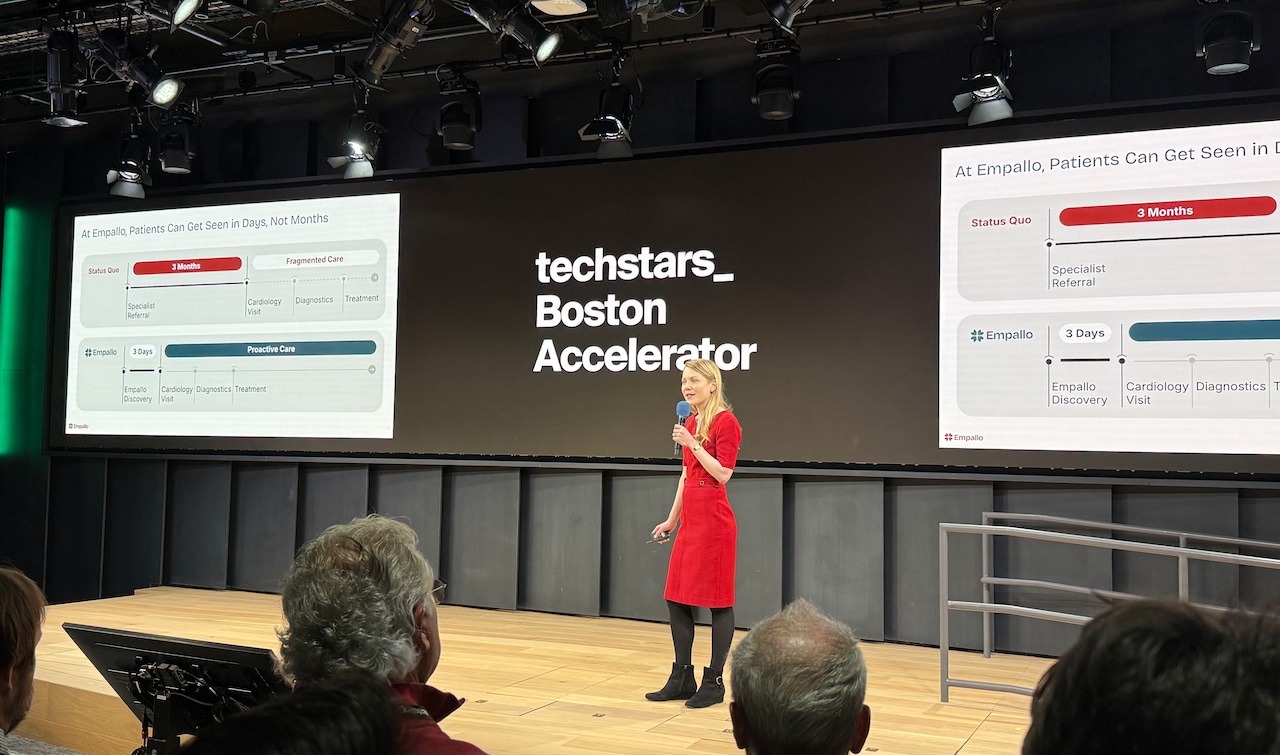
Empallo: A virtual clinic for heart care. Founder Claire Beskin, a recent graduate of MIT’s business school and former management consultant, noted that $300 billion is spent on cardiac care in the US each year — “Much of it on acute events that could’ve been prevented,” she said.
The startup’s “tech-enabled cardiac clinic” is already operating in eight states, she said, and is in-network with a handful of big health plans, including Aetna, United Healthcare and Blue Cross Blue Shield.
It handles everything from scheduling to prescriptions to billing. Empallo’s approach, Beskin said, is “virtual first,” meaning it tries to give patients an online consult with a doctor when possible, and send them into the office when necessary.
“The moment for cardiac telehealth has arrived,” she said.
There were two other startups in yesterday’s cohort that my panel of judges found deserving of honorable mentions: Brixely, focused on applying AI to commercial real estate deals, and Bundled, a service aimed at helping consumers get better prices on subscription products — and more easily cancel those they don’t use.
You can see all of Tuesday’s pitches in the replay of the event’s livestream.