
WESTFIELD — Three hundred students from Westfield High School and Westfield Technical Academy presented their science and engineering projects in the WHS auditorium to over 100 judges, scientists, industry professionals, and educators with backgrounds in science and engineering at the 25th annual High School Science and Engineering Fair on Jan. 29.
“It was an incredible day. It’s always rewarding to see our students so engaged in their work and excited about presenting it to the judges. Our Science Fair is truly a community effort, and as a school community, we have so much to be proud of. Our students and the students who joined us from WTA really produced some impressive projects,” said WHS Principal Charles Jendrysik.
During the four hours of judging that morning, which was covered live by Westfield Community Television, coordinator and science teacher Christina Smith said the science standards in the Westfield high schools allow students to progress all the way to the International Fair.
“It’s not unusual to send students to the international fair. We send students to the regional fair, which is smaller than this fair, and usually, mostly our students. When they get to the level of competing across the state, there is heavy competition, but our students do well,” said Smith.
Winners who will be moving on to the regional fair were announced with balloons at a public viewing that evening and the next day during school.
WHS science teachers Jakob Wyman and Renee Sweeney said 15 projects from WHS and two from WTA were selected by the judges to move on to the regional fair, with five projects selected as alternates. Sweeney said Westfield has 15 slots altogether at the regional fair.
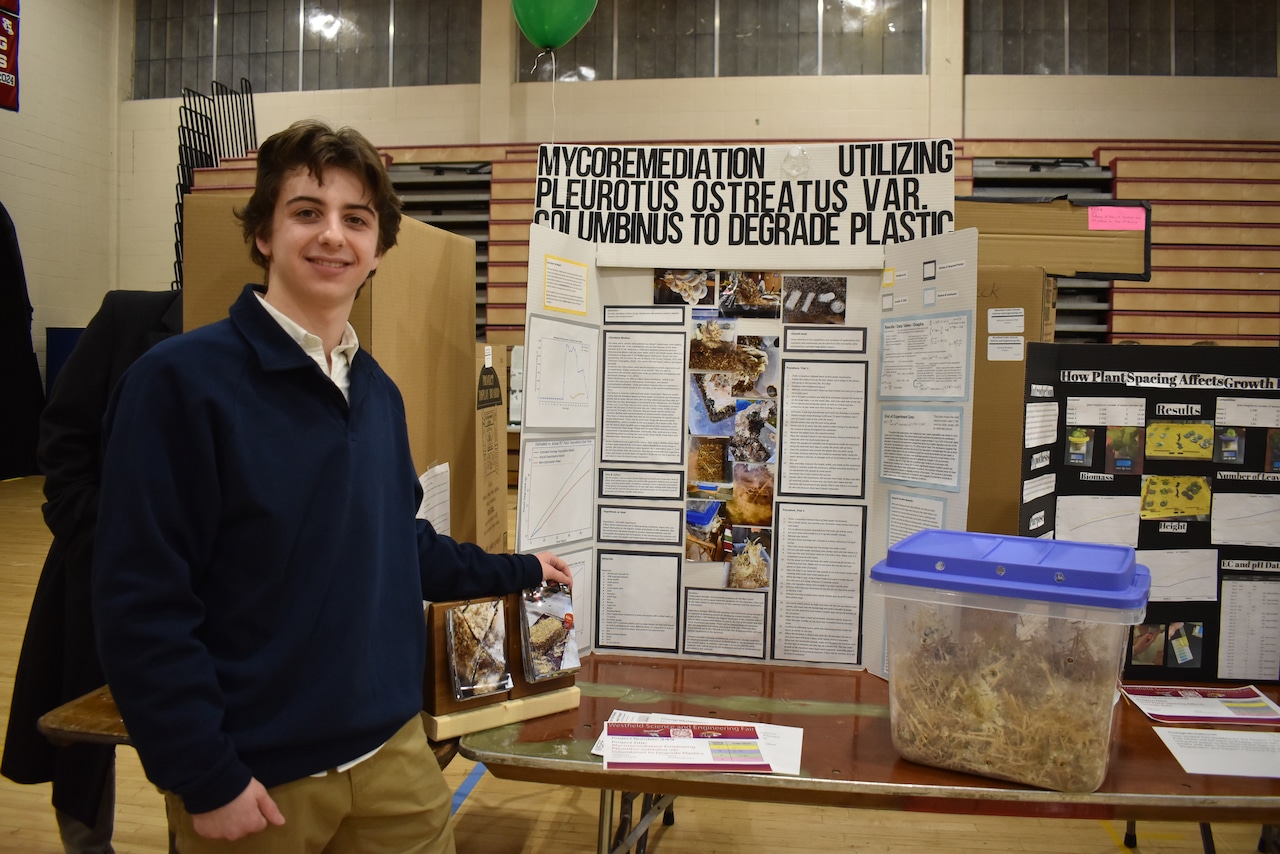
The project that was scored the highest by the judges went to WHS junior Giovanni Santaniello with his project on “Mycoremediation — utilizing pleurotus ostreatus var. Columbinus (oyster mushrooms) to degrade plastic.”
“We need a way to degrade plastic while benefiting something else,” Giovanni said. For the project, he grew oyster mushrooms in hay — a challenge on its own, to see if they would break down polymer plastics into monomers.
The first batches he grew encountered mold, so he had to sterilize the hay by boiling it, which he said also hydrogenated it. Some green mold remained, but no more black mold.
He said the model showed the mushrooms degraded the plastic by 6-7% of the original size. After achieving that target, he put them in a shed that was 30 degrees below, where the mushrooms survived and continued to decompose the plastics.
Santaniello’s recommendation, based on results, was to grow mushrooms in landfills.
Second place went to senior Kaitlyn Goulette, who studied the consumption rates of Acheta Domesticus (crickets) as a function of varying electromagnetic wavelengths.
As an astronomer, Goulette said she is interested in studying light pollution. She talked about attending a recent lecture by an astronomer who said we are losing the night sky. She said light pollution has physical impacts and disrupts circadian rhythm if it occurs over the years, with health side effects.
Using red, blue, white lights, and darkness with four groups of crickets, Goulette fed them every 12 hours. She found that the blue group ate the most, which was not a benefit. “The crickets’ photo receptors are sensitive to blue light,” which she said led to overeating.
Goulette concluded that blue light is the worst for insects. She said many LED lights that people purchase are blue-toned, and recommended looking for warmer-toned LED lights that are yellow or red. “I think there’s going to be a big switch to warmer tones,” she said.
Asked if any of the crickets escaped, she said her mom found a cricket in the bathroom that morning, and wasn’t happy.
Third place went to Teagan Chisholm-Gotshalk for her project, “Smile, Say ‘Plastics’: Investigating how many microplastics are hidden in cheese.”
In her project, she looked at melted cheese for microplastics, comparing online black fragments for evidence. Her conclusion was, if cheese is wrapped in plastic, there are thousands of microplastics from the packaging in the cheese.
“In the US, it’s all about preservation and shelf life, which is probably cheaper,” Chisholm-Gotshalk said. She spoke about a trip to Costa Rica she made last year, where she met Carla, an artisan cheesemaker, who only likes to use metal or paper to wrap her product.
Also moving on to the regional fair was junior Pablo Contreras, with his engineering project, “Alzheimer Detecting Neural Network.” In it, he did a data analysis on Alzheimer’s cases, using demographics such as gender, age, education and socio-economic factors, and also analyzed the severity of the cases.
Contreras concluded that people in certain data groups are more susceptible to Alzheimer’s. He said this was his second year participating in the science fair. Last year, he built model rockets from scratch.
Moving on to regionals, seniors Andy Liu and Alec Piepergerdes explored noise pollution and its effects on wildlife by studying Eisenia hortensis (European night crawlers).
They observed the earthworms for two weeks, and then introduced loud noises, up to 93 decibels, to see how it would affect them. Some of the discomfort they observed included the worms curling into a ball, surfacing, an absence of moisture and excessive burrowing.
Their conclusion was that loud and disruptive noises have a negative impact on worms and other wildlife.
Seniors Mirabella Prefontaine and Zoey Patterson worked on “Roots in Recyclables: Can Paper Feed Plants.”
“We tested out five different types of paper, 50% potting soil and mixed them all together. For plants, we grew radishes and Wisconsin fast seed mix,” said Prefontaine. They found that all of the plants grew well in soil mixed with paper.
Prefontaine said she dabbles in gardening. “My mom is a huge gardener,” she said.
Senior Aaron Boyd talked about his project on “Cane Sugar substitutes — which one to pick?” Boyd said he explored the Jaccard index of a list of sugar substitutes, looking at 20 attributes for each cookie, such as density, coloration, crumbling and crispiness.
Boyd said the goal was to find which substitute was the most mathematically similar to sweetener to cane sugar. His conclusion was that maple sugar and Stevia were the most similar to cane sugar, at 75% identical. The least similar were date sugar and turbinado sugar.
Boyd baked all the cookies for the project and couldn’t taste any of them. Sweeney said tasting is universally not acceptable or allowed as a scientific standard.
Asked how many he baked, Boyd said, “Probably about 400 cookies. The sight of another sugar cookie makes me nauseous because of the amount I had to bake and smell.”
On the air, Smith talked about her first experience as the coordinator of Science Fair after participating for many years as a science teacher. “It has given me a greater appreciation of the work that all the teachers do. As the supervisor, I cannot express my appreciation enough of the work that all the teachers do; it is a team effort,” she said, shouting out Sweeney, who she said made a lot of it happen.