

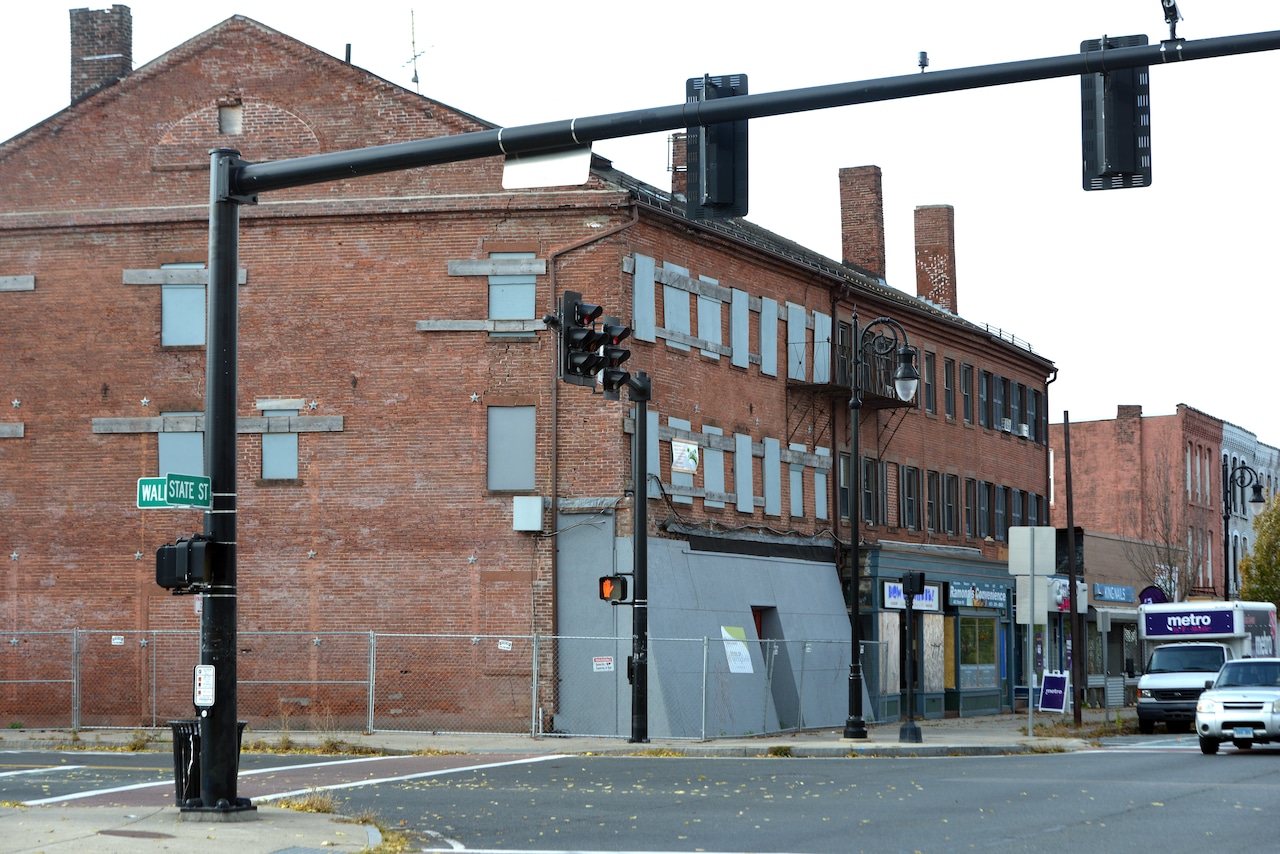
SPRINGFIELD — A nonprofit social service agency has purchased the historic Gunn Block building and has plans to resume the stalled restoration of the long vacant structure as soon as possible.
Urban Impact Initiative, a growing organization that runs a variety of programs including reentry training for women leaving incarceration, substance abuse recovery assistance, doula services and even a youth wrestling program, has purchased the building at 473-477 State St. in November for $110,000 and plans to preserve it for its permanent headquarters and other uses.
“Nothing has been done since it was last purchased in 2023 the building is being seriously compromised which means our history is being seriously compromised,” said Jynai McDonald, founder of Urban Impact Initiative.
Saving the Gunn Block, which is one if the oldest, if not the oldest, surviving commercial buildings in the city, has been a long and sometimes frustrating effort.
DevelopSpringfield purchased the building in 2013 about a year after the city condemned it. It shored up the walls using Community Preservation Act funds and had plans to replace the failing roof but never had enough money.
In 2023 it sold the property to Thomas Napolitano, owner of Napolitano Investments, LLC of Glastonbury, Connecticut. His plans called for the first floor to be used for retail and offices and the upper floors were to be converted into studio and one-bedroom apartments.
Napolitano received a $250,000 grant from the Community Preservation Act the same year. McDonald and the committee that oversees the awarding of the funding, which comes from a 1.5% surcharge on real estate taxes, appeared before the City Council Monday night to request the funds be transferred to Urban Impact.
The money was promised to Napolitano Investments to replace the roof, repoint the masonry and restore the windows, but the owner never did any of the work. The money is still in the committee account because it only awards funds after work is completed and inspected, said Robert McCarroll, chairman of the committee.
McDonald said her priority will be to replace the roof to prevent further damage to the 1835 building. It will also be used to repoint the masonry and replace windows so boards shuttering them can be removed to make the building less of an eyesore.
“We are sticking to the original plans and the original intention of that money. we just want to move the needle on that project,” McDonald said.
Once the building is shored up and protected, McDonald said she hopes to use the first floor for a community café and offices for Urban Impact, which now operates out of borrowed space. There will also be space for a learning center where she plans to hold a myriad of work training courses including digital literacy classes for the neighborhood.
The second and third floors will continue to be used for affordable housing. McDonald said she hopes to have five or six one- and two-bedroom units there.
She said her organization is also applying for historic tax credits and other funding including a state underutilized properties grant which will be coming available soon to pay for the work.
While McDonald admitted the project is a challenge for a new developer, she said she is a lifelong resident who currently lives in a historic home so she brings that experience.
City councilors voted 13-0 to approve the transfer, saying they want to see the building preserved. Many agreed they like McDonald’s plan and said she has a solid track record in the city and believe she will get it completed.
“I’m very confident in the developer,” City Councilor Melvin Edwards said. “She is one of our homegrown residents and constituents. She has put a good company together. She has surrounded herself with good people.”
The City Council also voted Monday to award a homeowner $300,000 in emergency funding from the Community Preservation Act fund to enclose the roof and walls of an 1869 home at 37 George St. that was heavily damaged by fire in May.
Paola Martinelli and her husband purchased the property, which was in foreclosure and in poor condition, in 2017. They had slowly been restoring it while living there but the fire made the home uninhabitable and left the structure open to the elements, McCarroll said.
The $300,000 was left over from a committee proposal to assist with the redevelopment of the former Kavanaugh building that was rejected by the City Council in June, he said.
The funding for the home on George Street was far more controversial. After more than an hour of debate the City Council approved the grant in a 10-3 vote.




