
Black and white residents of Springfield lived together in harmony, declared The Rev. William N. DeBerry. He doubted the Ku Klux Klan would ever establish a presence in the city.
It was February 1921. There were rumors that the Klan, which had sown racial terror across the South during Reconstruction, was forming a branch in Springfield. Black leaders in Boston had asked President-elect Warren Harding to suppress the group.
DeBerry – a prominent Black leader in Springfield, pastor of St. John’s Congregational Church – described the Klan as a “blight.” He probably heard the stories. His wife had grown up in Pulaski, Tennessee, the place where Confederate veterans founded the Klan after the Civil War.
“This secret society is composed of outlaws, and should be placed in the same category as lynching and the government should suppress it,” DeBerry told The Republican at the time. “I am sorry that the Ku Klux Klan has crossed the Mason and Dixon line.”
In a few years, residents in Western Massachusetts who joined the Klan would gather for outdoor rallies in the thousands. Scores of crosses would burn from prominent locations across Western Massachusetts.
Their presence here would stoke fear to the point that Black and immigrant children were too afraid to play outside after dark.
And yet, it’s also a story of resistance — of teachers and police officers and city officials responding in their communities against a movement that swept the nation during the 1920s.
The Klan wanted to “make America American,” as one Klansman put it while speaking in Springfield. The organization espoused white supremacy and opposed Blacks, Jews, Catholics and immigrants.
And many found that message attractive, including prominent white citizens. By one estimate, more than 130,000 people in Massachusetts would joint the Ku Klux Klan during this time.
‘A compliment to be refused membership’
By September of 1921, The Republican reported that organizers of the Ku Klux Klan had begun operating in the Pioneer Valley, seeking recruits in Springfield, Holyoke and in communities as far flung as Orange and North Adams.
“Federal officials are following the movements of strangers who have been in Springfield recently and who are thought to be organizing here a branch of the Ku Klux Klan,” the paper reported on Sept. 30, 1921.
The Morning Union reported that two Klan organizers had been scared off by an investigation into their efforts. The Klan’s imperial wizard, William Joseph Simons, who lived in Atlanta, Georgia, had sent the organizers, the paper noted. They came bearing material for people who had expressed interest in the group.
The Klan appears to have found a willing audience for its recruitment.
“Many citizens impressed with the alleged ideal of the Ku Klux Klan as printed in newspapers were so desirous of joining that they asked the national headquarters of the organization to send its organizers here,” the Morning Union wrote.
And yet, the Klan received quick condemnation from Springfield’s mayor at the time, Edwin F. Leonard.
Citing the fact the Klan was anti-Black, antisemitic, anti-Catholic and anti-immigrant, Leonard declared it to be anti-American. “Some of our most splendid types of citizens come from these very people who are not eligible to membership in the Ku Klux Klan,” The Republican quoted him saying on Sept. 30, 1921. “These citizens are 100 per cent American at heart. It should not matter what a man’s origin, religion or race is. Our nation is made up of all types of people.”
Then the mayor made known his stance on the Klan, which was trying to recruit people like himself in high positions across the country.
“I would consider it a compliment to be refused membership in such a gang as the Ku Klux Klan,” Leonard said.
A month later, the local NAACP planned a protest meeting, its local president, active in combating the Klan’s activities, The Republican noted on Oct. 31, 1921. For instance, the NAACP had opposed the racist 1915 movie “The Birth of a Nation,” which glorified the Klan and led to its resurgence.
Despite these denunciations, some residents in Western Massachusetts found the Klan’s stance compelling.
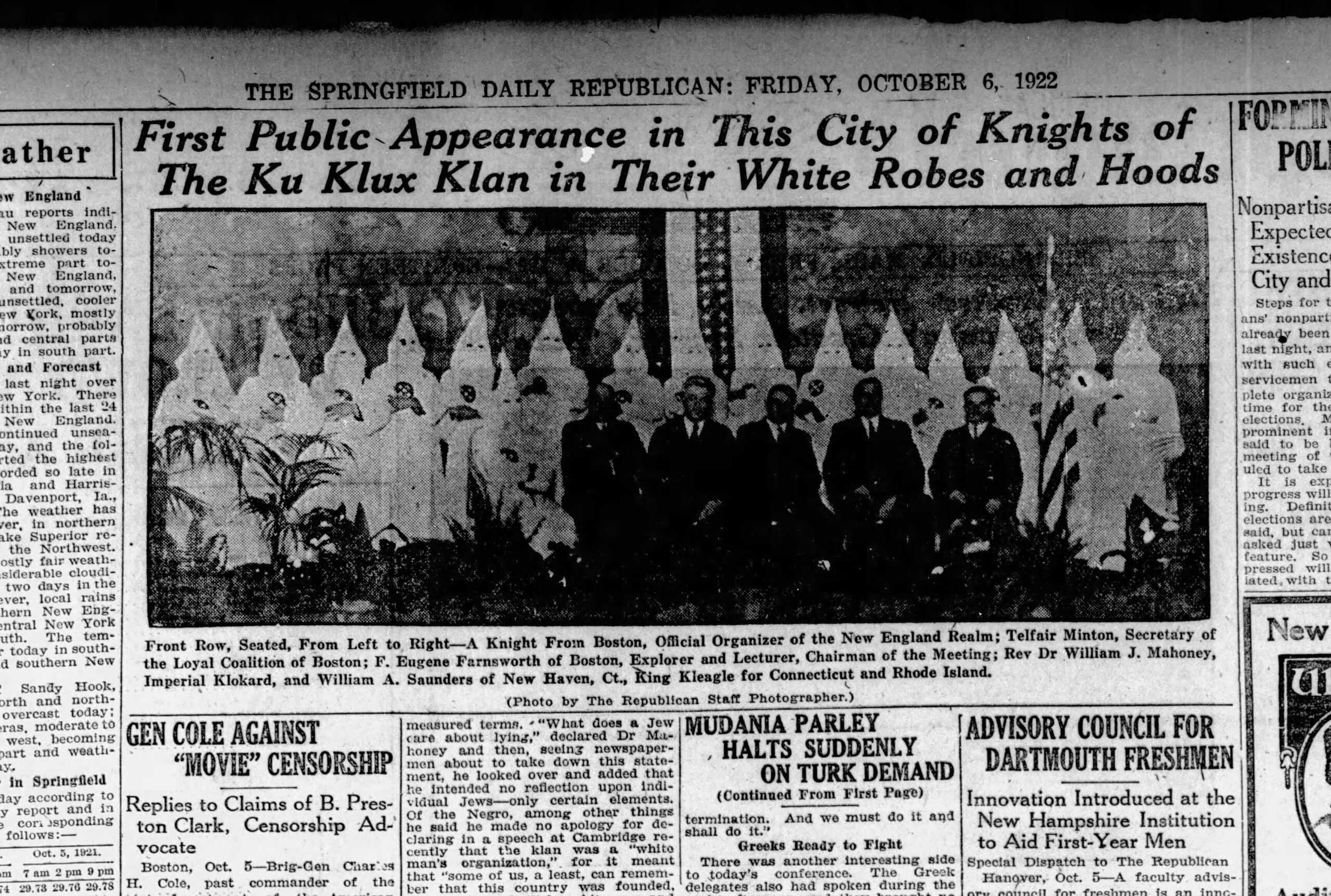
A photo of hooded members of the Ku Klux Klan that appeared in the pages of The Republican on Oct. 6, 1922. The paper noted it was the first time the Klan appeared in Springfield with its hoods and robes.
‘Second public Klan gathering in New England’
In the summer of 1922, The Republican reported that Charles W. Louis, who worked at Louis Brothers, a machine shop, and lived at 43 Dwight St., was “working to further the work of the Invisible Empire in this city.” Louis said the Klan was planning on opening a lodge hall in Springfield, perhaps somewhere downtown.
That September, Louis, by then identified as an officer in the Klan, asked the city for use of an assembly hall at the High School of Commerce. He wanted to hold an informational meeting in October to present the group’s beliefs. According to his application to the city, Louis said he hoped Springfield residents of authority and influence would attend.
But if the Klan thought it could use a Springfield hall for a meeting, the city’s property committee soon set it straight. The committee rejected a request brought by the “violators of decency and every principle of law and order,” in the words of the committee’s chairman, Aime Cote.
“Because we believe the order is antagonistic to racial concordance and questions equality of the colored people and inasmuch as the public buildings are supported and paid for by groups of all races and color, we consider it is not right to give the Ku Klux Klan the use of public buildings,” Cote said.
The paper reported that the Klan then looked to use a private hall. It said the group had many members and was likely to form “a very strong organization.”
“It declares that its chief principle is ‘America First’ and denies that it is in any way opposed to the Jews but that they are banned merely because the organization is a Christian one,” The Republican wrote on Sept. 9, 1922.
In early October of that year, the Klan held a meeting in Springfield. It was the second time the group convened a public meeting in New England, The Republican noted. It featured a principal lecturer, William J. Mahoney from Atlanta, a reverend who held a doctorate.
Mahoney spoke for three hours, largely about the “abuse of the American press, the Boston press in particular,” that was critical of the Klan, the paper reported on Oct. 6, 1922.
A year before, for instance, the New York World wrote a series of articles exploring the operations of the Ku Klux Klan. Among the actions reported by the paper: 41 times that someone was flogged, 27 instances in which someone was tarred and feathered and four killings — more than 150 instances of violence wrought by the Klan. For its work, the New York World won a Pulitzer Prize.
“No man can understand the motives and principles of an organization until he becomes part of it,” Mahoney told the crowd.
Just below that news story on The Republican’s front page was another small item: A federal grand jury in Atlanta indicted the interim imperial wizard of the Knights of the Ku Klux Klan, an E. Y. Clark, on mail fraud charges.
Mahoney would continue his travels. A few weeks later he was attempting to address a group of about 50 in Bayshore, Long Island, when a group of about 200 Catholics, Jews and Blacks entered the hall and demanded the meeting end, according to a story in The Republican on Nov. 7, 1922. When police said the meeting could continue, the group left, but threw rocks through the windows.
About three weeks later, a flaming cross burned on a hill outside Hartford, Connecticut, around midnight. The head of the Klan in Connecticut attended, as well as A. S. Green, a Worcester man who headed the Klan in Massachusetts. Some had traveled from as far away as New York and New Jersey. The group was there to initiate 60 members from Springfield into the Klan, The Republican reported on Oct. 29, 1922.
The Klan regularly lit crosses at its ceremonies, according to a history of the practice that the U.S. Supreme Court recounted in a 2003 opinion. The group also used the burning cross as a symbol of hate that it directed towards people it wanted to intimidate, its display a threat of “impending violence.”
Those threats were having an effect throughout the region.
A few months later, The Republican reported that the activity of the Ku Klux Klan impeded the efforts of “Americanization” among Westfield’s immigrant residents. Those residents, the paper said, knew from their reading of foreign-language papers of the Klan’s anti-immigrant drive. The 1920 census said there were about 4,500 foreign-born residents in the city, and 1,143 did not take steps to become citizens.
“The pupils consider it a waste of time and money to try and obtain something that they have to fight for after they have become eligible under the law,” The Republican wrote on Jan. 21, 1923. “References to the Klan are made repeatedly in Americanization classes until the teachers are at a loss how to combat the influence of the organization.”
Around the same time, parents and teachers told The Springfield Daily News that Black, Jewish and Catholic schoolchildren, from kindergarteners to those in high school, feared that racial violence seen in other parts of the country, often carried out by the Klan, would come to Springfield.
Between 1877 and 1950, there were 4,084 lynchings intended to incite terror across the South, according to the Equal Justice Initiative. It fueled a migration of Black people to the North.
Children of immigrants and Black families who moved to the Springfield area from the South stopped playing in city streets as night fell, the paper reported. Some asked their parents to keep them from school.
The children repeated rumors that the Klan sent letters to priests threatening to destroy church property. “Fear continues to haunt the youngsters,” the paper said. These rumors were apparently false; local police and the priests denied the existence of such letters, according to the paper.
But at least one resident received a threat purportedly from the Klan.
On Jan. 22, 1923, The Springfield Daily News reported that a Holyoke barber, Paul Ripa, received a note signed by “The Loyal Order of the Ku Klux Klan” saying he had a week to leave town. The article didn’t give a reason why he would receive such a message. The barber, however, said he thought the letter was a joke.
Across the country, Klan activity was surging.
In September 1923, the governor of Oklahoma declared martial law, calling up 6,000 troops in an effort to break the Klan’s influence in that state.
An Associated Press story published in the Morning Union said Oklahoma Gov. J.C. Walton testified before a military court that “the invisible empire has usurped the power of the political government.” The group, he said, carried out hundreds of beatings, floggings and whippings, the terror of them cowing newspapers in that state into silence.
A year before, the governor of Louisiana, John M. Parker, fearing the Klan would catch wind of his plans should he mail a letter, pick up a phone or send a telegraph, sent a letter carried by a reporter to the FBI, according to an account on the FBI’s website.
A mob had kidnapped and killed two men in Mer Rouge in that state and the governor feared local judges and prosecutors were too influenced by the Klan to act. The Klan planned to kidnap the FBI agents working the case. And when the matter finally went to trial, the Klan interfered with the trial by kidnapping witnesses. The Klansmen who were indicted were only convicted of misdemeanor charges.
The accounts of rising Klan activity across the country played out in the pages of The Republican, often on the front page.

The front page of the The Springfield Republican on Nov. 27, 1924 reporting how the Ku Klux Klan burned crosses across the region, reportedly to celebrate its recruiting efforts.
A coordinated cross burning
In Western Massachusetts, the first of the crosses began to burn around 9 p.m. on the day before Thanksgiving, Nov. 26, 1924.
The night was “crisp and clear and visibility excellent,” the Springfield Union reported. Thousands of residents saw the crosses.
Four crosses burned in Springfield, The Republican reported. The Morning Union said there were seven. Others blazed in Agawam, Blandford, Chester, Chicopee, Easthampton, East Longmeadow, West Springfield and Westfield.
A cross burned on Court Square in Springfield, close to where the police station stood at the time. Another cross was burned along Bowdoin Street, inside the enclosure of the U.S. Armory. And yet another burned near King Philip’s stockade, a knoll in Forest Park alongside the Connecticut River.
The Springfield Union reported a city councilor, Michael Kane, a dentist, a city engineer and a manufacturer had helped knock down the cross in Court Square.
Instead of wood, the crosses in Springfield were being fashioned from iron pipe. Police in Springfield did not detain anyone that evening, but the Springfield Union reported that the fires were the result of an “organized body of men,” as mechanics and carpenters seemed to craft some of the crosses with care.
Louis, the local Klan leader, claimed to be unaware of plans to burn crosses across the Valley.
The group burned a cross outside St. John’s Catholic church in Chester. Three crosses were ignited in Holyoke. Whoever was behind the cross burnings lit off fireworks as well.
Three crosses burned in Palmer, according to the Springfield Union, and police who were investigating detained a man named Jerome Makara for reckless driving.
The Republican called the fires “probably the most extensive the hooded order has yet brought about in Massachusetts.” The Klan, the paper reported, was celebrating its successful recruiting efforts.
It was similar to a demonstration the Klan made in central Massachusetts near Worcester, when it burned 25 to 30 crosses before Patriots’ Day and Easter Sunday, the paper noted.
Days later, police detained a North Dakota man named Jack Thompson that The Springfield Daily News said had been in the city for months helping organize for the Klan in Springfield and Connecticut. Police found two revolvers and a dagger in his Belmont Avenue apartment. He was found to possess a Klan membership card.
Thompson said the Klan burned 67 crosses in the Connecticut River Valley the day before Thanksgiving, but said he didn’t participate in any of the burning.
When asked by police why the Klan burns crosses, Thompson told them, “It’s nothing but kids’ play. It is done mostly to alarm the public.”
When police said the Klan was unable to rent a hall in Springfield, Thompson laughed and replied that the number of Klansmen in the city was too large for any hall. In the end, police did not charge Thompson.
In the same edition of the paper, The Springfield Daily News reported that Makara, the man that Palmer police had detained Thanksgiving eve while they investigated the burning crosses, received a $25 fine for speeding (between 35 and 45 mph, officers estimated) after he fled from officers. When detained, he told police he lit the cross. A judge fined him an additional $50 for lighting a fire without a permit. (That fine was the equivalent of $940 today.)

The Springfield Union reported on a rally of the Ku Klux Klan held in Southwick on June 7, 1925. The paper reported with 10,000 in attendance, it was the largest Klan gathering in the state.
‘We may have to kill some one yet’
As the Klan burned crosses throughout the Connecticut River Valley, it was experiencing a hostile reception in the central part of the state.
When the Klan held meetings in that part of the state, hundreds came out to oppose the group.
For instance, the Klan held a meeting that drew about 15,000 people to the fairgrounds in Worcester in mid-October 1924. As cars carrying Klan members left the fairgrounds, a group of 800 met them on a corner in the city, jeering and throwing stones. The New York Times reported some members of the group pulled a man from his car and beat him.
After the riot at the Worcester meeting, the Klan held no more large gatherings in Worcester, according to Mass Humanities. Membership in the group dwindled.
Months later, however, the Klan held a meeting in Southwick. About 10,000 gathered, according to a Springfield Union reporter who reported from the scene. Participants included prominent residents from Springfield, West Springfield, Chicopee, Holyoke and East Longmeadow. The Republican said attendance was closer to 5,000.
“The meeting passed without any disturbance whatsoever,” the paper reported.
A state leader of the Klan gave a “vitriolic and sarcastic” speech where, referencing the clashes that accompanied meetings in the central part of the state, said, “We may have to kill some one yet, but if we start I can tell you we have the numbers and qualities to do it right.”
One speaker praised the prohibition laws in the country, saying that upholding those laws would result in reduced crime.
Concession tents sold soft drinks and food. Two children, about 4, sang a Klan song. At the end of the meeting, the group burned a 60-foot cross.
The Southwick liquor raid
Somehow, during the Klan meeting in Southwick, the local sheriff’s office drew the ire of the Klan. Sheriff’s deputies working traffic duty during the conclave learned in the days following that members of the Southwick Klan threatened their lives, according to the Springfield Daily News on June 17, 1925.
Their reaction? Not to worry about it, the paper reported.
A few days later, a raid on a cottage resulted in the arrests of a Southwick man and woman. The cottage in the Congamond section of town allegedly contained moonshine, beer, wine and cider.
But it was not sheriff’s deputies or local police who carried out the raid. The Springfield Union reported on June 21 that the Klan, which had recently discussed upholding the law that created the constitutional prohibition on alcohol, was behind it.
Authorities in Southwick, the paper reported, were unaware of the raid. “Members of a citizens’ police organization in Springfield” carried out the search.
The chair of Southwick’s Board of Selectmen, W. F. Barnes, denied any Klan connection days later, saying the board turned to the Springfield Military Police, as they wanted a group “we can rely upon” to address the sale of liquor.
Southwick selectmen, in the weeks following, criticized a deputy sheriff named T. J. Malone for letting liquor sales continue unchecked, even as he worked to stem the regional booze trade over the summer of 1925.
But alcohol was not the issue, according to the paper. Klan-friendly officials felt the sheriff wasn’t with the program.
“According to information volunteered by officials who are in a position to know the true state of affairs, it is not Sheriff Malone’s efficiency as an officer that is the cause of the present situation but his attitude toward the Ku Klux Klan, which is known to have a large following at Southwick … Sheriff Malone is also said to have been warned to move on when attempting to interfere with Klan activities,” the paper reported that August.
Malone had recently asked the Southwick Select Board for the list of residents permitted to carry firearms. “Clashes which have followed meetings of the Klan in the eastern end of the State have prompted many to carry firearms, it is reported,” The Springfield Union said.
In September, state officials said they would investigate the Springfield Military Police Reserves after they received reports that some of its members guarding a four-day Klan event at a farm in Agawam claimed they were State Police, according to the New York Times.
The Springfield Union noted of the weekend meeting: “A spokesman for the Klan, who although dressed in civilian clothes, was recognized as a member of the Military Police Reserves, refused to divulge but little information.”
In other words, Southwick officials turned to an outside organization to carry out law enforcement duties rather than use a sheriff who had not treated the Klan in the way they thought he should. Members of the same organization provided security for at least one Klan meeting.
By that time, Bailey’s Farm along Shoemaker Lane in Agawam appeared to be a regular meeting place for the Klan. Members erected a stand from which to sell hot dogs and soda, according to The Republican. Rather than burn crosses at this site, the group set up an electrically lighted cross that it hoisted up on pulleys.

Pan African Historical Museum Director Sam Bradley stands in the area of the Pan African Historical Museum he calls the crying corner. Bradley intentionally wanted the Ku Klux Klan (KKK) robes and images of lynchings and murders to be in a confined space to force people to face the cruelty of the past. Feb. 18, 2026. (Douglas Hook / The Republican)
‘It’s part of our history’
Historians suggest that the violent and negative response the Klan received in the central part of the state contributed to its demise.
After the events following the rally at the Worcester fairgrounds in 1924, “the Worcester Klan virtually disappeared as a force to be reckoned with,” wrote historian Mark Paul Richard in his book about the 1920s Klan in New England. (He declined to be interviewed for this story, citing death threats he said his colleagues received after speaking about the 1920s Klan.)
Other Klan members grew disaffected, and scandals within the group’s national leadership contributed.
In January 1926, the Klan in New Haven said it was disbanding, breaking off from the national group, because members began to regard the group as un-American. “The Klan has degenerated into nothing less than an organization of greed,” a Klan leader wrote in a letter to national Klan officials that he shared with the press. The Springfield Daily News reported Klan groups in several Connecticut cities were considering breaking up, and the paper said other groups across New England could follow suit.
Today, the Klan in Springfield lives on in memory.
When he was growing up in the Pine Point neighborhood, Sam Bradley remembers parents telling their children not to go into a particular patch of woods where the Klan was believed to meet.
These days, visitors to the Pan African Historical Museum in Tower Square, where Bradley is director, often don’t know the history of racial violence and terror directed at Blacks.
“Most of them, for the most part, they only know what I tell them,” Bradley said.
The museum displays a Klan robe and hood, donated by a South Carolina man who was destroying some of his father’s effects. The robe is stained with blood, the apparent aftermath of a whipping, according to Bradley.
It is part of the smallest exhibit of the museum, which also details slavery, segregation and lynchings. The exhibit is shocking for many visitors, Bradley said. Some grow mad. Others cry. Others begin asking questions.
Bradley displays the robes because it’s part of the history of Black Americans.
“We have a saying called Sankofa,” Bradley said. “That’s an African word. Sankofa means if you don’t know your history, you’re not going to be able to develop a better future.”
White supremacists are part of the present, Bradley said. They marched unmasked in Charlottesville, Virginia, in 2017. Their fliers have been found in Westfield and Easthampton in 2023.
“They were trying to get it back going again,” Bradley said.