

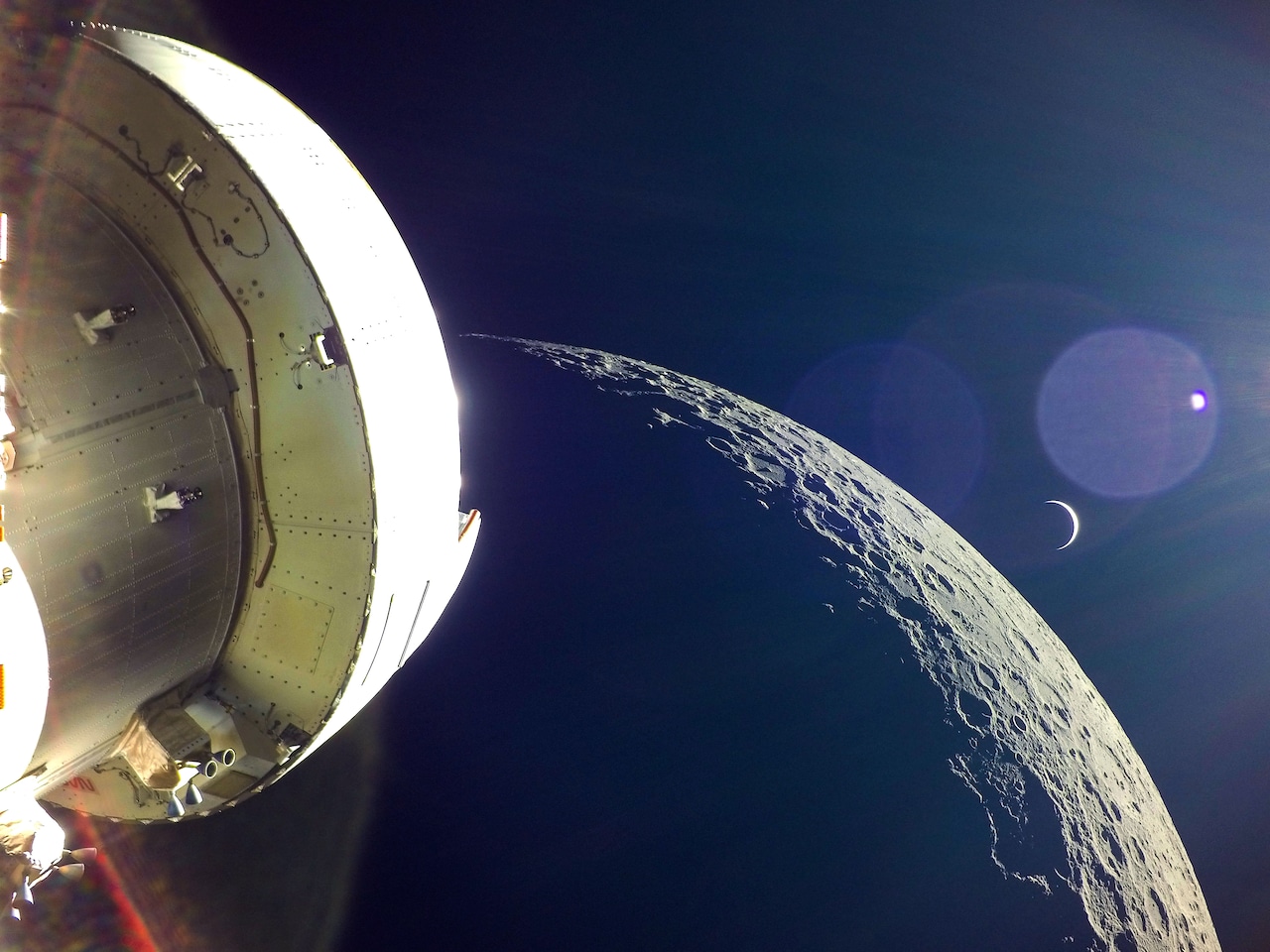
Weather permitting, you can find tonight’s waxing gibbous moon halfway up in the south at sunset. That’s its peak height for tonight. In the coming week, as it thickens to its fullest phase, it will also take a lower more southerly path each night.
Full moon comes on the morning of June 11 at 3:44 a.m., just two hours after cresting at its highest — only 19 degrees up — in the south at about 12:45 a.m. Full moons occur when opposite the sun in the sky, so when the sun is high, full moons are low — and vice versa.
Since the coming full moon is the one closest to the summer solstice, it will be our lowest of the year. For most of us, that low track and the late hour combined with thick foliage makes this a full moon that many may not even notice. The haze that often comes with summer’s warmth, won’t help either. (Astronomical summer starts on Friday, June 20. We are already in meteorological summer, defined as the three statistically warmest months of the year— June, July, and August.)
Before electric lighting overwhelmed the night across our global civilization, people in general were as aware of the phases of the moon, and where and when it would appear, as we are of time of day. Light pollution is a problem that continues to rob more of the night, and night sky from the citizens and denizens of our small planet.
For the next few evenings, the waxing gibbous moon is already well up as skies darken. If you happen to see it, keep in mind that a lunar landing is planned for sometime on Friday. It will be the second attempt for a private Japanese company called iSpace. Their first moon landing attempt ended in failure in 2022. This will be just the most recent of several other private efforts.
Two such missions were successful: Intuitive Machines’ Odysseus on Feb. 22, 2024, and Firefly’s Blue Ghost on March 2, 2025. Both are American companies. The Indian space agency’s Chandrayaan-3 lunar mission touched down at the lunar south pole in August 2023, and China’s Chang’e 6 probe landed on the moon’s far side to collect samples on June 1, 2024.
A similar cadence of private and national moon launches appears likely to continue over the next few years. NASA missions may be less than conspicuous however.
Artemis is the name given to NASA’s program to return humans to the moon for the first time since the last Apollo mission in 1972. In 2022, the Artemis I test mission successfully flew an unmanned Orion capsule out past the moon and back, but the planned Artemis II mission for a crewed flight around the moon has slipped from this year to 2026.
The first crewed lunar landing, Artemis III, is still slated for 2027, although few expect that to hold. Further missions involving the Lunar Gateway space station — for which much of the hardware has been built — are planned for 2028 and 2030. The Lunar Gateway would serve as a way-station for astronauts going to and from the moon.
Currently, the White House seeks to end funding for the Space Launch System (SLS) rocket, which is 140% over budget, and costs a staggering $4 billion for each launch. The Orion capsule and Lunar Gateway programs are also on the chopping block.
If Congress votes to cancel the SLS rocket, it is uncertain what will happen. The SpaceX Starship, a presumed replacement for SLS, has yet to achieve orbit, so at the very least, the Artemis timeline for America’s return to the moon is probably too optimistic.
Here’s a little heads up: It’s not out of the question that China — forging ahead with plans to land humans on the moon by 2030 — could beat us there. They are also making steady advances with their own Tiangong space station while NASA may be scaling back its activities on the International Space Station due to budget shortfalls.
China accelerated its own space station development after the U.S. prohibited its participation in the International Space Station. Tiangong is now the second largest man made object currently orbiting Earth. This fact caught me off guard a few months ago when a random spotting of what I thought was the typically bright ISS turned out to be the Chinese space station instead.
After the Apollo 17 mission in December 1972, our last manned moon mission, there were a few unmanned probes from the U.S. and Soviet Union, and several landings by the Soviet Union. Luna 24, which returned 170 grams of lunar regolith in 1976, was the the Soviet Union’s final moon mission.
But for two brief flybys, our closest neighbor in space was essentially abandoned for almost the next decade and a half. In January 1990, Japan’s Hiten probe went into orbit and released a package that impacted the moon. Half a dozen additional 1990s missions picked up the pace, and more than two dozen have now flown since the turn of the century.
That brings us to the present, and whatever form lunar exploration takes from here on, it seems unlikely that the moon will be left to itself anytime soon.
I have marveled that I can personally remember looking at the stars of the night with my father before a single artificial satellite orbited our world. In 1957, he took me and siblings to the waterfront on Long Island to see Sputnik, the world’s first artificial satellite. I was with my mother in 1969 when we watched Neil Armstrong step onto the moon.
In 1972, the year of the last Apollo moon mission, the Soviet Union launched a craft meant to land on Venus, but it never escaped Earth’s gravity due to an engine malfunction. Just last month, on May 10, that very same Kosmos-482 Venera landing capsule made an uncontrolled reentry through Earth’s atmosphere — a relic of a past returning to the world it left more than half a century ago.
For the record, 10 Venera craft successfully landed on the surface of Venus. In 1975, Venera 9 gave us our first views of the planet’s surface.
Designed to be tough enough to make it through the thick atmosphere of Venus, Kosmos-482 likely survived the trip down, and to the depths of the Indian Ocean where its wreckage may never be found.
Find rise and set times for the sun and moon, and follow ever-changing celestial highlights in the Skywatch section of the Weather Almanac in The Republican and Sunday Republican.
Patrick Rowan has written Skywatch for The Republican since 1987 and has been a Weather Almanac contributor since the mid 1990s. A native of Long Island, Rowan graduated from Northampton High School, studied astronomy at the University of Massachusetts-Amherst in the 1970s and was a research assistant for the Five College Radio Astronomy Observatory. From 1981 to 1994, Rowan worked at the Springfield Science Museum’s Seymour Planetarium, most of that time as planetarium manager. Rowan lives in the Florence section of Northampton with his wife, Clara, and their cats, Eli and Milo.




