

When she looks around her life, Niurka LeBron likes what she sees.
She’s got a job and a calling. She’s got a roof over her kids’ heads. She has friends. And in her own little way, like so many of us, she’s trying to leave her corner of creation better than she found it.
But it all could have been so different.
Not too long ago, she was just another name and face in the criminal justice system. Indicted and convicted on fraud charges, she was sentenced to nine months of home confinement.
Then LeBron crossed paths with a woman named Stacey Borden.
Borden, the founder of New Beginnings Reentry Services in Dorchester, gave LeBron the hand she needed. She guided her through the judicial system. She helped with her home confinement. And when she served her time, she helped LeBron get back on her feet.
“Reentry starts with zooming into the prisons, zooming into the jails, letting [people] know, you know, what it’s going to be like on the outside,” LeBron said, her eyes shining and the warmth of her enthusiasm radiating from her.
That life after jail, after prison, she continued, “starts with letting [people] start strategically thinking, and planning how they’re going to act, what they’re going to do as they move forward with their lives, and actually having a plan.”
“Nobody plans to fail,” she said, bluntly and pointedly. “They just fail to plan. And you know that.”
It’s a suffocatingly humid Thursday morning in July. And, of course, it’s raining.
LeBron, who now helms her own business, SoulSmart Health & Wellness, and teaches returning citizens to cook, is holding forth in the Ironworkers Hall in Southie.
The debate over how Boston can assist the roughly 3,000 people who return to the state’s largest city from jail and prison every year has been swept up in this year’s mayoral campaign.
A few minutes earlier, philanthropist Josh Kraft, who’s challenging Democratic incumbent Mayor Michelle Wu, rolled out his plan to smooth the path for people returning from incarceration.
The Democratic hopeful, who is the son of billionaire New England Patriots owner Robert Kraft, said he wants to open city jobs to returning citizens. LeBron was at Kraft’s side as he made the announcement.
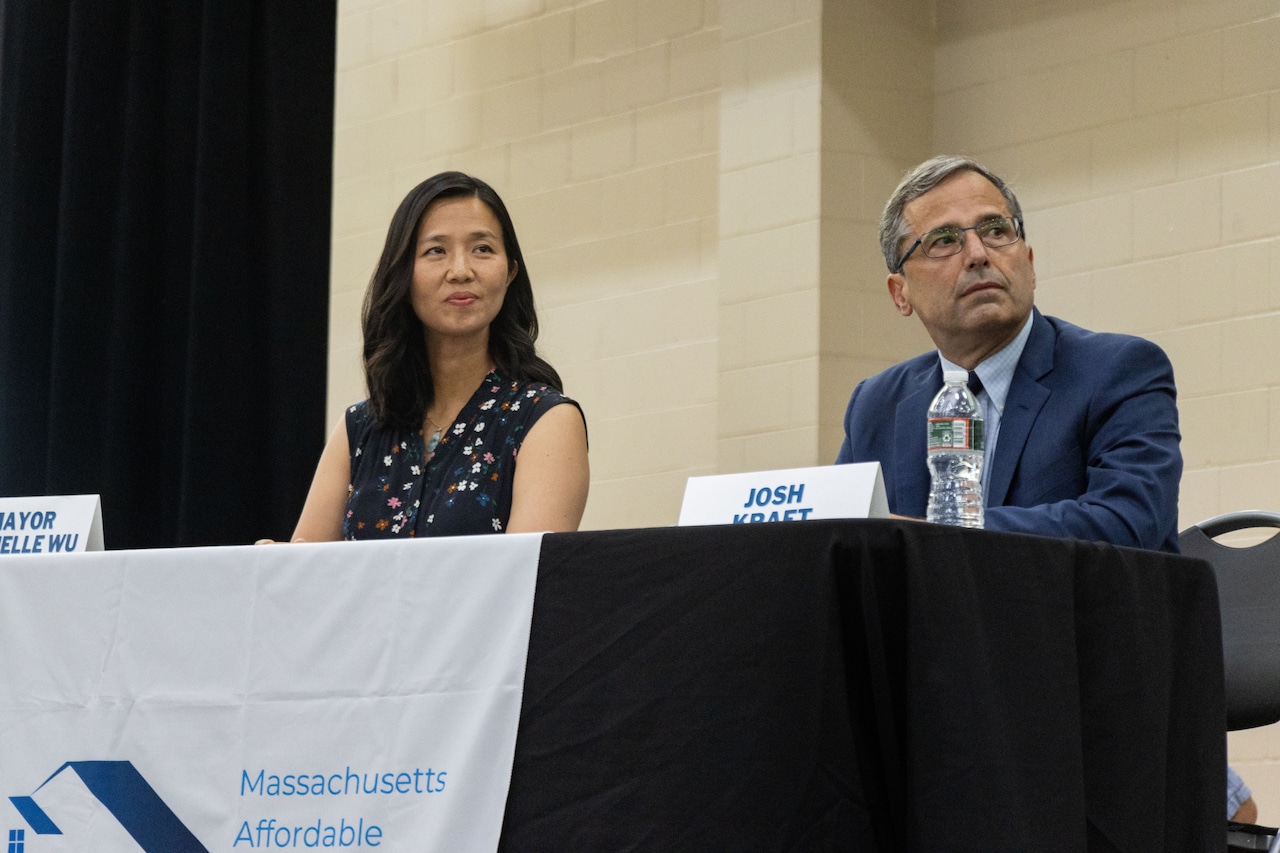
Kraft pitched a plan that includes preparing people for life after jail with a 90-day regimen of job training, financial literacy, health coverage and mental health care, and other programs that would begin before they leave custody.
“In the three decades I worked at the Boys and Girls Club, and through the Patriots Foundation, I met so many people who had done time,” Kraft said.
“Siblings, parents, cousins of kids we served at the club,” he continued. “They had seen some hard times, but [they] had so much to give back to our communities.”
Kraft faulted Wu’s administration for shuttering “Operation Exit,” a program that began under former Mayor Marty Walsh, which connected formerly incarcerated people with jobs.
“I want City Hall to be a place that supports lived experience, not only when building out a revamped Office of Returning Citizens, but across the board,” he said.
Wu bristled at the criticism, telling MassLive in a separate interview that Operation Exit ended before she took office in 2021. Two programs have since taken its place.
“This was another example of more irresponsible Kraft macaroni baloney put out on the campaign trail,” Wu said. “Operation Exit, in fact, had ceased prior to our administration starting.”
But “we have had two programs running that take that concept and build on it and make it more effective,” she continued.
One such program “focuses on direct placement of returning citizens to city jobs that have been identified with supports and with programming,” Wu explained.
The other is a “partnership with the trades, but has a more clear curriculum and placement partnerships,” she continued. “So, keeping it going, but in a different iteration. But overall, our administration has more than tripled the budget for our Office of Returning Citizens over the last three and a half years.”
Such programming is key, according to experts.
While returning citizens, broadly, face challenges finding jobs, housing and schooling after they leave custody, the challenges facing women — particularly women of color — are even greater, research shows.
Even though almost 2.5 million women are released from prisons and jails every year, fewer opportunities are available to them, according to the Northampton-based Prison Policy Initiative.
That’s partly because more women serve time in jails, rather than prisons, where shorter sentences mean they have less access to training and programming.
Meanwhile, “many women with criminal records face barriers to employment in female-dominated occupations, such as nursing and elder care,” according to the think-tank’s 2024 analysis of women behind bars.
“It is little surprise, therefore, that formerly incarcerated women — especially women of color — are also more likely to be unemployed and/or homeless than formerly incarcerated men, making reentry and compliance with probation or parole even more difficult,” the analysis found.
“All of these issues make women particularly vulnerable to being incarcerated not because they commit crimes, but because they run afoul of one of the burdensome obligations of their community supervision,” the think-tank concluded.
That makes mentorship efforts, both informal and formal, and inside and outside the prison walls, all the more critical, Borden said.
“I was drug addicted. I come from early childhood sexual trauma. I was mentally ill. I couldn’t function and I kept stealing,” she said. “I was hungry. I was feeding my addiction, and I didn’t know any better.
She pauses, then continues.
“Maybe I knew better. My addiction didn’t know better, right? And so the women in prison raised me. And I made a vow to get out of prison and go back and get my sisters,” she said. “So the work that we do out here isn’t just, you know, ‘Get out of prison, and now you’re out.’ No, [it’s] ‘Get out of prison and help us. Let us help you reinvent yourself.’”
“… As a formerly incarcerated woman, mentorship is vital,” she said.
Borden found her mentor in Andrea James, the executive director of the Roxbury-based National Council for Incarcerated and Formerly Incarcerated Women and Girls.
Without James, Borden said she wouldn’t have met such key leaders and advocates as U.S. Rep. Ayanna Pressley, D-7th District, “or even understood the political realm.”
Now, she’s paying it forward as Niurka LeBron’s mentor, even as LeBron mentors those who have returned to Boston in her wake.
“I, personally, was able to benefit from being at New Beginnings Reentry Services,” LeBron said. “But if those free resources were not there, I’m not sure what my transition would have looked like.”
MassLive Reporter Tréa Lavery contributed to this analysis.
If you purchase a product or register for an account through a link on our site, we may receive compensation. By using this site, you consent to our User Agreement and agree that your clicks, interactions, and personal information may be collected, recorded, and/or stored by us and social media and other third-party partners in accordance with our Privacy Policy.