
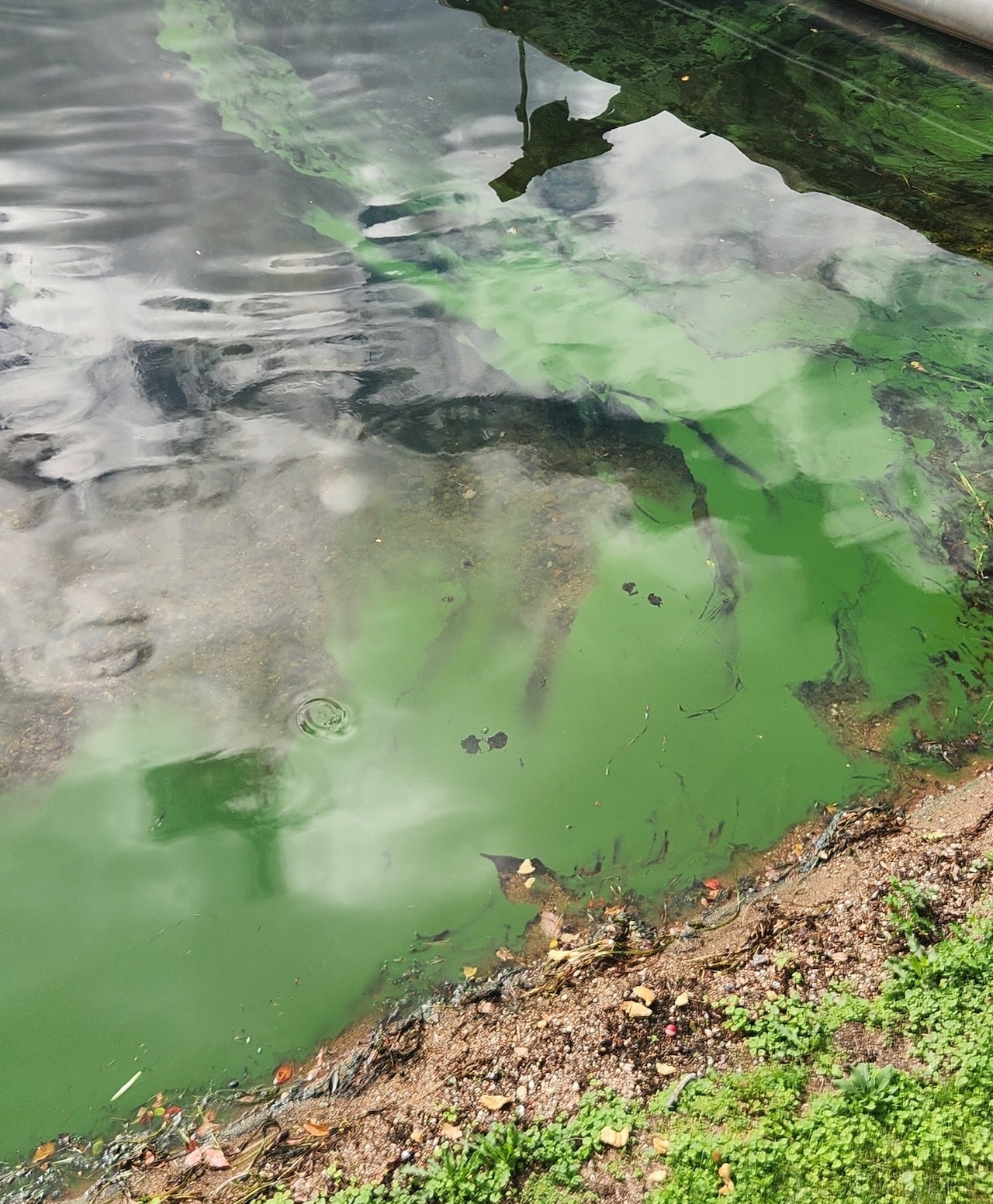
SOUTHWICK — Representatives of the town’s Lake Management Committee submitted a draft to the Select Board last week of how town officials might respond to a report of an algae bloom in the ponds of Congamond Lakes. The draft comes after a board member acknowledged that the process to let residents and visitors know what was going on was “a little broke” when a small bloom was reported in September.
“When we had [the bloom] this year, it had been a while because of the alum treatment, and for whatever reason, with change of personnel and people coming and going, the process was a little broke — everybody didn’t have all the pieces to the puzzle,” said board member Douglas Moglin during the meeting about the town’s response.
For a solution, LMC Chair Richard Grannell and Vice Chair Eric Mueller offered two flow charts of how the town would respond in the event of another bloom.
Mueller said two charts were needed — one focusing on identifying the algae and whether it is toxic or harmless, and the other on actions and communication.
To give the flowcharts context, Mueller told board members that while there are thousands of strains of cyanobacteria and algae, “what steps you should take is directly dependent on what specific algae is involved, and what are the specific local conditions and the extent of the bloom you’re seeing.”
“Identification needs to be a key part of an effective decision process,” Mueller said.
But regulations specific to the commonwealth make reacting to a bloom vitally important, he said.
If algae blooms get too dense, the state doesn’t allow treatment, which Mueller said made the state unique. In most other states, if an algae bloom is discovered, “you kill it.”
“If that happens, basically, your lakes close until the winter, until the winter kicks everything off. So, it’s really important that if you’ve got something that’s going to take off, you’re on top of it before it gets to the point where you’re not allowed to treat it … at times, speed is important,” he said.
That led to the first flow chart for steps for initial identification when a bloom is reported.
That process would involve the LMC determining if the bloom is toxic or harmless, and if its members aren’t available, using the two companies the town contracts with that can identify and treat a bloom if needed.
Which type would lead to what steps would need to be taken by town officials.
Mueller said the number of people in the decision chain should be small, but too many people in the chain could slow things down.
How to get the information out is critically important.
“We have to be careful because, depending on how the information goes out, the public may overreact,” he said.
He recommended having one place for an official message about the bloom, and when town officials are contacted, they point residents to that, like to the town’s website.
That message would come from a group comprised of the chief administrative officer, the harbormaster, the Board of Health agent, and an LMC and Select Board member.
Mueller also suggested sending out a CodeRed message.
If treatment isn’t necessary, there is a question as to whether there might still be a need to post a lake-use advisory.
There will be situations where nothing is needed, he said, but the person who reported the bloom needs to be told about the type of algae and why there was no advisory announced.
If treatment is needed, additional measurements would be needed, and the group would need to decide when the advisory can be lifted.
Board member Russ Anderson asked if time was important.
“Timing is critical because if you let it go, it can explode,” Mueller said.
Anderson also suggested preloading CodeRed messages so they could be sent at any time during the day, night or weekend.
Board member Douglas Moglin suggested the town website have a Congamond Lakes page using three colors: green, yellow, and red to describe the ponds’ conditions.
Grannells said signs could be made that would be posted at the boat ramps and marinas regarding an advisory.
Board member Diane Gale asked about those who live on the ponds and keep their boats in the water.
Anderson asked if those residents with dock permits the LMC issued each year include their telephone number in the application, and if so, those numbers could be preloaded into the CodeRed database, which Grannells and Mueller thought was an excellent idea.
There are some details that need ironing out, but Mueller was confident everything could be done quickly.
“Let’s get the thing done. We’ve got time, it’s February. I’d love to be ready to pull the trigger on this thing in March,” he said.
Grannells and Mueller reminded everyone that until the aluminum sulfate treat in 2020, algae blooms occurred regularly on the ponds.
The September bloom was the first since the treatment.
“[The alum treatment] has taken a lot of the pressure off, but then we had this event — let’s be on top of this. The alum doesn’t guarantee we can never have a bloom,” Mueller said.