
SAN FRANCISCO — Should there be any wonder as to why the Red Sox are hovering just one game over .500 as the halfway point quickly approaches, consider this: In 79 games, the Red Sox have allowed a staggering 49 unearned runs this season.
Put another way: the five they yielded yesterday, leading to a 9-5 loss to the San Francisco Giants, did not even represent a season-high. (They allowed six in a game against the Chicago White Sox back in April).
It seems obvious to point out that had the Red Sox played a cleaner game Sunday at Oracle Park, they would have won and earned their fifth straight series victory.
But a case could also be made that if the Sox had not been busy doing a reasonable impression of the Bad News Bears all weekend, they could have swept the series.
They won Friday, overcoming an unearned run allowed. On Saturday, they added to their litany of one-run losses, but likely would have won had they not given up two unearned runs in a 3-2 loss.
And they certainly would have been victorious Sunday, but for the the five with which they were charged.
Eight unearned runs handed over, like a gift with a tidy bow at the top, to a quality opponent.
“We’ve got to play better defense,” said Alex Cora. “The whole weekend was kind of sloppy in that department. We were good for a while there (until recently), but….”
Two unearned runs scored in the third, erasing what had been a 1-0 Red Sox lead, when third baseman Nate Eaton and left fielder Jarren Duran collided, jarring the ball loose from Eaton.
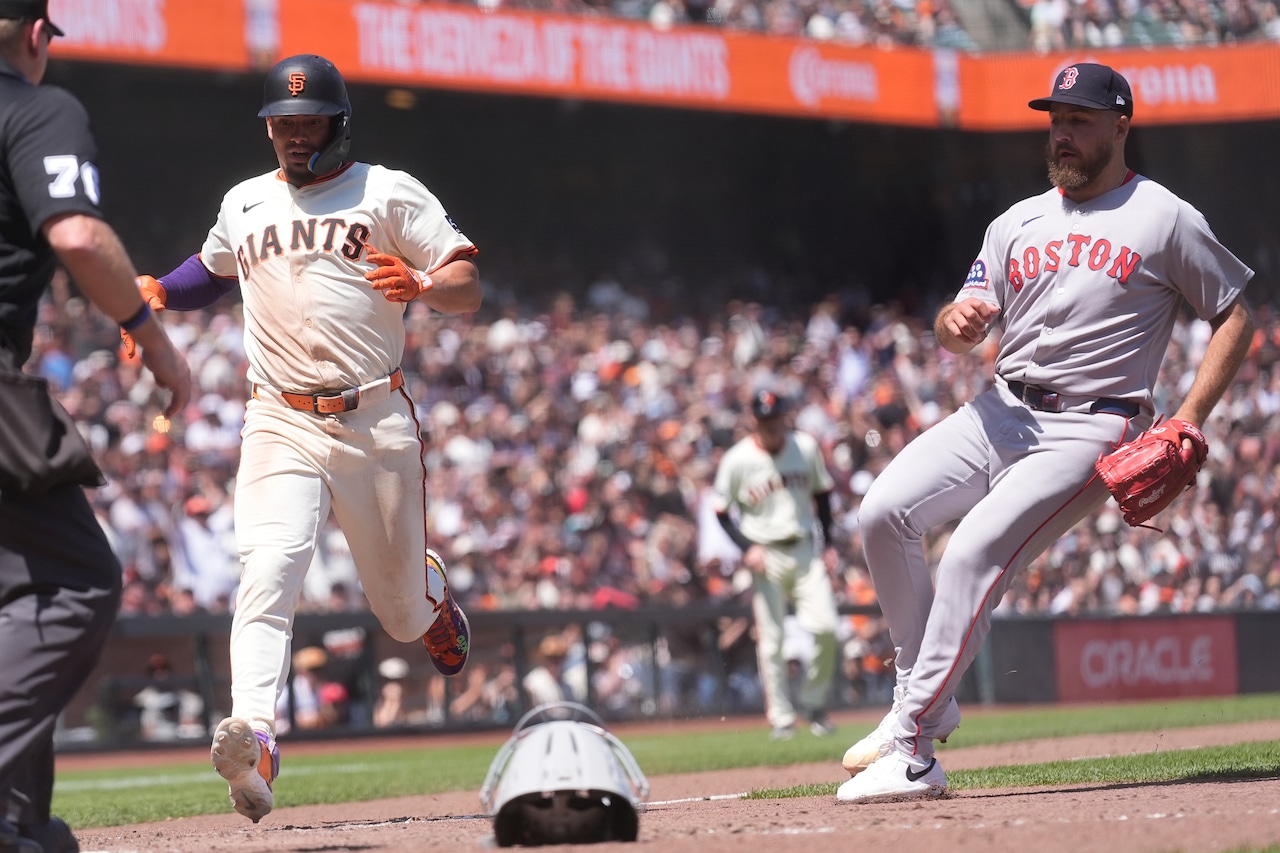
But the bigger issue came in the seventh, with the Sox clinging to a 5-4 lead. A single, double and a one-out sacrifice produced the tying run, but the Sox were an out away from escaping the inning when Mike Yastrzemski lined a ball directly at Romy Gonzalez, making his second start of the season at second.
Gonzalez closed his glove on the liner, only to have it squirt loose and into right field, scoring the go-ahead run. The flood games opened thereafter, with two more Giants baserunners crossing the plate.
“That’s gotta be made — it’s as simple as that,” said Gonzalez.
Asked if he had a tough time picking up the ball off the bat, Gonzalez said: “Doesn’t matter. We’re major leaguers — that’s a play that has to be made 100 out of 100 times.”
The frustrating thing about Sunday was that the Red Sox managed to chase San Francisco ace Robbie Ray with four runs in five innings. And to their credit, they kept adding on offensively, with another run in the sixth off the San Francisco bullpen.
But it didn’t help that the Red Sox’ bullpen, which entered Sunday with a scoreless streak of 19.2 consecutive innings, inevitably buckled some, charged with five runs — though only two were earned.
The Red Sox exist on a very thin edge for now, stripped of their two best hitters (one permanently) and relegated to trying to find platoon advantages on a daily basis.
Lefty-killers Rod Refsnyder and Gonzalez did their part, both homering off Ray in the fifth, producing three runs. But it’s nearly impossible when you’re giving up an average of a half-earned run per game, and the degree of difficulty increases against quality opponents like the Giants.
And so it was that rather than a happy trip to southern California, riding the momentum of a fifth straight series win and the prospect of an almost guaranteed winning trip, the Red Sox took flight under a cloak of frustration and unrelenting thoughts of What if?
Only the wretched Colorado Rockies have allowed more unearned runs, with 59. The Red Sox, despite some different personnel at several positions and a commitment in spring training to improve their defense, are somehow on pace to top last year’s total of 95, which would seem next to impossible.
“We’ve got to definitely clean up the defense,” said Gonzalez. “We can’t have eight, nine unearned runs a series. Especially with a team like this. They’re a good ballclub, and just giving them extra outs, that always comes back to bite you.”
“We gave the opposition more than 27 outs,” sighed Cora, “and I’ve been saying this for a while: you do that and you’re going to pay the price.”
Despite repeatedly learning that rather obvious lesson the hard way, it hasn’t changed the behavior.