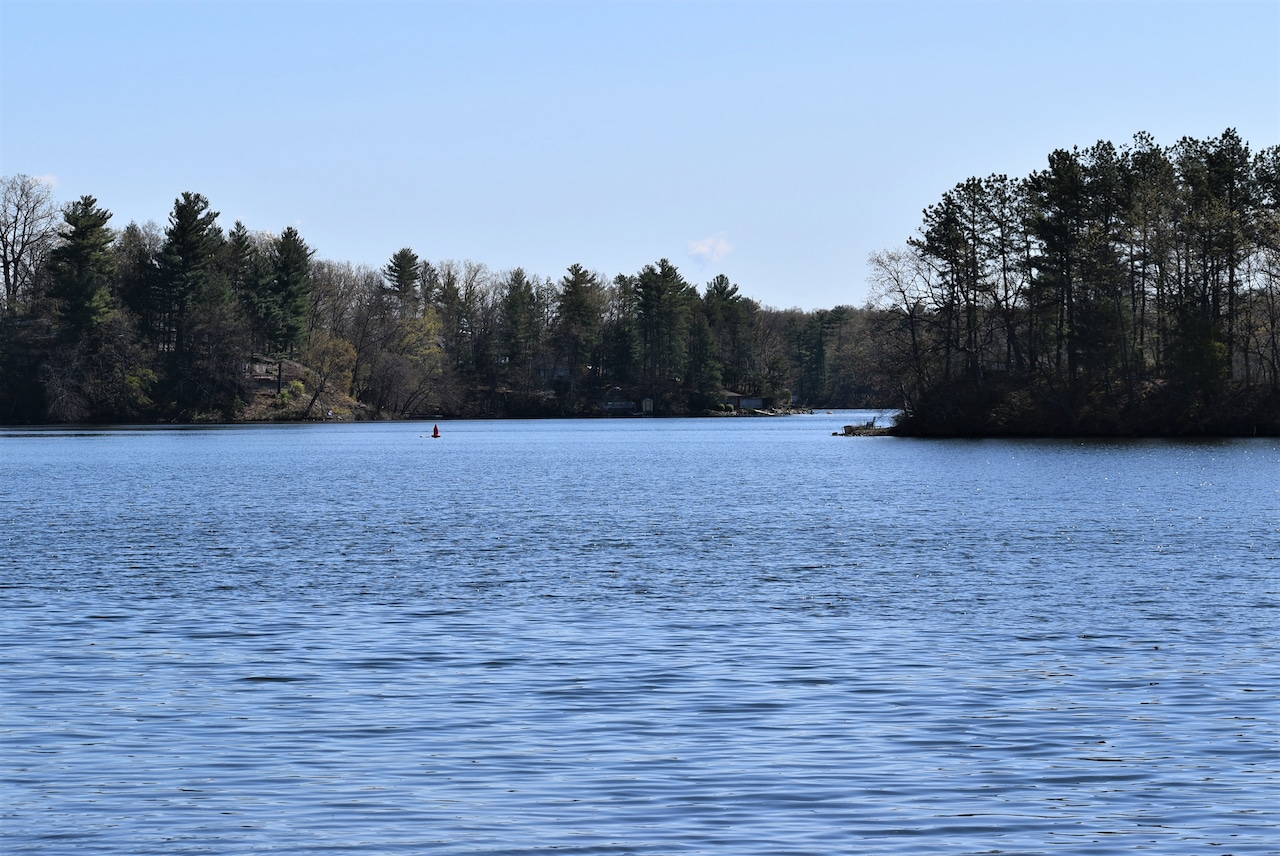
SOUTHWICK — Before a Watershed Plan and Environmental Assessment for Congamond Lake is prepared, the National Resources Conservation Service is hosting a public meeting on Wednesday, Jan. 14, at Town Hall to discuss the various options for increasing the ponds’ water quality and flood mitigation proposals.
“We need to get a lot of buy in residents,” said Richard Grannells, the chair of the Lake Management Committee, which has managed the lake for decades and works to improve its quality.
“We need to show them how important the lake is, not only for Southwick, but for the state,” Grannells.
In a press release about the meeting, the NRCS said it was being held to “present the purpose and scope of the planning effort [and] public input is encouraged to support evaluation of formulated alternatives.”
While significant progress has been made to increase and stabilize the ponds’ water quality, they are still considered polluted, according to federal and state standards, which is how a state Department of Environmental Protection analyst described it at a meeting held in November at Town Hall.
“The data management and water quality assessment section has analyzed the data and determined the Congamond Lakes are polluted,” said MassDEP’s Holly Brown.
The meeting held in November was to ask the town which of two options it might use to increase water quality; one was to create a “Total Maximum Daily Load” plan includes a “pollution budget” that limits the total amount of a pollutant water can handle, limits the load from “point” sources like factories or sewage plants, and limits “nonpoint” sources like fertilizer runoff.
The other is a nine-element watershed-based plan would manage “nonpoint” sources through grants, partnerships, and other voluntary programs, and is much less formal than a TMDL.
Select Board member Diane Gale at a recent board meeting proposed the town using the nine-element plan.
Once the town formally endorses the nine-element plant it would qualify, but not be guaranteed, federal grant funding to pay for water quality restoration plans.
During the meeting next week, representatives from the LMC and NRCS, along with the technical consultant team, will provide information on the scope of the planning activities, various alternatives being considered for as part of the assessment, answer questions and concerns about the planned activities, and seek public input, according to the NRCS announcement.
The announcement included that federal funding has been received to assist the town in developing the plan but has not yet been secured for the design or construction of these projects.
While the three great ponds are defined by the state as polluted, it’s not like there are industries or manufacturers using them to dump waste byproducts, it is a product of 14,000 years of plants and trees decaying and falling to the bottom of the ponds, which Grannells calls “muck.”
That decaying material is loaded with phosphorus, which is a nutrient that drives the growth of “chlorophyll a” which creates the conditions in which algae grow.
Because of the high levels of phosphorus and chlorophyll in the ponds, the state classifies them as a Category 5 impaired water body and requires a mitigation plan.
Grannells said at next week’s meeting those who attend will hear about increasing water quality and preparing for a severe flood.
In the last eight months, technicians with Pare Corporation have done an on-the-ground survey of Great and Canal brooks to determine the potential cost of dredging each to minimize the amount of stormwater that gets into the ponds when it rains.
Dredging the brooks would be an enormous positive step to improve the ponds’ water quality, Grannells said.
Because of decades of debris from leaves, fallen trees, and heavy undergrowth, and beavers building lodges, the canals don’t move water out of the ponds, as they did before being clogged.
Dredging both canals would allow the ponds to naturally flush out the phosphorus-loaded sediments.
As for the possibility of the ponds’ flooding, in 2023 the LMC asked the NRCS to develop a plan to maintain the water levels of Congamond Lake in the event of a 100-year flood, an event that raises the level of a body of water between 1 and 3 feet, and has a 1% chance of occurring annually.
When the NRCS issued its preliminary report in June 2023, it offered four options to mitigate flooding in the ponds, including one of “take no action.”
Two options are characterized by the NRCS as “structural solutions.” One is to build an outlet pipe in North Pond, replace the culverts between the ponds, and install a larger weir at the entrance of Canal Brook. The other is to do all of those things, and also build a new weir on the Great Brook canal.
The fourth option, called a “non-structural solution,” was to purchase and demolish 79 homes along the shore at risk for flooding in a 100-year storm.
The cost of the solutions in the NRCS report ranged from zero, for the “take no action” option, to $43 million for the “non-structural” option, to $54 million for the structural option that addresses Canal Brook only, and $72 million for the option that includes Great Brook.
Next Wednesday’s meeting will be a hybrid in-person and virtual meeting starting at 6 p.m. To participate remotely, visit, https://parecorp.zoom.us/my/nrcs.ma.
Assistance will be provided to anyone who has difficulty in determining how to participate.
Comments or questions may be submitted until Feb. 14 by mail to Congamond Lake – Great Brook Watershed Plan EA, c/o Pare Corporation, 10 Lincoln Road Suite 210, Foxboro, MA 02035 or by email to Congamond@parecorp.com.