

There isn’t a franchise in the game that isn’t envious of the Red Sox’ current crop of top prospects.
What front office executive or manager wouldn’t want the likes of Kristian Campbell and Marcelo Mayer on his roster? Or fellow rookie Carlos Narvaez, or the likes of Wilyer Abreu, who has a little more than a year and a half of major league service time?
And finally, there’s the tantalizing Roman Anthony, universally regarded as the top prospect in the sport, just a ride down the MassPike away.
That collection of young talent is likely unmatched.
But it comes at something of a cost. The Red Sox aren’t the Chicago White Sox or the Pittsburgh Pirates, integrating young future stars as part of along rebuild, hopeful of a turnaround in two or three years’ time.
No, the Red Sox have bigger goals. After failing to qualify for the playoffs the past three seasons, expectations were greater for the 2025 season. From team president and CEO Sam Kennedy to chief baseball officer Craig Breslow to manager Alex Cora, the message before spring training was, essentially: Enough waiting — we’re aiming to play into October.
That urgency following an aggressive — and expensive — offseason can sometimes clash with integrating young players into important roles. The likes of Campbell, Mayer and Narvaez aren’t being indoctrinated in some laboratory with little scrutiny. They’re under the microscope for a team desperate to be relevant again.
Rookies in Miami or Pittsburgh might be allowed to make mistakes for teams with no designs on contending. That’s not the case with the Red Sox, where fan interest, media attention and the expectation of playing on a winning team all complicate things.
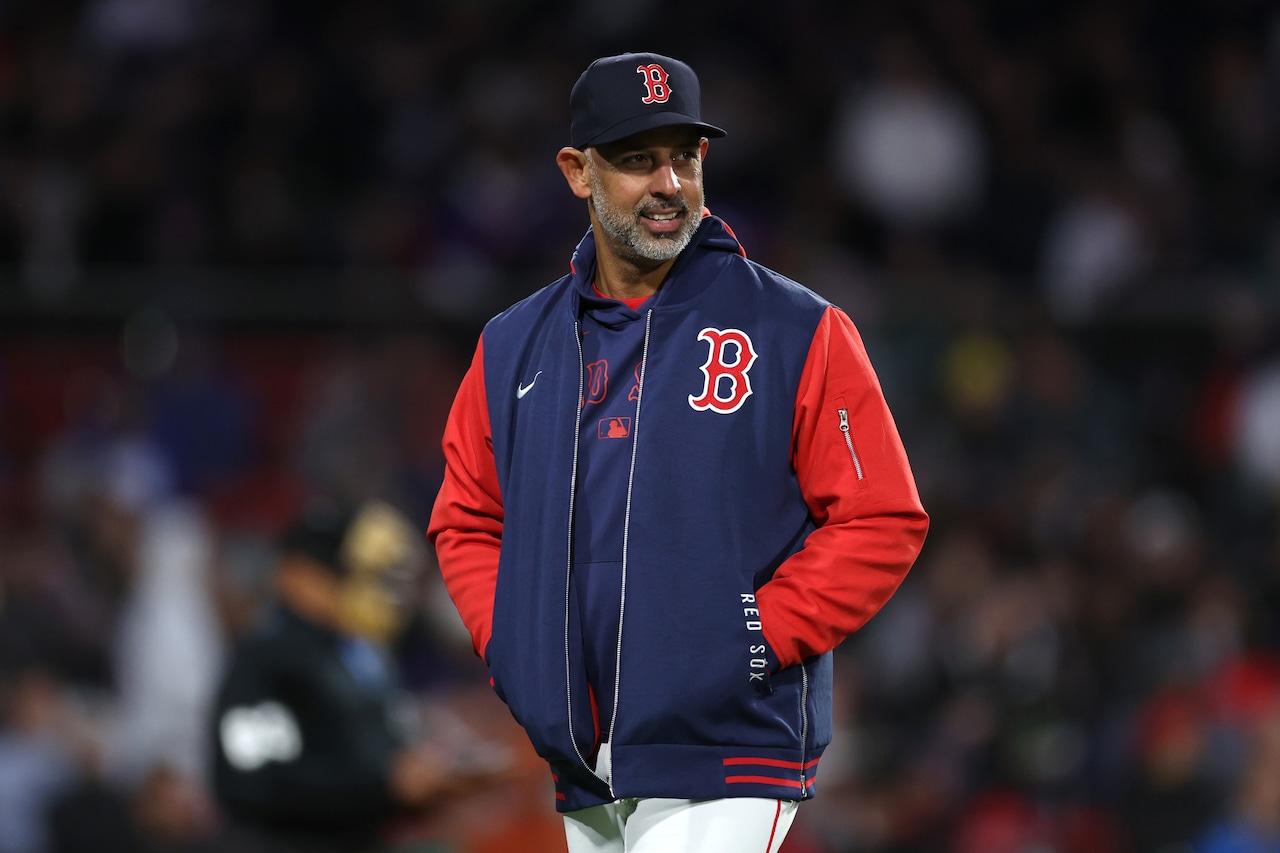
No one deals with the twin tasks of developing or winning more than Alex Cora. He’s expected to oversee the continued development of three rookies in his everyday lineup, and win enough to have the Sox in the running for the postseason.
“There’s a fine line with that,” said Cora. “Obviously, we believe we can do both. But the one thing that’s challenging, just being honest, is that transition from player development to here. Up here, every pitch matters, every at-bat matters, every error has its consequences. That’s something (in the minors), it’s not like that. It’s not the case.”
An errant throw or a caught stealing might mean a loss for the Worcester Red Sox, but the WooSox and all other minor league affiliates exist not to win games but to prepare players to help win games in Boston.
When those same mistakes happen for the parent club, there’s actual fallout. It might mean a loss, with far more obvious repercussions.
“That’s something we try to communicate, let them know, ‘Hey, man on third less than two outs, you have to put the ball in play,’ ” said Cora. “If they don’t, it makes it harder to win games and that’s something the coaching staff and myself, more than anybody else, I have to make sure they understand that.”
Of course, mistakes are going to be made. Kristian Campbell made a wide throw to the plate attempting to prevent the tying run from scoring and it led directly to a loss Wednesday in Milwaukee. The night earlier, Mayer was overly aggressive in a one-run game and attempted to advance 90 feet on a flyout to shallow right; he was cut down at third.
If either of those happened in the minors, the players would be pulled aside by a manager or coach afterward and instructed to learn from their missteps. But in the big leagues, learning lessons often come with a far higher price.
“It’s hard,” admitted Cora, who recalled the decision to move Campbell into the cleanup spot earlier this month. At the time, Campbell had been named the American League Rookie of the Month for March/April, and his at-bats were impressive.
With Triston Casas injured and not wanting another lefty like Abreu in the top four in the order, Cora opted for Campbell. But the rookie soon slumped badly.
“Was it too much on his plate?” asked Cora. “Maybe. But where we were at the time, we needed that. We tried to put all the good at-bats together and it didn’t happen.”
Undaunted, and perhaps out of a similar case of desperation, Cora auditioned Mayer in the same cleanup spot Wednesday.
Another example: on Tuesday night, the Red Sox had Brewers starter Aaron Civale on the ropes, with nearly 60 pitches thrown in the first three innings. This seemed like the perfect opportunity for the Sox to accomplish what Cora has been preaching: to chase opposing starters early and force teams to utilize their long- and middle-relievers.
Instead, in the Boston fourth, Narvaez swung and was retired on the first pitch of his at-bat, Campbell quickly fell behind 0-and-2, and Abreu swung at the first pitch. In no time, Civale had righted himself, with no small help from three overly-eager Red Sox hitters.
“It’s trying to win as many games as possible, but also, teaching the game,” said Cora.
Cora makes it a point to check in regularly with each of his young players to make sure they’re not feeling overwhelmed.
“We’re living in a different world now,” he said. “They’ve got a lot to deal with, between our expectations, the fan base’s expectations, and even expectations from their families. That’s something people don’t think about. Most of these guys, they’ve been ‘dudes’ throughout their careers and they’ve never been through struggles.
“Now that they’re dealing with that, how are they going to react to it? How are their families going to react to it? As a manager, I have to make sure I have the pulse of that and try to help them out.”
In today’s environment, prospects don’t arrive quietly. Casual fans know of their potential and their stats, and the hype begins immediately. Cora himself was stunned when Mayer ventured onto the field before his debut Saturday and was greeted with a standing ovation.
“The expectations, this aura that they have now, is a lot different that it used to be,” said Cora. “It’s a lot different now. (The fans) already know everything about them by the time they arrive. But the right ones, they don’t care about that stuff. They’re going to be OK.”
In his playing days, Cora himself famously mentored Dustin Pedroia in 2006 and 2007, to the point where the rookie infielder took away playing time from Cora.
But the relationship between players is different than the dynamic that exists between player and manager.
“In the end, I think those conversations from their teammates have more weight than me talking to them,” Cora said.
For now, Cora oversees a lineup that features three rookies as everyday players; in time, that number will grow to four when Anthony is inevitably summoned from Triple A.
Surely, Cora didn’t anticipate 2025 as a season in which nearly half of his lineup would be rookies. It’s rare for clubs with playoff designs to be so young.
Then again, no one anticipated losing Casas for the season or Bregman for as long as two months. And it just so happens that the organization’s best reinforcements are super-talented rookies.
There will be growing pains for everyone. Mistakes will be made. And during touch stretches, like the current one, it will be tempting to accuse the Sox of counting on their first-year players too heavily.
But there’s a payoff to be realized, too, the hope that the talent will manifest itself, regardless of age, and that Campbell, Narvaez, Mayer, and at some point Anthony, will be meaningful contributors.
Until then, though, there will be challenges as the players learn as they go.
“I truly believe that, when it matters, we’re a group that’s going to be in contention,” said Cora. “For how bad it looks now, we’re still playing around .500, the same thing we’ve been doing the last few years. We just have to be patient, talk to them and walk them through the process.”
_______________
Everyone else is doing it, so I might as well, too: Here’s my 21st Century Red Sox team.
Some context: Longevity counts, so even though, for instance, Adrian Beltre may have had the best season for a Red Sox third baseman in the last 25 years, I didn’t select him because he only was here for that one season. I prioritized impact over a longer period of time.
Some positions were easy, others quite challenging. It’s somewhat ironic that the Red Sox are casting about for solutions at first base since that’s been a position with a lot of turnover this century.
Without further ado:
C: Jason Varitek. There wasn’t an easier choice on the ballot for the franchise leader in games played at the position.
1B: Kevin Youkilis. Youkilis split time at the corner infield spots, but his best seasons came at first.
2B: Dustin Pedroia. Again, there can be no debate on this one.
SS: Xander Bogaerts. I gave a lot of thought to Nomar Garciaparra, but three of his best seasons came before this century, and as great as 2000 and 2001 and 2003 were, 2002 and 2004 were cut short by injuries or The Trade.
3B: Rafael Devers. Not for his glove work, obviously, but you can’t deny the offensive production.
LF: Manny Ramirez. For all his foibles, Ramirez was a force of nature in the batter’s box.
CF: Johnny Damon. A case could be made for Jacoby Ellsbury, whose highs were higher. But Damon’s impact was greater in his four years — both for his play and his personality.
RF: Mookie Betts. He wasn’t here as long as he could have been, but for 2016 and (especially) 2018, he has to be here.
DH: David Ortiz. Duh.
SP: Pedro Martinez. He was here for just five seasons this century and he had already started to fade by 2004. But oh my, that run between 2000-2003.
SP: Jon Lester. From 2008 through 2013, his prime, he was good for 15 wins and 200 innings annually
SP: Tim Wakefield. Wakefield never had one of those truly remarkable individual seasons, but how can the franchise leader in innings pitched and starts not be here?
SP: Curt Schilling. We tend to forget that Schilling was only here for four years and healthy for just three. But 2004 doesn’t happen without him and he was part of two championship teams.
SP: Derek Lowe. Lowe was kind of a hybird, but he saved 66 games in the first two seasons of the century and then averaged 202 innings and 17 wins as a starter in the next three. More than good enough.
CL: Jonathan Papelbon. I think it’s likely that Papelbon’s career with the Sox is somehow underrated. The numbers are something else.




