
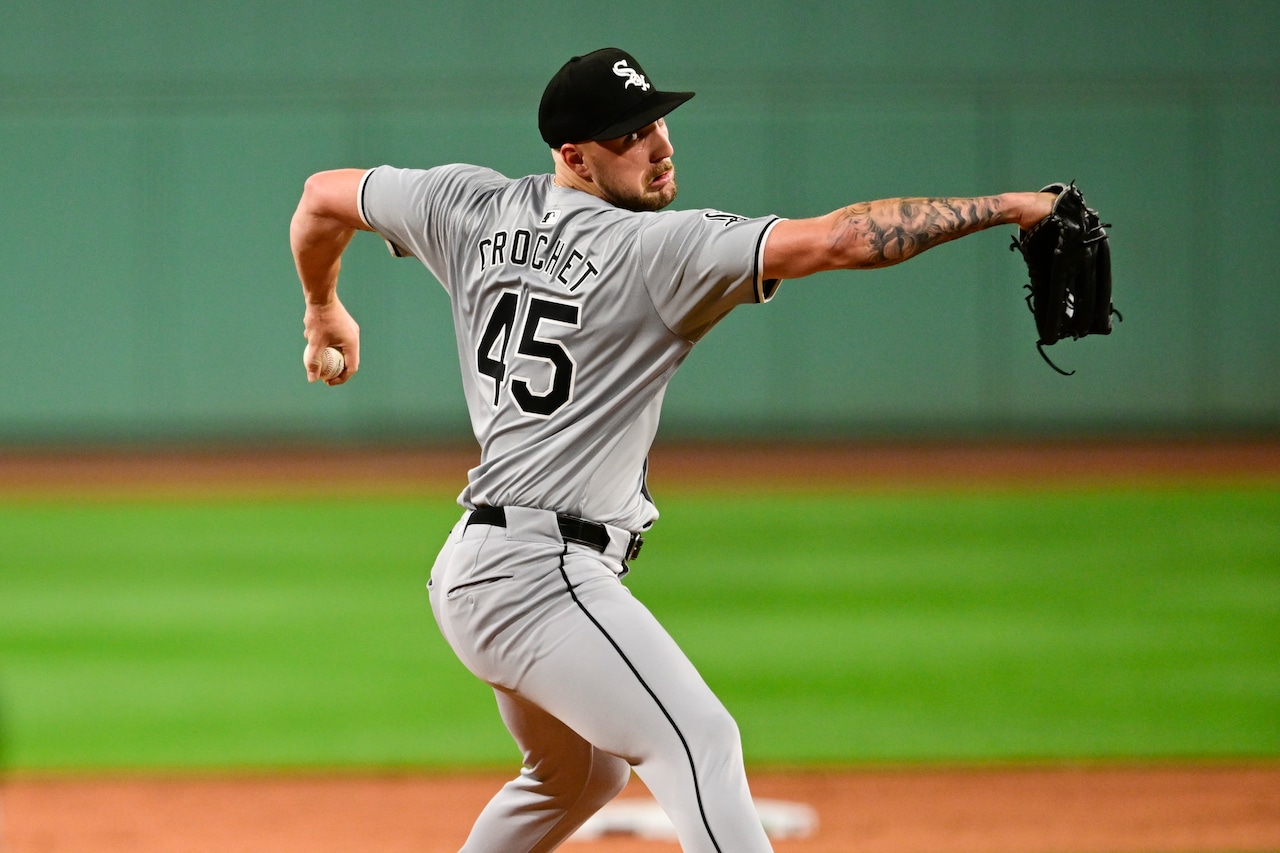
The most obvious benefit to the five-player deal the Red Sox executed with the Chicago White Sox Wednesday was that it delivered the Red Sox with someone who profiles as a No. 1 starter.
Garrett Crochet gives the Red Sox what they’ve lacked for a number of seasons — someone to log 180 or so innings a season, a pitcher in whom the team would feel confident starting a postseason series. Not since — here’s that name again — Chris Sale, pre-Tommy John, have the Red Sox had such a person in their rotation.
And given that it’s almost impossible for a team to compete for a pennant without such a piece, the Red Sox have checked a major box.
But the deal also represents something more symbolic. For the first time in a long time, the Red Sox have acted boldly. Or in the parlance of the week, they’ve made a move that made them uncomfortable.
- BETTING: Check out our MA sports betting guide, where you can learn basic terminology, definitions and how to read odds for those interested in learning how to bet in Massachusetts.
Last year, that was hardly the case. Trading for Tyler O’Neill and signing Lucas Giolito were decent acquisitions, but they didn’t move the needle in a dramatic way. Meanwhile, during the Chaim Bloom Era, the Red Sox were so focused on the future and stockpiling prospects that a bold stroke was almost unimaginable. The Sox weren’t close enough to contention to justifying a risky transaction. They were too busy rebuilding and accumulating to risk anything resembling a daring deal.
That’s changed with the Crochet deal.
The trade is not without its risk. Crochet has somewhat of a limited track record in the big leagues, having throw just 219 innings in the majors and has made just 32 career starts. He’s also undergone Tommy John surgery. Neither his health nor future performance can be fully predicted.
But as Craig Breslow acknowledged earlier this week, teams are more equipped to project pitching outcomes than they’ve ever been. There’s plenty of data and diagnostic tools to help organizations anticipate what’s ahead, and the metrics on Crochet are off the charts.
His stuff is elite, and though it represents a relatively small sample size, so are his results to date. The Sox know they are getting a pitcher with an elite fastball, the ability to get swing-and-miss that few can match. They’re getting a 6-foot-6, 245-pound physical specimen who should be able to hold up under a big workload. He’s a quality lefty, which their rotation has lacked. And the intangibles are present, as his teammates and others in the Chicago organization can attest: he’s accountable and competitive.
All of that said, there are no guarantees here. That goes double for the prospects the Red Sox surrendered.
For the purposes of projecting, let’s focus on the top two minor leagues involved in the deal: Kyle Teel and Braden Montgomery. Teel is one of the game’s better catching prospects and his inclusion in the deal leaves the Red Sox without a catcher of the future candidate. Montgomery may have an even higher ceiling, as a potential five-tool player.
But to state the obvious, the Red Sox had to be willing to give something to get it. In this case, they had a handful of others teams in competition for Crochet and to win the bidding, were motivated to offer the best package for the future. Even after subtracting two of the organization’s Top 5 prospects, the Red Sox still have three other players ranked among the Top 30 in the sport.
In fact, they’re still deep enough that, for the right return, they can move another piece from the now Big 3 and still have a well-regarded system.
Franky, how well Teel and Montgomery (and Wikelman Gonzalez and Chase Meidroth) develop should be of little consequence to the Red Sox. It’s perfectly OK if, in the aftermath of a big trade, both clubs emerge happy with the outcome. No matter how talented the prospects sent out were/are, none was going to be a No. 1 starter for the Red Sox.
Breslow chose the trade path. Had he instead gone to eight years and $218 million to outbid the Yankees for Max Fried, that, too would have been fraught with peril. So would signing Corbin Burnes. When you’re committing nine-figure salaries to pitchers already past their 30th birthday, you’re taking on an inherent gamble.
Baseball executives face this choice: hope that players continue to perform at their previous level, or hope that players improve as much as you project you will. There are no easy paths.
The Red Sox could have remained static and hoped that someone on their staff emerged into a front-of-the-rotation type. Maybe Brayan Bello, for instance, still will. But that seems less likely to happen than for Crochet to match what he’s already done, and at 25, continue to grow. Fun fact: Crochet is actually more than a month younger than Bello.
But hoping and crossing their fingers wouldn’t have elevated the Red Sox in the American League race. Trading for a pitcher just now entering his prime offers a far better chance.
For those criticizing the organization for being too timid, too patient, that argument has been stripped away. Finally, the Sox acted boldly to fill their most obvious need. Regardless of what happens next year, three years from now or five, it’s hard to second-guess their willingness to take that big, uncomfortable step forward.
__________________________
It’s natural that people want to make comparisons between Wednesday’s deal and the one that brought Sale to the Red Sox eight years ago. Both came from the Chicago White Sox. Both are lefthanded. And the Red Sox gave up two elite prospects in both deals.
But the comparisons end there.
At the time of the deal for Sale was made, he had thrown 1110 major league innings, compared to 219 for Crochet. Sale had finished in the Top 6 in Cy Young Award voting five times; Crochet has yet to throw enough innings in a singe season to qualify for an ERA title.
So the comps are kind of silly. Sale was far more established, far more accomplished and far more of a sure thing. There was far less projection about what the Red Sox were getting on their end.
A far better comparison — as NBC Sports Boston’s John Tomase has noted — would be the deal for Josh Beckett after the 2005 season. Like Crochet, Beckett was 25 and like Crochet, had about four years of service time under belt. Even here, though, the comparisons are imperfect: Beckett had made 103 starts, many more than Crochet’s 32, and had already been a World Series hero, pitching the then-Florida Marlins to a title over the Yankees in 2003.
The return was somewhat similar, too. The Sox surrendered Yoan Moncada and Michael Kopech to headline the deal. Moncada was considered by some to be the best prospect in the industry at the time of the deal, while Kopech was one of the top pitching prospects.
That one worked out fine for the Red Sox. In his second year in Boston, Beckett was brilliant in October (4-0, 1.20) and pitched the Sox to a World Series title. Moncada and Kopech were both plagued by injuries and under-performance.
If Crochet has even one October as dominant as Beckett’s, the deal will be a success from the Red Sox’ vantage point.
______________________
If there’s a major drawback to the deal before Crochet even puts on a Red Sox uniform, it’s this: it greatly upends the Red Sox’ future catching situation.
It’s an open question how the Sox replenish at the position. Current starting catcher Connor Wong provides somewhat better than league average offense for the position, but defensively, is limited, with poor pitch blocking and framing skills.
If the Red Sox need an upgrade in the next year, where will they turn? An argument could be made that finding quality catching is even more challenging than finding quality starting pitching, though plenty of teams seem to win without it.
More and more, teams seem to be satisfied with defense-first candidates who are capable of handling a staff, keeping the running game in check and pitch-blocking. Any offense teams get from the position is considered a bonus.
It may be a long way off, but following the 2027 season, the following are heading for free agency: Adley Rutschman, William Contreras and Cal Raleigh are due to become free agency.
Internally, the only top catching prospect in the system, Johanfran Garcia, is just 20 and isn’t projected to reach the big leagues until sometime in 2028.
________________
Assorted items gathered through a week of lobby strolling:
* Before the Kansas City Royals acquired Jonathan India from the Cincinnati Reds, the Royals had some interest in — and brief discussions with — the Red Sox about infielder David Hamilton. Hamilton is versatile, an elite defender and is a plus-plus basestealer (33-for-37 in 2024). There are some who question whether he’s an everyday player, but he has some value around the game.
* Looking more closely at the breakdown of Juan Soto’s deal, this struck me as noteworthy: Factoring in a $75 million signing bonus Soto will make in excess of $46 million million in every year of his 15-year deal except one: in 2027, his salary will “drop” to $42.5 million. The cynic in me wonders whether it was structured that way because of potential labor strife. The current CBA expires after 2026, and I wonder if agent Scott Boras wasn’t anticipating some sort of strike or lockout in the early months of 2027. More and more, there’s a feeling that a work stoppage is almost inevitable as hard-line owners get behind a salary cap proposal that is sure to be bitterly opposed by the Players Association.
* There’s already a buzz starting about Vladimir Guerrero Jr. becoming a free agent after next year and how his righty power bat would fit at Fenway. And undoubtedly, Guerrero would be a good fit, especially if the Red Sox end up dealing away Triston Casas. But while Guerrero is an awesome talent, his inconsistency should be at least somewhat troubling. In his last five seasons, Guerrero has twice had an OPS of .940 or greater, including a career-best 1.002 in 2021. But he’s also had two seasons in which his OPS was below .800 — .791 in 2020 and .788 in 2023. That’s a lot of variance for an elite player.
* Was told that former Northeastern star Aaron Civale, a Connecticut native, dreams of pitching for the Red Sox.
* Former Red Sox (and Baltimore) GM Dan Duquette, who’s doing some consulting work for some teams, was at the meetings, looking to get back into the game full-time. Ironically, the Hilton Anatole in Dallas, where the meetings were held, was the site of the 2000 winter meetings, too, where Duquette signed Manny Ramirez to his landmark eight-year, $160 million deal.