

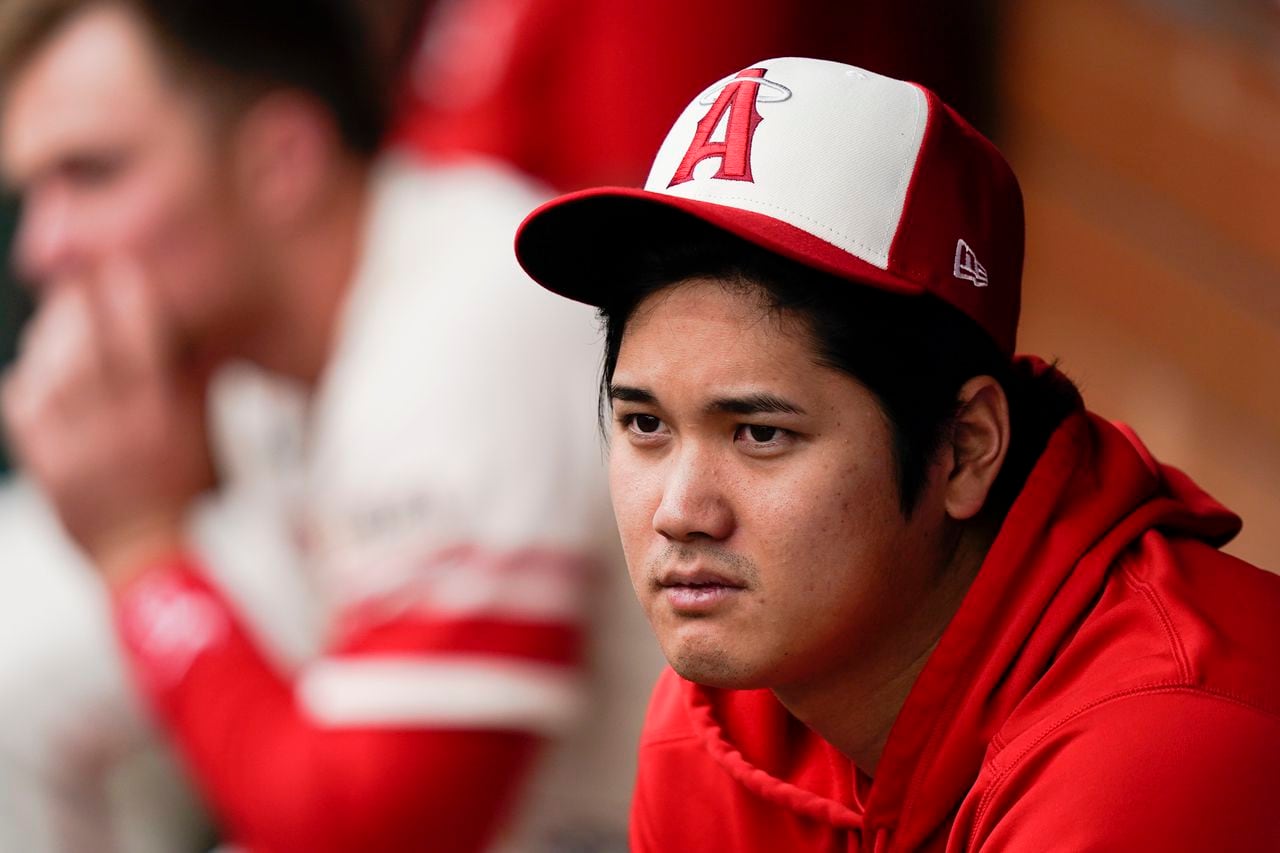
Shohei Ohtani is set to become highest-paid player in baseball history, if not the highest-paid pro athlete in North American sports. Even with recent elbow surgery precluding him from pitching in 2024, he could sign for $500 million, perhaps even more.
There has never been a baseball player like him, able to provide elite production as a hitter while also serving as a front-of-the-rotation starter. Accordingly, sometime over the next few weeks, Ohtani will richly rewarded by some MLB franchise.
Should the Red Sox be that team? Of course.
Unless, that is, they shouldn’t.
That determination is complicated. There’s plenty to support the argument. Oddly, despite Ohtani’s talent, an equal case could be made that he’s not a good investment.
Follow along, as we try to have it both ways:
The Case For:
* Ohtani isn’t just a generational talent; he’s a multi-generational talent, unique in the game’s history. Signing him would send the most obvious signal imaginable that Red Sox ownership is serious about winning again, and will stop at nothing to field the most talented roster.
For a team that has finished in last place in each of the last two seasons, three times in the last four and six times in the last dozen years, that’s a powerful and important message.
* Signing Ohtani would provide an immediate and sizable boost to ticket sales. The Red Sox have, unsurprisingly, seen attendance decline in recent seasons. In 2022 and again last year, the Red Sox failed to draw 2.7 million fans; the last time that happened in a full, non-pandemic season was 2002, the first year of ownership by the current group.
From 2008-2012, the Red Sox drew in excess of three million fans to Fenway each season; they haven’t done so since. With Ohtani as part of the roster, the Sox would almost certainly crack the three million mark again and perhaps even set a club attendance record (3.062 million fans in 2009 is the current mark).
NESN ratings have cratered in recent seasons, too, reflecting the general downturn in interest in the team. Where once Red Sox games garnered TV ratings anywhere from 7.0 to 9.0, and occasionally double-figures for Yankee games, last year, for the second year in a row, they averaged 2.67, a considerable drop-off.
That trend would be immediately reversed with Ohtani, to say nothing of the number of subscriptions that could be sold for the “NESN 360″ streaming app.
* He would be giant boon for the Fenway Sports Group brand internationally.
FSG is a world-wide sports and marketing company. They’ve partnered with the likes of LeBron James to lift their profile, and have investments in Europe (Liverpool AC), in hockey (Pittsburgh Penguins), NASCAR (Roush Racing), golf (TGL) and other sports.
Having an internationally recognized and admired athlete the stature of Ohtani would only further enhance FSG’s brand.
* Across MLB, the Red Sox’s popularity has sunk. Signing Ohtani would mean increased exposure in every possible way. They’d be featured on the maximum number of games for ESPN’s Sunday Night Baseball and Fox’s Game of the Week. National (and international) media coverage would explode.
* At a time when the Red Sox are about to embark on a huge commercial development project in the neighborhood surrounding Fenway Park, Ohtani’s presence could potentially attract more businesses and investors. During the season, the promise of at least three million paying customers before and after games in the Fenway neighborhood would only enhance traffic for restaurants, hotels and other retail outlets.
* Baseball is becoming increasingly international with each passing season. If Ohtani is the top free agent target this winter, countryman Yoshinobu Yamamoto is No. 2. There are other Japanese stars intent on following in their path, and the same is true for star players in Korea.
The more the club’s profile is enhanced internationally, the easier it will become to attract other free agents, making the Red Sox a destination point for players all over the world.
* The best Red Sox teams have been star-driven, led by Roger Clemens, Pedro Martinez, David Ortiz, Mookie Betts and others. The Red Sox fans have long supported the team, through good and bad seasons, and pay some of the most expensive ticket prices in the game. They deserve, in turn, to see the best the game has to offer. And no star shines brighter than Ohtani.
The Case Against:
* The most obvious need for the Red Sox this winter is starting pitching, and while Ohtani has been an excellent starting pitcher (3.01 career ERA, a ERA+ of 142 and a WHIP of 1.082), he will not be able to pitch in 2024 after undergoing major elbow surgery this past fall. Thus, the Red Sox would be busting their offseason budget without addressing their biggest immediate need.
* The team’s payroll will become top-heavy because of one player. The assumption is that, at minimum, Ohtani will command an average annual value of at least $40 million, with some estimates projecting that number to be closer to $50 million.
As presently constituted, the Red Sox are currently about $49 million shy of the first CBT threshold of $237 million. Ohtani’s contract would either take them close to that threshold or slightly over it, without accounting for the two starting pitchers they so obviously need, an upgrade at second base and a righthanded bat.
Signing Ohtani and filling their other needs would take the Red Sox dangerously close to a $300 million payroll, which would not only result in a ridiculously high tax rate, but also result in other hugely painful competitive disadvantages when it comes to draft picks and international free agent pool money.
* Ohtani is, at almost 30, already a significant injury risk. He’s undergone one Tommy John surgery in 2019, and recently had a second major elbow procedure performed. Ominously, his representatives have not made clear whether the more recent surgery was another Tommy John procedure, or merely the “bracing” surgery that Trevor Story underwent last January.
Either way, that’s worrisome. How much longer can Ohtani’s invaluable right elbow hold up? While rebounding from one Tommy John surgery is now almost commonplace, a second is a challenge. Would a third such injury spell the end of his pitching career altogether?
* As terrific as he is, Ohtani has not by himself turned his team into a winner. In his six seasons with the Angels, the team never had a winning record and never qualified for the postseason. They finished fourth, or next-to-last in five of his six seasons. The Angels twice finished better than 30 games out of first place in the AL West.
And remember: Ohtani was teammates with Mike Trout, arguably the best position player in the sport. That the two combined couldn’t make the Angels contenders is a reminder that MLB isn’t the NBA; one — or even two — great players couldn’t lift them out of also-ran status. And as good as Rafael Devers is, he isn’t the player that (a healthy) Trout is.
What does that portend for Ohtani’s impact on the Red Sox?
* As long as Ohtani continues to pitch, and including 2024 when he won’t be able to pitch, Ohtani is restricted to DH duty. It’s demanding enough to get 500 or more at-bats while pitching every fifth or sixth day. He can’t be asked to play the outfield, too. Even the most talented athletes have their limits.
Having Ohtani as your everyday DH for the next six or seven seasons takes away a lot of options for a manager. Forget resting Devers or Masataka Yoshida once a week each, and getting them off their feet, away from defensive responsibilities; those at-bats are already spoken for by Ohtani.
Granted, Ohtani’s production as a hitter would be welcomed by just about every team. But that comes with a cost, one that limits roster flexibility.
_______________
For now, fairly or unfairly, free agent lefty Shota Imanaga is the “other” pitcher about to be posted from Japan.
He’s not Yoshinobu Yamamoto, who is righthanded, five years younger and far more accomplished. Yamamoto has won the last three Sawamura awards, the Japanese equivalent of the Cy Young, and has also won three consecutive pitching Triple Crowns (wins, ERA and strikeouts).
But even if Imanaga can’t match Yamamoto, he’s bound to attract lots of bidders when he’s posted.
Here’s one veteran talent evaluator’s scouting report, having seen Imanaga compete extensively in both the World Baseball Classic and NPB (the Nippon Professional Baseball league).
“He’s an undersized lefty who can really throw strikes,” said the evaluator. “He has a plan out there on the mound. He’s not overpowering but I think his strike-throwing and feel to pitch are really his strengths. The (four-seamer) fastball plays. It’s got ride to it, and it’s also got some spin to it. He’s got the ability to got some swing-and-miss with it, even though it’s not overpowering. He can locate it, move it around the zone and keep it away from the barrel.
“I would say his next best pitch would be his split-change. Hitters don’t see that over here as much, and he can throw it to both lefties and righties. After that he has a slider which he throws to lefties, and a curve.”
In his WBC appearances, Imanaga topped out at 95-96 mph with his fastball, a considerable bump over what his usual velocity of 92-93 mph.
One potential red flag is that Imanaga is prone to giving up homers, with 18 allowed over 159 innings this past season and 14 in 158.2 innings in 2022.
“Part of it is the fact that they play in smaller ballparks,” offered the evaluator. “I would also say that he doesn’t have overwhelming swing-and-miss stuff. And sometimes when Japanese pitchers decide they’re going to come over to the States, they really start transitioning to how it’s going to be like and how they’re going to attack hitters. I’d say all those factors play a part (in the homer total).”
One concern is Imanaga’s size. He’s listed at 5-foot-10, but most scouts think that’s a bit generous.
“Even though he’s shorter, he’s got a little stockiness to him,” the evaluator said. “But I do think that’s a concern, along with the lack of innings he’d had.”
Imanaga’s career high in innings is 170 (2019), but is usually in the 140-160 inning range.
“Now, saying that, (New York Mets righty Kodai) Senga had one season there when he threw over 180 innings and came over here and did well,” the evaluator said. “I just think, over a long period of time with a multi-year contract, (stamina) would come into play.
“I see him as a back of the rotation guy. He’s a strike-thrower, but when it comes down to just the quality of the pitches, that gives me a little pause. And the durability.”
___________________
Two owners were in the news this week, and they couldn’t have been more different.
San Diego Padres owner Peter Seidler passed away Tuesday. Seidler was, by all accounts, what an owner should be: committed, generous and willing to do just about anything to put the best product on the field. Seidler saw the Padres as a civic trust, and was determined to bring San Diego its first championship.
His passing hit the San Diego community hard, with Petco Park opened to accommodate mourners, including some players, to come and pay tribute to his memory. Seidler was aggressive in signing free agents, without much regard to the bottom line.
“I kind of like spending money,” said Seidler last year. “You can’t take it with you.”
Oakland owner John Fisher couldn’t be more different, by contrast, and on Thursday, he did take it with him — “it” being his baseball team, the A’s. Fisher got the approval of 29 other owners Thursday to move the A’s to Las Vegas, having overseen the disintegration of a once-proud franchise with his tiny payroll and disinterest in finding a new home for the club in the East Bay.
Vegas will be the fourth stop for the franchise, which originated in Philadelphia, before moving westward to Kansas City and then Oakland.
The A’s will be lame-ducks for the next three seasons while Vegas builds them a ballpark and it’s unclear where they’ll play in the interim. But Fisher has a sweetheart deal waiting for him on the Strip, and never mind about the fans he left behind or the club’s history.
EXTRA INNINGS
1) The introduction of the pitch clock this past season was an unquestioned success. Games moved at a far better pace and the sport seemed to rediscover its own natural rhythm, with the average time of game shortened by 24 minutes from the year before, to a more reasonable 2:40. But earlier this week, owners signaled that they may be willing to further reduce the time between pitches with runners on base from 20 seconds to 18 seconds, all with the idea of saving an additional five minutes. And that seems unnecessary, if not a little greedy.
2) If, as has been speculated, as many as eight teams are looking for two starting pitchers this winter, the laws of supply and demand are about to be tested to the max. At most, there are a half-dozen elite starters on the market, after which the quality begins to dip. The top free agents — both foreign and domestic — are likely in for record paydays, but the real craziness may happen with the next tier of middle-to-back-end starters, many of whom are likely be vastly overpaid. Either that, or we’re about to see a record number of trades.
3) As a country, we’ve never been more divided at the ballot box, where we seemingly can’t agree on anything. But that’s not the case when it comes to voting for MLB awards. Both the AL Rookie of the Year (Gunnar Henderson) and NL Rookie (Corbin Carroll) were unanimous selections, as were the AL MVP (Ohtani) and NL MVP (Ronald Acuna Jr.). So, too, was AL Cy Young Award winner Gerrit Cole. In fact, of the six main player awards, the only winner who wasn’t unanimous was NL Cy Young Award winner Blake Snell, who still captured 28 of 30 first-place votes.




