

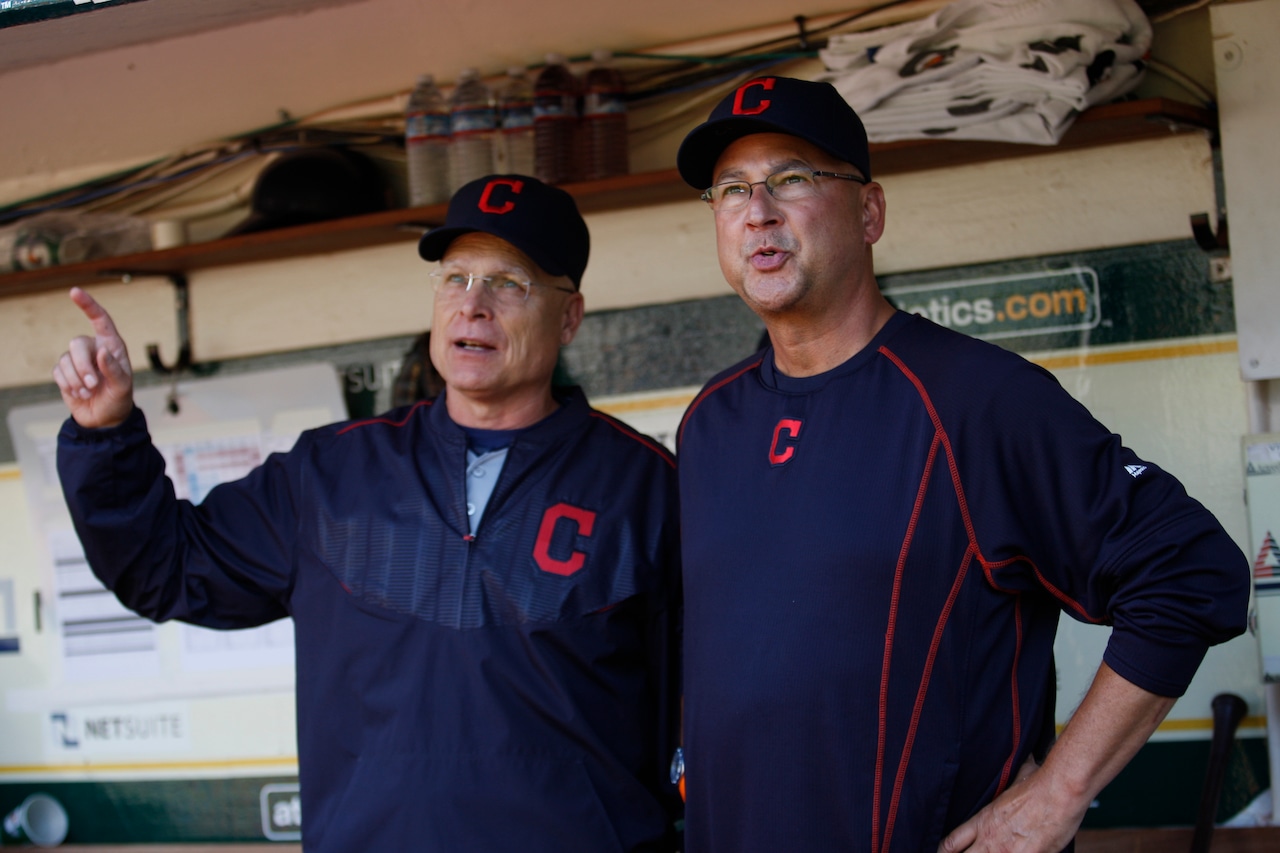
Brad Mills was lying in bed late one night when his phone buzzed with a text message. He could not have been more surprised by the news his son Beau had texted him.
His close friend, Terry Francona, after retiring from baseball only 13 months ago, was returning to the game.
“I had no idea he was even thinking about it,” said a chuckling Mills, the Red Sox’ bench coach under Francona from 2004-2009. “I saw (the text) saying Terry had agreed to manage the Cincinnati Reds. I thought, ‘What!?’ I had absolutely no idea. People don’t believe me when I say that, but I had no idea.”
It wasn’t long before Francona called his friend of more than 40 years to both confirm the news and ask the next logical question: Did Mills, too, want back in?
“I didn’t answer him back right away,” said Mills. “I thought it would sure be interesting, but I had to consult my family before I even talk about it, because of everything they had been through.”
Mills had walked away from the game in 2020. Publicly, the word was his retirement was because of the threat of COVD. But anyone who knew him knew that the real reason was Mills was grief-stricken by the drowning death of his 18-month grandson, known as Beau Bear.
In the four-plus years since, Mills wanted to be home with his family: his wife Ronda, his son Beau, his daughters and his grandchildren. Brad and Ronda attended grief counseling, sometimes several times per week.
“This has been a great time to be able to spend with my family,” he said. “But they were all excited (by the prospect of me getting back into the game). To a person, they were all like, ‘For sure.’ And that’s how it all got started.”
Mllls assumed he was done with the game, and made peace with that. While at home in Texas, Mills would watch games on TV and occasionally take a radio out on the golf course with him. When the game has been part of your life for decades, it’s nearly impossible to disassociate from it completely.
“People would ask, ‘Do you miss it?’” said Mills, “and I would say, ‘You know what I miss? Seven o’clock every day. From 7 p.m to 10 p.m., you get excited and you really enjoy that time.’ I couldn’t quantify it, but, yeah, I missed the relationships with the other coaches, the players and the media.”
He passed the time spending time with his three grandsons, all of whom play baseball in Texas. He’d attend their games and throw the occasional round of batting practice. He also followed the game from afar and kept tabs on old friends. But returning to it wasn’t in the offing.
And then came a call from an old friend. Mills calls Francona ‘T’; Francona famously refers to his friend as “Millsy.”
“Working with him — in the clubhouse, on the field, setting the culture for the team — is something fun to be around,” said Mills of the relationship with Francona. “The friendship part of it is huge, but (working together) is a big part of the friendship. It didn’t take long for us to get back into that rhythm — talking about the players, about the team, who they had. The excitement started right away.”
- BETTING: Check out our MA sports betting guide, where you can learn basic terminology, definitions and how to read odds for those interested in learning how to bet in Massachusetts.
Indeed, the prospect of once again being Francona’s aide-de-camp proved irresistible. The two had first met on the campus of the University of Arizona in 1977. Fate had them selected by the same team, the Montreal Expos, where their friendship continued and blossomed.
And when Francona got his first chance to manage in the big leagues, there was little doubt about whom he wanted on his coaching staff in Philadelphia. It was the beginning, as the movie says, of a beautiful friendship. For the next few decades, almost without exception, everywhere Francona went, Mills followed.
Mills was Francona’s bench coach with the Red Sox from 2004-2009, leaving two years ahead of the end pf Francona’s stay in Boston, to become manager of the Houston Astros for a few seasons. After Francona re-surfaced as the manager of the then-Cleveland Indians, so, too, did Mills, assuming the familiar position in the dugout as Francona’s most trusted lieutenant.
One spring with the Red Sox, after Francona had already guided the Red Sox to their first World Series in 86 years, he was given a lucrative contract extension. Soon after putting pen to paper on the new deal, Francona raced to a nearby Fort Myers drug store to purchase a thank you card for Mills, into which he stuffed a generous check in gratitude for his friend’s contributions.
“He’s like my big brother and one of my closest friends,” said Francona. “I kid him all the time and tell him that I know what he’s going to do before he does it. But he knows what I’m going to do before I do, too. It’s nice. If he doesn’t agree with something, he just tells me. He doesn’t care if he hurts my feelings and I certainly don’t care if I hurt his. I’m biased, but if you’re trying to find something negative to say about Millsy, you really better start searching. He’s just salt of the earth and everybody who’s been around him feels that way.
“He can talk to you in a disarming manner. He’s just a sweetheart. With him, it’s like having a security blanket. He knows me so well. If I’m not on the field for some reason, I know we’re not going to skip a beat. Without him, I would have never made it. He looks out for me; it’s like we’re brothers.”
Then, the unimaginable happened and the Mills family was overwhelmed by grief.
“What came out of that,” said Mills, “was that I needed to be where I was at with them. I needed to be with my family. But my son, Beau (a former Cleveland first-round pick), came to me and he said, ‘Dad, you really didn’t get a chance to quit on your own terms, or leave on your terms. This might be a good way to close that door and do that.’ I had kind of resigned to it being like that for years.
“The game is always a big part of our family and what we’ve gone through. It helped us heal a little.”
Asked what it will be like to stand next to his good friend in the dugout on Opening Day next March, Mills said: “I think it’s going to be like it always was and it won’t change. I think that’s how it will be. We can pick up right where we left off.”
Together, they’ll try to win some games. They’ll lob insults at one another and finish each other’s sentences. And maybe, just maybe, help Mills continue to heal some more.
________________________
Sasaki-mania has begun.
Japanese pitcher Roki Sasaki is about to be posted by the Chiba Lotte Marines, after which all 30 teams can bid on him. The dollar amounts will be nothing like the bidding war that developed around countryman Yoshinobu Yamamoto a year ago because, at 23, Sasaki will be considered an international amateur free agent and can only sign a minor league deal.
Most teams have between $4.6 million and $7 million available from their international free agent bonus pools. If he’s posted before the end of November, he’ll be paid from teams’ 2024 bonus pools, much of which has already been verbally committed to Latin American amateurs. If he’s not posted until well into December, teams will be able to bid using their 2025 bonus pool money.
So how good is Sasaki and what can be expected from him?
“Premier talent with dominant stuff,” said one veteran scout regularly assigned to the Pacific Rim who has seen Sasaki often. “I know he’s had some injuries (shoulder and forearm this past year) and setbacks, but he’s done everything to show that he’s ready to come to the States.”
The scout said Yamamoto, by virtue of being several years older, was “more polished, more accomplished. But in terms of raw stuff, Sasaki is superior. But he is younger and by virtue of not being as polished as Yamamoto, it’s going to take some time to transition and learn how to get major league hitters out. Whereas Yamamoto had more confidence in his stuff and more pitch-ability, even if the raw stuff wasn’t quite as good.”
Sasaki’s four-seamer can hit triple-digits on the radar gun, but the fastball tends to be fairly straight.
“And big league hitters have seen 100-mph velocity,” cautioned the scout, “and Sasaki is going to have to continue to learn to figure out, ‘OK, how am I going to work with this fastball?’ if he finds out while warming up that he doesn’t have his slider working that day. But the split is as good as I’ve seen out of any of those pitchers (in Japan) when he’s on.”
One cautionary note: Sasaki has not thrown more than 130 innings in Nippon Professional Baseball (NPB) and isn’t accustomed to making 30 or so starts per season. Coming to MLB will be a step up in both competition and workload. But on the plus side, Sasaki has been managed carefully when it comes to innings and hasn’t been overused as some Japanese pitchers have been in the past — both as an amateur and a professional.
“I think the right thing to do is to monitor the innings as he transitions,” the scout said, “because these lineups (in MLB) are much, much deeper than what he’s accustomed to. If you look at the NPB, the (quality of the) offense has gone down every single year for the last seven or eight years.”
Sasaki, who grew up in northern part of Japan, had a small-town upbringing and for much of his life, hasn’t been accustomed to the spotlight.
“I’m not saying he couldn’t adapt to the bright lights and big city,” said the scout, “but he’s not about all the glamour. He’s more reserved and tends to keep to himself. He’s fine blending in and finds a comfort zone in the clubhouse. He’s not necessarily a leader. He’s not a bad guy or anything like that, but he’s not someone looking to have everyone jump on his back. He kind of lets his stuff speak for itself.”
Sasaki’s repertoire includes a four-seam fastball, two-seam fastball, a split-finger fastball and slider. Earlier in his career, Sasaki lacked a feel for his slider, but more recently, it’s become more of a plus offering.
“It’s more of a horizontal pitch, which is good because all the others are more vertical and bears in on righties,” the scout offered. “The slider has come on, and even though it’s not a tradition tight, hard-biting pitch, it’s different enough from all his others that hitters have a hard time picking it up.”




