

As winter temperatures fluctuate, Massachusetts residents are keeping a close eye on their utility bills.
U.S. home heating costs are projected to rise 9.2% this winter, which is more than three times the rate of inflation, driven by higher utility costs and colder-than-average weather, according to the National Energy Assistance Directors Association.
The impact is particularly significant for Massachusetts which faces some of the highest energy costs in the country, ranking 3rd by Poweroutage.com at $146 per month, which equates to 26.23 cents per kWh.
Because of these high costs, EverSource is providing a look at the complex factors that determine what customers pay for electricity and natural gas.
According to EverSource spokesperson William Hinkle, a utility bill is best understood as three distinct “buckets,” each influenced by different economic and policy forces.
Energy supply
The largest and most unpredictable factor that goes into the bill is the energy supply.
Under Massachusetts law, utilities like EverSource do not generate electricity or their own natural gas production, meaning it’s purchased by them on a regional wholesale market and then delivered to customer’s homes.
This means that prices are driven by global supply and demand. For instance, Hinkle said the conflict in Ukraine caused a global spike in natural gas prices in 2022.
Winter constraint is also a factor. During this time of year, customers are more reliant on their heating systems, meaning that supply rate costs for both gas and electric increase and are higher in comparison to warmer seasons, according to the Massachusetts Department of Public Utilities (DPU).
“We have tightly constrained supply to begin with. But when we’re in those cold winter months, when the natural gas supply for the region is further constrained, you typically will see supply prices go up,” Hinkle said.
There’s no markup and utilities pass the cost of energy directly to consumers without profit, according to the DPU.
According to a June 2025 Boston Globe article, Massachusetts residents are also concerned about data centers, which are specialized buildings used to store, process and manage digital data, coming to the state and using high amounts of electricity.
“I have major concerns about data centers,” Massachusetts program director for the advocacy group the Acadia Center Kyle Murray told the Boston Globe, adding, “they just end up driving up costs for everyone else — they get a favorable rate, and then average citizens end up paying more.”
According to Data Center Map, Massachusetts only has 46 data centers. This is a small number in comparison to other states like Virginia which has 568 or Texas which built 392.
Public benefits: Investing in policy
The second bucket consists of public benefits. These are state-mandated programs funded through utility bills to support public policy goals such as Mass Save and other initiatives that offer residential assistance, solar energy programs (net metering) and electric vehicle infrastructure.
“Through charges on your bill, you’re paying to fund these programs,” Hinkle said.
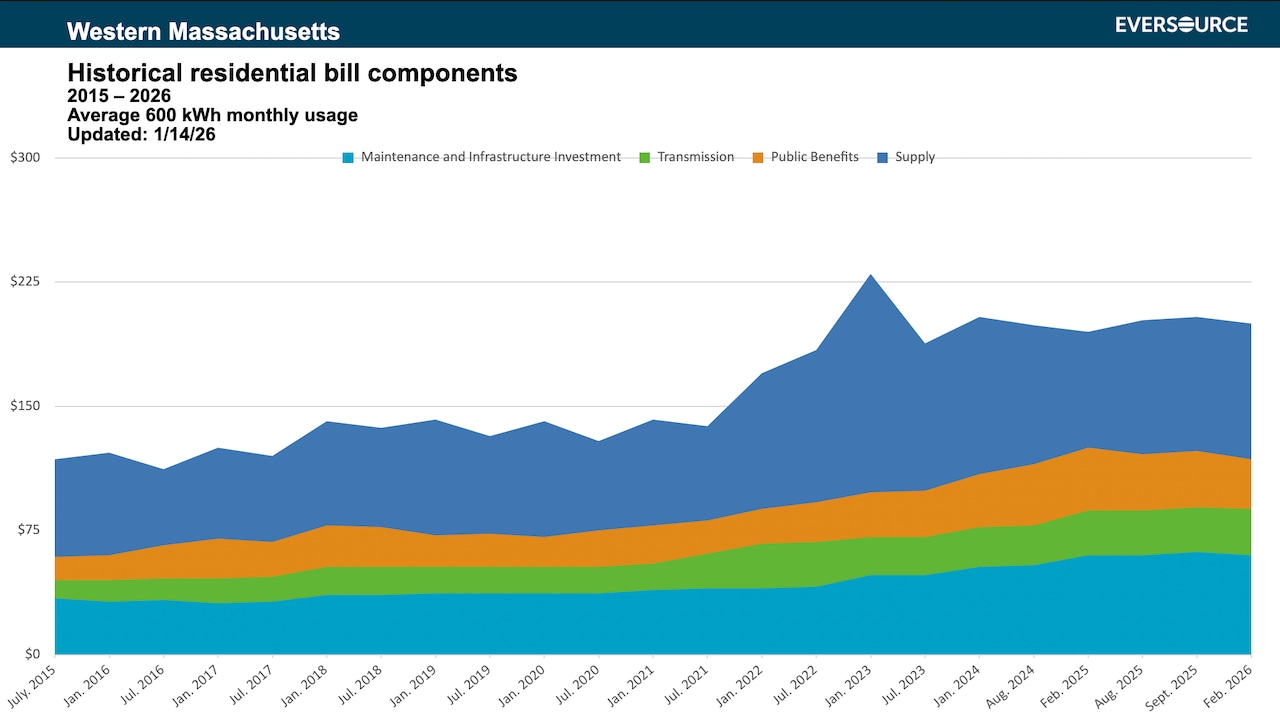
As the state expanded these programs in Western Massachusetts, the energy efficiency rate alone increased by over 300% over the last decade, he explained.
According to a 2025 analysis from Mass. state Sen. William Brownsberger, policy-driven costs including Mass Save add 17.5% to 24% to electric bills and 12.3% to 39.1% to gas bills, depending on the customer type, season and utility territory.
Hinkle noted that because customers are already paying for these programs through their monthly bills, they should make sure they are getting their money’s worth.
He encouraged all residents to utilize Mass Save to lower their overall consumption.
“Those energy efficiency programs, they ultimately help you use less energy,” he said. “The cheapest unit of energy is the one you don’t use. Regardless of rate changes, using less energy is the most effective way to bring your total bill down.”
Maintenance and infrastructure
The final bucket is maintenance and infrastructure. This factor covers the poles, pipes and people required to keep the grid running.
Hinkle explained that since 2019, the cost of a utility pole has risen by 60%, transformers by 100% and wire by 50% due to inflation.
Also, whenever utility companies do construction or repairs on the street, they are required to pay for police details to manage traffic.
Hinkle said that since the cost of those police details have increased, those operational costs are contributing to bill increases.
“The cost of everything has gone up,” he said. “We work diligently to keep those costs as low as we possibly can, but they are broader economic forces, inflationary pressures, supply chain challenges that have driven up these costs.”
The 10-year trend: Everything is up
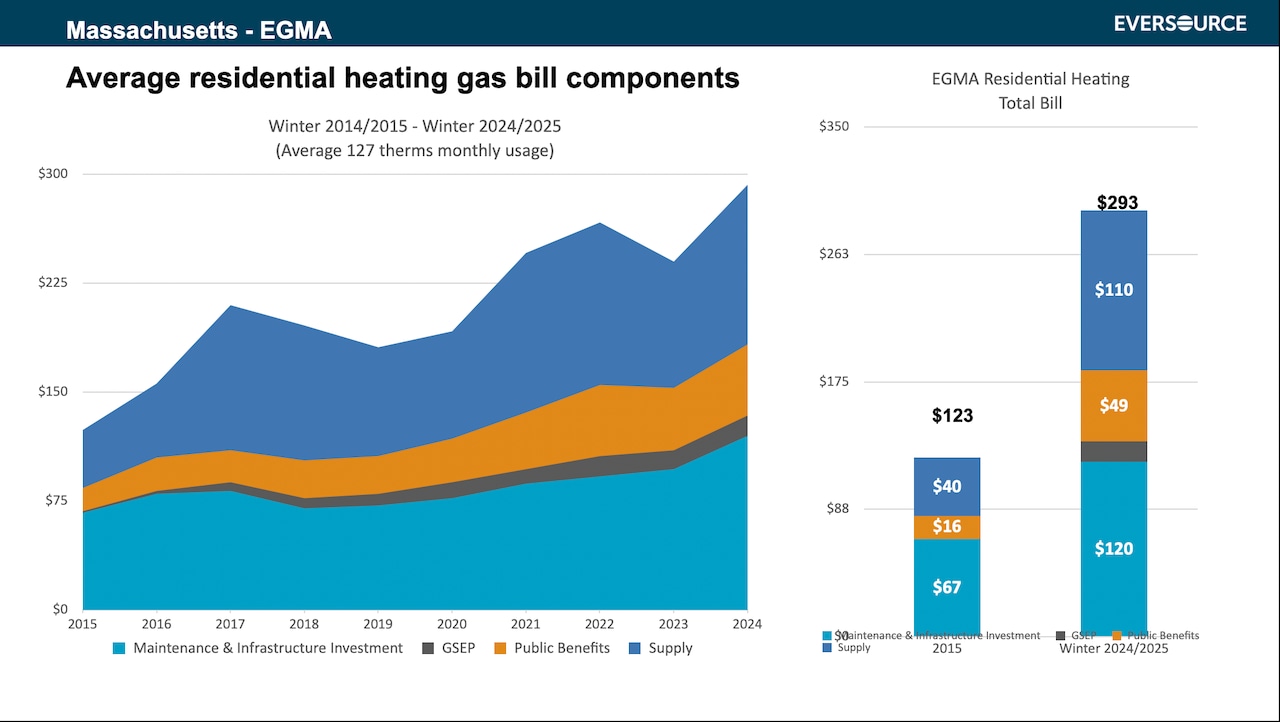
Data from EverSource shows that the cost of gas supply rose by 62% between 2015 and 2025. During the same period, maintenance costs rose by nearly $70 per typical bill.
Governor Healey’s relief plan
To combat the high utility bill costs during the cold winter months, Governor Maura Healey has introduced a relief plan that will offer reduced costs for gas and electric in February and March of this year.
Electric customers will see a 25% reduction in current charges, which is partly funded by state-administered alternative compliance payments (15%) and a temporary deferral of rate components (10%).
Gas customers will meanwhile see a 10% reduction.
However, these stabilization measures are not permanent discounts, Hinkle emphasized. The costs are being deferred to warmer months when usage is lower.
“It makes winter bills more manageable for our customers,” he said. “And then at a time when their total bills are lower that money will ultimately be collected in those lower usage months to spread out over several months.”
Hinkle called the plan an “immediate relief” that is not a “silver bullet” that will solve higher utility costs in the long run for Massachusetts residents.
“I think it’s important for customers right now when they need it most, to see some relief,” he told MassLive. “This isn’t solving every problem, but it is ultimately a benefit for customers, especially here in the short term.”




