
More than 25 years ago, a $20,000 check from the state to the New North Citizens’ Council, a community nonprofit, went uncashed.
Time passed. The money became part of the state’s unclaimed property division, a department that’s like the island of misfit toys of money, taking in orphaned funds from banks and other entities and holding them until they are claimed.
“Find Your Unclaimed Property Now!” declares the state’s public online portal, FindMassMoney.gov. The site allows the public to look through a massive dataset to see if the state holds lost property in their name.
But if the Springfield council searched, it wouldn’t find that $20,000 listed. It would have to call the state office and ask if it had property in the organization’s name.
That’s because more than $450 million in property is not listed in the online portal, based on an analysis by The Republican newspaper of Springfield, using the full unclaimed property database it obtained from the state.
While the state wins points for getting money back to its rightful owners, about half of the funds are not returned. The analysis by The Republican identified features of the program that can slow or obstruct the return of money.
The Republican’s review turned up many examples of money that belongs to recognizable groups and businesses in Western Massachusetts — from about $19,000 owned by a Holyoke man to $40,000 for the Center for Human Development.
Existing Massachusetts laws or policies would have to be changed to get money back to owners faster, as some states do.
“Everybody should go out and check the website,” said Rory Casey, the Holyoke’s city treasurer, who is working to claim lost money for the city. “That’s certainly been one of my takeaways. I’ve been telling folks here in the city, colleagues, (and) people in my family. ‘Go and check.’ It’s pretty wild some of the stuff that’s out there that you’re owed.”
Property isn’t detailed in the public portal for a variety of reasons, such as when the owner’s address is not listed. In the Springfield council’s case, the funds were an unpaid check from the state itself, a category that’s excluded from the online portal.
Most of those properties don’t have an address reported to the Unclaimed Property Division, but even the few that do require additional verification, said Mark William Bracken, assistant treasurer and director of the division.
The online portal acknowledges that some property is excluded from the website and to call for a “complete search.”
Maria M. Ligus, the council’s executive director, said she didn’t know anything about her organization’s unclaimed money and declined to comment.
Defining ‘lost property’
That unclaimed check is a tiny fraction of Massachusetts’ unclaimed property system.
Lost property is not rare. The state holds more than $4 billion of the public’s unclaimed funds. Mostly that’s cash, but it also includes the value of stock and mutual funds, liquidated investments and even physical property.
“We say it’s one in 10 people. It’s probably closer to one in four (or) one in five people have unclaimed property,” Bracken said.
It’s everyone from reporters at The Republican, to your coworker, to Lady Gaga, who has more $50,000 in unclaimed tax refunds under her legal name Stefani Germanotta, a fact the commonwealth publicized in 2023 and remains true as of June, according to records The Republican reviewed.
What is “lost property?”
Think checks that go uncashed, refunds from a utility company sent to an old address and bank accounts that get forgotten about and are deemed inactive. The department does not deal with real estate or vehicles, but does get some physical property from safe deposit boxes.
When an institution can’t find the property’s owner, it turns it over to the state, and Massachusetts keeps that property in perpetuity for people to claim.
The state spends millions each year to advertise the program — including in The Republican and on MassLive.com — and employs several investigators who focus on reuniting large sums of lost money with their owners.
Still, between fiscal years 2015 and 2024, the state has returned less than half of the unclaimed funds it’s taken in, according to an analysis by The Republican.
From 2015 through 2024, the state has received about $2.4 billion and returned $1.1 billion.
A 2019 survey by the Unclaimed Property Professionals Organization found Massachusetts’ return rate was higher than many states, but not among the nation’s top dozen.
A growing number of states have programs that automatically mail checks to people for property under a certain amount, typically less than several thousand dollars, if they can confirm the person’s identity by using other records, like tax returns and those from the registry of motor vehicle.
Massachusetts does not plan to start a similar program.
“In terms of returning money, Massachusetts is arguably better than most states, but certainly deficient in that it’s not automatically returning money,” said Ron Lizzi, a Connecticut advocate for more transparency in state-run unclaimed property systems.
Unclaimed money can be used by the state. Most of the money goes into the state’s general fund and the stabilization, or rainy day, fund, which the state can use to plug budget deficits.
The state still owes people their money, though, if they make a claim, Bracken said. “We turn it over to the state every year, and the state does whatever they want with the money. But the underlying value of that money is always here to be paid out,” Bracken said.
‘Consumer protection’ goal
Every state in the country has an unclaimed property division, according to the National Association of Unclaimed Property Administrators. In Massachusetts, the program goes back to the 1950s. State laws governing it have largely remained unchanged in 70 years, said Bracken, who has run the unclaimed property division since 2011 and is also executive director of the state lottery.
When a business owes a person or entity money but can’t find them, it can hold onto the funds for three years in most cases. Examples: overpaying a utility bill, an uncashed check, or a life insurance policy never cashed out after someone dies.

After three years, the money is turned over to the state’s unclaimed property division.
“That money belongs to that individual. It does not belong to the business,” Bracken said. “It is a consumer protection to be able to kind of have a central depository of people’s money,” he said. “And we try to make it as easy as possible for people to figure out and know: ‘Hey, all you really got to do is check your name.’”
FindMassMoney.gov allows people to search for lost property and make a claim for it. There is no expiration date: Property owners in Massachusetts always have the right to claim their cash. Their heirs inherit that right.
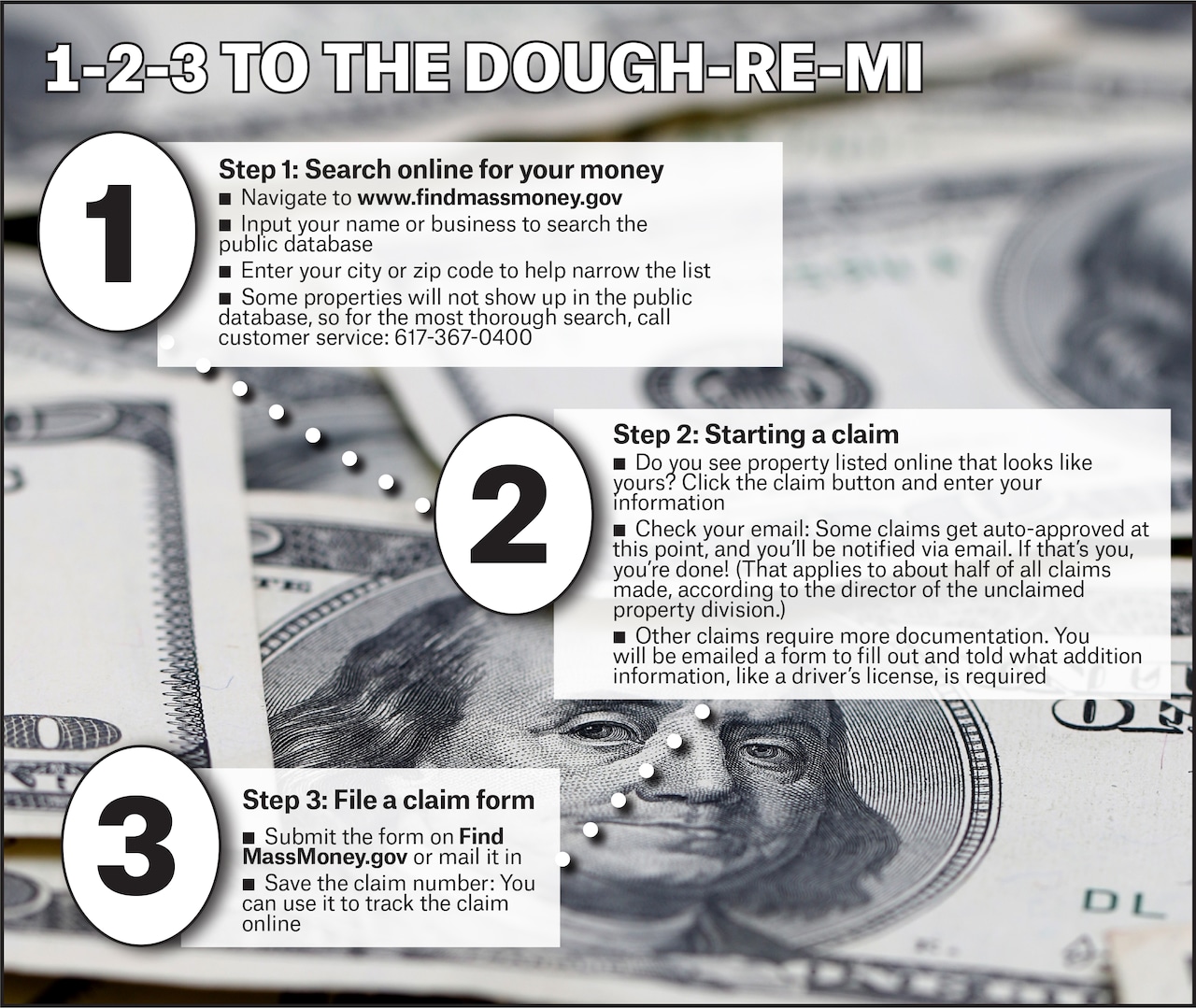
On the state portal, people can search for property under an owner’s name and narrow it down with a city or zip code. An owner can make a claim for the property on the website by filling out basic information that gets cross-referenced with a third-party verification system. If it matches, the claim is approved in minutes, Bracken said.
That’s the case in about half of all claims. If it doesn’t match or meet the fast-track requirements, the person will get a claim form to fill out and return, while providing certain documentation.
The claim form will state what the property is worth. But the online public portal does not show any amounts or show a range — as some states, including Washington and Wisconsin, display in their portals. That’s to prevent fraud, Bracken said. He worries fraudsters would search for the large amounts and go after them.
Showing the amount of money could motivate people to take possession of what is theirs, though, Bracken said. Sometimes he hears people say, “‘Oh, it’s probably nothing,’ and they don’t do anything,” he said.
The online database is not a complete search and excludes some properties, as in the case of the $20,000 state check issued decades ago to the New North Citizens’ Council.
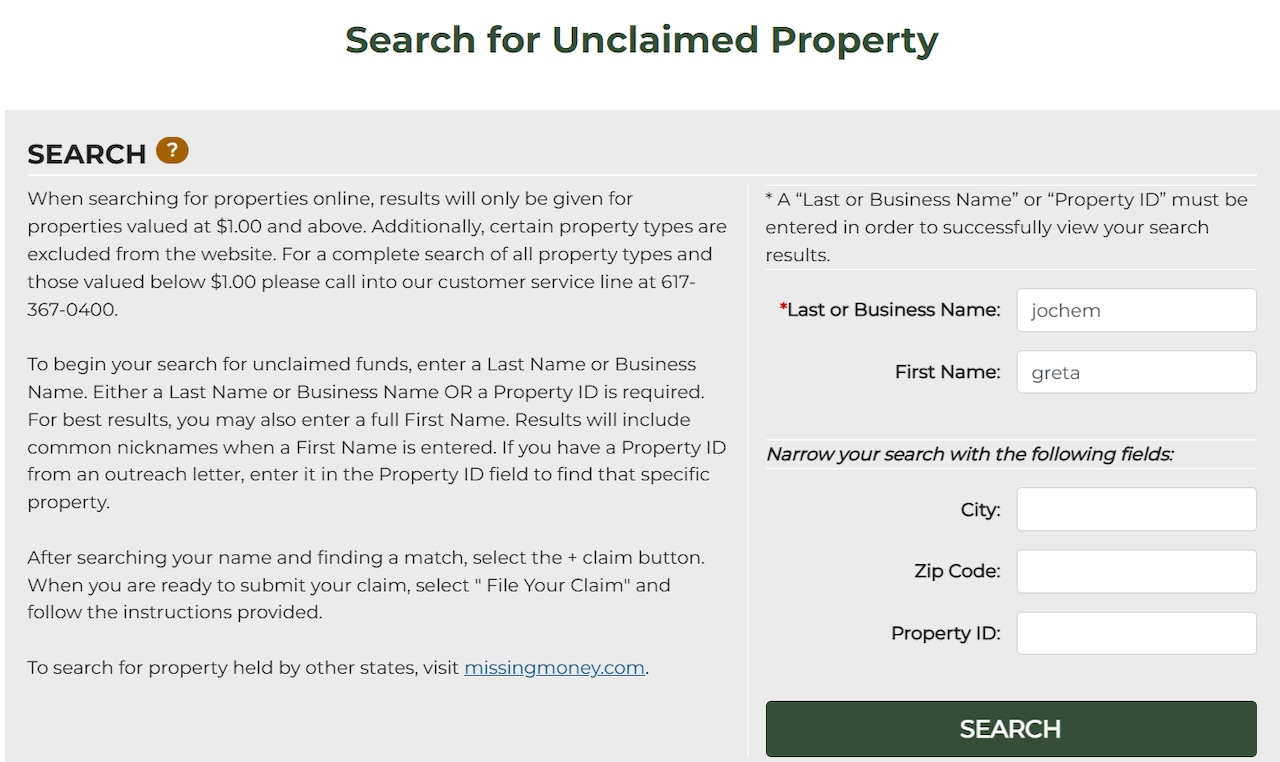
While searching, the portal tells users that some property, including cash less than $1, is excluded and to call customer service for a complete search.
Bracken estimates 10% of the properties are not listed on the portal. If the property doesn’t have an address reported to the unclaimed property division, it doesn’t show up.
That’s because a name alone isn’t enough information for someone to know property is theirs, Bracken said. “If a property for a common name was put on website with nothing other than just a name, then everyone with that name would file a claim thinking it is them, and it would cause mass confusion,” he said. If someone calls the office, they can do a robust search and ask additional verification questions.
Uncashed state checks are a category that’s excluded from the public portal. The vast majority of them lack an address reported by the state agency that relayed them to the unclaimed property division, Bracken said.
Even if they have an address attached, they require more verification, but it’s possible the public portal could include them in the future. “Who knows, maybe you bringing up the question will change a process,” Bracken said in an email.
Between uncashed state checks and property without an address, more than $450 million worth of property is not on the public web database, according to an analysis of a more complete database The Republican obtained in an information request. That does not include property worth less than $1 that the portal also skips.
‘Eye opening’
In Holyoke, the city is owed about $30,000, according to state data The Republican obtained. It’s from a smattering of sources, like uncashed checks, insurance proceeds and refunds. Some of it has been in the state’s lost property system for more than a decade.
Casey, the city treasurer since 2022, heard about the state’s program through its advertising and searched for the lost cash.
“It certainly was eye opening,” he said. “Some of the things are quite old.”
Casey had a summer intern working on filing claims this year. “It’s a pretty simple process, but once you have to do that simple process dozens of times, it can eat up quite a bit of time,” he said.
Springfield has roughly $40,000 in unclaimed money that it plans to reclaim after the city treasurer’s office finishes an audit, said assistant city collector Michael Marcinkewich. Early this summer, the state sent Springfield a list of what it was owed, Marcinkewich said.
Many contacted by The Republican were hesitant to comment on their unclaimed property. One person, who had more than $10,000 in unclaimed property, didn’t want to comment publicly out of fear it reflected poorly on them.
Some organizations contacted by The Republican seemed to think they were being accused of mismanagement or weren’t aware of the funds.
The Center for Human Development has more than $40,000 in unclaimed property in the database. The Springfield-based human services organization has more than 80 addresses in Massachusetts and Connecticut, a spokesperson said. “This brings occasional challenges in mailed materials reaching the correct CHD location in a timely manner, and from time to time, it results in items ending up in the Unclaimed Property Division,” the spokesperson said in an email, in response to questions.
“While those processes can take time, the vast majority of our unclaimed property items ultimately end up appropriately accounted for,” the statement said.
The Trustees of Reservations, a statewide nonprofit that works in land conservation, recently filed paperwork to claim about $60,000 from an inactive savings account, a spokesperson for the organization said. Staff check the database regularly, she said.
Westover Air Base has an uncashed check from the state for $25,700 that’s been in the lost property system for more than a decade. When contacted by The Republican, a Westover spokesperson said they were looking into the issue but didn’t provide a comment.
One Springfield law firm that had $75,000 in unclaimed insurance proceeds didn’t reply to a request for comment.
One mystery emerged from the newspaper’s review.
One of the largest amounts listed to a group in Hampden County was a Bank of America check for $117,337 to “West Springfield Parent Teacher.”
The lost check was reported to the state in 2021. Attempts to reach PTO organizations in schools were not successful and a call to the town’s accounting division was not returned.
The Republican visited the residential address listed in the state database as associated with the lost property. A woman there said she worked in the schools years ago but didn’t know anything about it.
Investigating lost property
When Reginald J. Steele calls people to tell them they have unclaimed money in their name, it’s not unusual for them to hang up. With a rise in scams, he said, “I can certainly understand people’s hesitation.”
If people are uneasy, he’ll tell them to call the number on the state’s unclaimed property website. Or he will mail them an official letter.
Steele is one of several full-time state investigators that search for people with unclaimed property. He focuses on the largest sums of money in the system, but also works to return money to charities and nonprofits. He once found $20,000 for the Springfield Symphony and Orchestra.
At times, claiming money surfaces painful memories of the death of loved ones. “Sometimes it’s too much for them,” he said. Steele has worked with one woman for years whose parents had several hundred thousand dollars in unclaimed property that could be hers. “She said, ‘If I take this money they are really gone,’” he said.
In another case, he came across $50,000 in an abandoned Bank of America account. He tracked down the owner. “It turned out the money was raised for the child of someone that was killed in the Pan-Am 103 bombing,” he said. Friends of a man who died in the 1988 terrorist attack raised money for his young son, but somehow it had gotten lost. Steele was able to give it to the family.
He does run into dead ends. “Some people virtually drop off the face of the earth sometimes,” he said. But he doesn’t get too hung up on finding them, he said, moving on to one of the other millions of names in the database.
For Steele, it’s not uncommon to work on claims in the hundreds of thousands or millions of dollars. “It’s almost overwhelming, but it’s amazing how much large dollar amounts are in our system that are still sitting here,” he said.
But most of the property in the system is worth far less. About 40% of the property is worth $10 or under, he said.
To try to reach people, including those with more modest sums, the state advertises the program, budgeting $5.8 million for that purpose this past fiscal year. Staff also go to public events for outreach. They will be at the Big E outside the Massachusetts building in September and will be able to help people search and file claims. Last year at the fair, staff helped people find nearly $900,000, Steele said.
Some states automatically send checks
Wisconsin has returned millions in unclaimed property to people without them ever having to search the state’s online portal or fill out a claim form.
That’s because it started a program in 2015 that cross references the information for unclaimed property under $2,000 with other data, like tax records. If it can verify the owner, it will send a check automatically.
“Unclaimed property is something a lot of people don’t know they have,” said Anne M. Eudaly, unclaimed property supervisor at the Wisconsin Department of Revenue.
It doesn’t work for every property under the threshold. Some don’t have enough information reported to the state and have to go through a regular claims process. But it works for many: Wisconsin returned $7.8 million in automated checks this past fiscal year, Eudaly said. And the state pays interest on some properties.
Other states have since created similar programs, including Connecticut, Delaware, Rhode Island and Illinois.
This year, Arkansas passed a law that will enable it to send some checks automatically and Pennsylvania started sending checks for lost property of $500 or less. Vermont started a program last year.
The Rhode Island program sent out more than $2 million in automatic checks for lost cash to people in the last few years, according to that state’s treasurer’s office. Most checks make it to people. Only 3% to 5% of checks are returned as undeliverable, the office said.
Massachusetts does not have a similar initiative or current plans to start one.
“Trust me, I would love to do it,” Bracken said. One problem, he said, is that the state requires a signature from the person claiming property attesting that their information is correct to charge them tax on the interest. The state pays 1% annual interest for the first 14 years.
The treasurer’s office would also have to work out data sharing agreements with other state agencies, like the RMV and Department of Revenue, Bracken said.

“We have explored the possibility of data matching in the past, but due to current Executive Branch policies, the Division is unable to issue automatic payments,” a spokesperson for the Treasurer’s Office said in an email in response to The Republican asking if Treasurer Deborah B. Goldberg wanted to start a program.
“That said, we have implemented numerous other ways to ensure that individuals are reunited with their unclaimed property,” the statement said.
The office sends direct mail to people with lost property to notify them. Last year, the office sent out more than 100,000 letters, Bracken said.
Lizzi, the Connecticut activist, wants the state to go further.
“Massachusetts should automatically return unclaimed money without requiring claims,” he said. “The state should use the data it has on its citizens, businesses and nonprofits to automatically return it. … Computers should do the work. Other states have been doing it for years. Massachusetts is behind.”

Jennifer Borden, a Boston attorney who specializes in unclaimed property, would also be happy for the state to start a program, believing it could cut down on costs of processing claims. Borden worked as the general counsel for the unclaimed property division for several years in the 1990s.
Overall, Borden thinks the Massachusetts system works well. “They are all about getting money back to rightful owners,” she said.
Lizzi has advocated for changes in his home state and elsewhere around the country. Years ago, he “fell into the rabbit hole” of unclaimed property in Connecticut, where he’s pushed for reform.
That prompted him look into other states. Across the country, billions in orphaned dollars sit unclaimed. “We’re talking about a huge amount of money and states should be doing a much better job at returning that money,” he said. “The potential to help people is enormous.”
If you purchase a product or register for an account through a link on our site, we may receive compensation. By using this site, you consent to our User Agreement and agree that your clicks, interactions, and personal information may be collected, recorded, and/or stored by us and social media and other third-party partners in accordance with our Privacy Policy.