
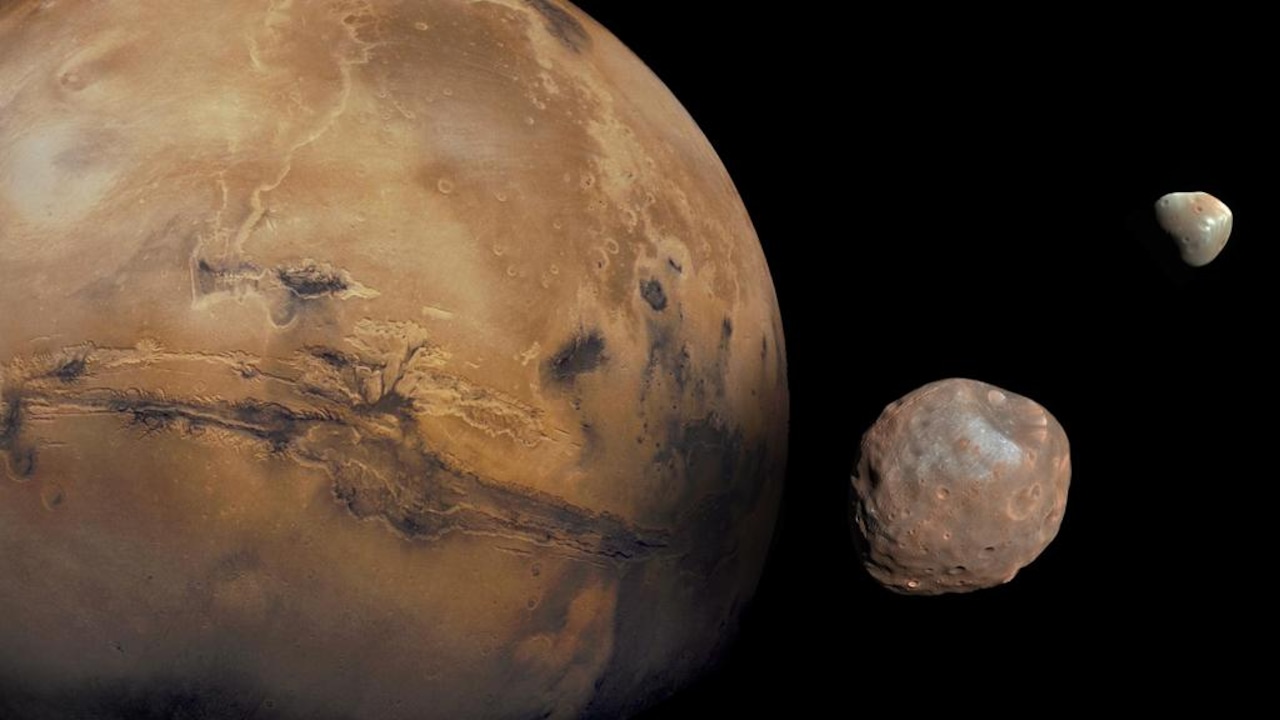
The second-closest planet to Earth is about to pass through a beehive in the sky — a beehive of stars.
Starting Thursday, Mars should be seen passing through the Beehive star cluster, according to the Old Farmer’s Almanac. The best time to see the red planet pass through the stars is two hours after sunset on Friday, May 2, according to the space website When the Curves Line Up.
The star cluster, also known as Messier 44, is typically best seen during the spring night sky toward the constellation Cancer, according to NASA. The Beehive is made up of around 1,000 young stars that are all loosely connected by gravity. These stars, between 600 and 700 million years old, are considered young in contrast to the Milky Way Galaxy, which is 4.6 billion years old.
Mars can be seen with the naked eye, though binoculars can be used for a closer look as it passes through the star cluster, according to When the Curves Line Up. While the moon is expected to be over 30% illuminated, some stars in the cluster could be washed out.
If stargazers cannot see Mars make its passage, they will get another chance — but will have to wait a while. Mars infrequently passes through the star cluster every year, either in the spring or fall. The red planet’s passage through the cluster should happen again starting Oct. 11, 2026, When the Curves Line Up wrote.
The famed astronomer Galileo took the first telescopic view of the star cluster in 1609, EarthSky reported. Using a paper tube and two pieces of glass, he counted 40 stars. Over a century later, astronomer William Messier added the cluster to his catalogue of nebulous objects in the sky, resulting in its scientific name.