
BOSTON — Throughout the course of modern baseball history, countless players have bet on themselves by going year-to-year with their salaries and eventually cashing in via arbitration and free agency. Kristian Campbell did the opposite earlier this week.
Campbell, just five games into his major league career at age 22, locked in the finances of the next decade of his career when he agreed to an eight-year, $60 million extension that can max out at $96 million over 10 seasons due to club options in 2033 and 2034.
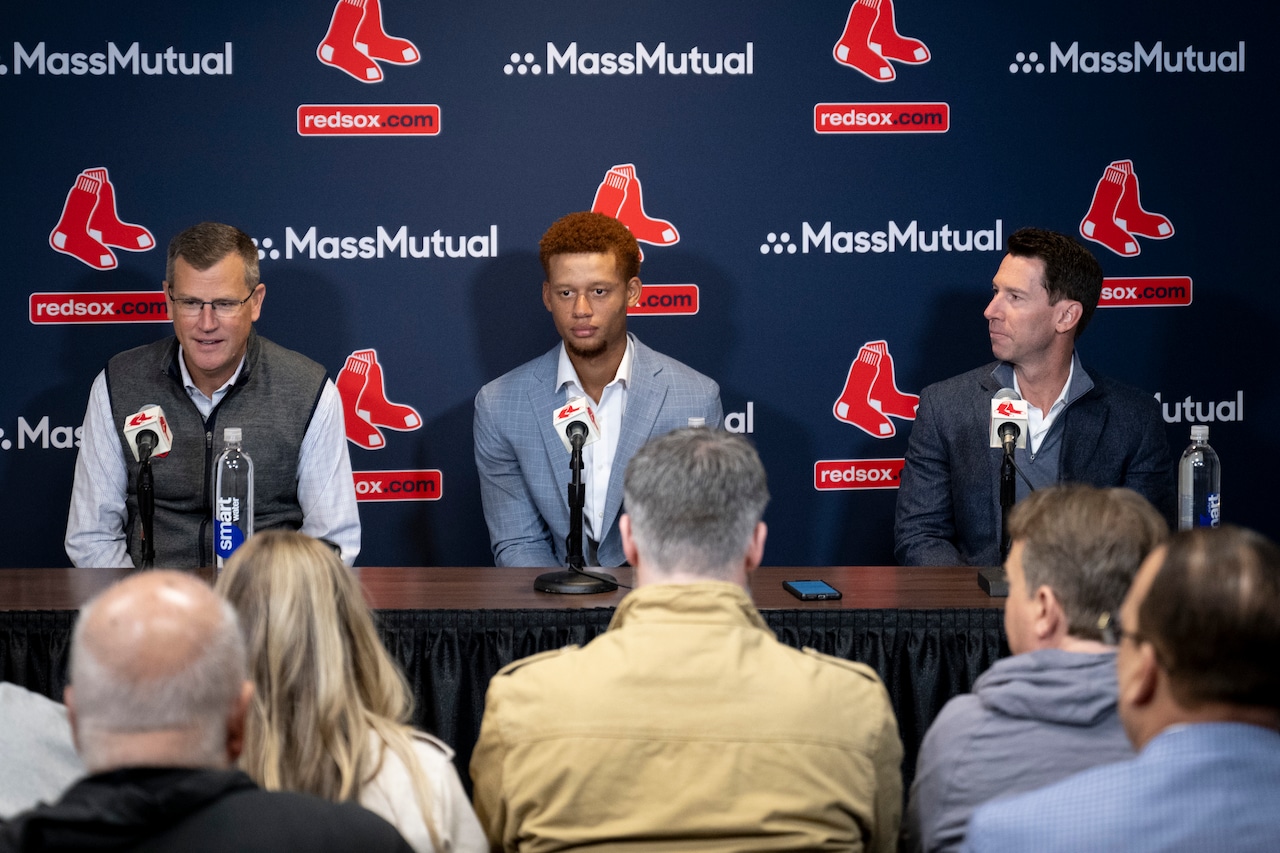
Not every rookie with as much upside as Campbell would have taken that deal if offered, but he did. On Saturday, during a press conference to celebrate the agreement with his family on hand, the rookie explained why.
“I was educated throughout this whole process. It was just a life-changing opportunity for me and my family. Can’t pass on that,” Campbell said.
Campbell’s well-documented story isn’t one of a blue-chip prospect who has always been destined for greatness. Instead, he was undrafted as a high schooler in 2021, given a redshirt as a Georgia Tech in 2022 and drafted in the fourth round by the Red Sox in 2023. A year ago, he was a relatively unknown High-A player before a phenomenal minor league season across three levels put him at the top of prospect charts and, soon thereafter, on the major league roster.
The Red Sox, like teams throughout baseball want to capitalize on the inherently team-friendly nature of early extensions, have tried to aggressively pursue similar deals with multiple young players. Some, like Campbell and Ceddanne Rafaela (who got $50 million after just 28 big league games) have engaged. Others, to this point, have not. Individual players make individual decisions based on individual circumstances.
“You’re not in their shoes and I’m not in their shoes,“ said manager Alex Cora. ”We know their background, but obviously they know more, and the reasons they’re doing it. Some people agree with it. Others don’t. At the end of the day, it’s what makes you happy and makes your family happy. I think his family and his future are in a really good spot.”
For the Red Sox, offering Campbell a long-term deal with a relatively low average annual value ($7.5 million for competitive balance tax purposes) was an easy call, not just because of his upside as a player but also his rise as a standout citizen in the organization.
“From a baseball sense, teams are getting better and better at forecasting what players are able to accomplish. But… these are investments not just in a set of skills or metrics or batted-ball profiles. These are investments in people,“ said chief baseball officer Craig Breslow. ”Sam talked about Kristian’s humility and our coaching staff knows him incredibly well and saw the adjustments he was able to make throughout a season. This is a guy who hours after playing his last game in the minor leagues last year was going to Fort Myers to start his offseason training. He’s the type of guy you feel really, really comfortable making a bet on.”
On Saturday, one day after holding a press conference for Garrett Crochet’s six-year, $170 million extension, the Red Sox were once again in a celebratory mood.
“Here we are today sharing what I would call a massively significant moment for this organization because Kristian was not drafted in the first round, he wasn’t a top prospect upon entering the organization. What he was, was a good player who made himself a great player because of his work ethic, diligence, open-mindedness and attitude,” Breslow said.
“Rather than use my own words to try to provide context around this decision and the extension, Kristian, you said it best,” Breslow added. “When asked whether or not this was a difficult decision, you said that this is the organization that invested in you, this is the organization that helped you become the player that you have. At the end of the day, this was an easy decision for you. I’m not sure there’s a better endorsement of what we’re trying to build here in Boston.”