

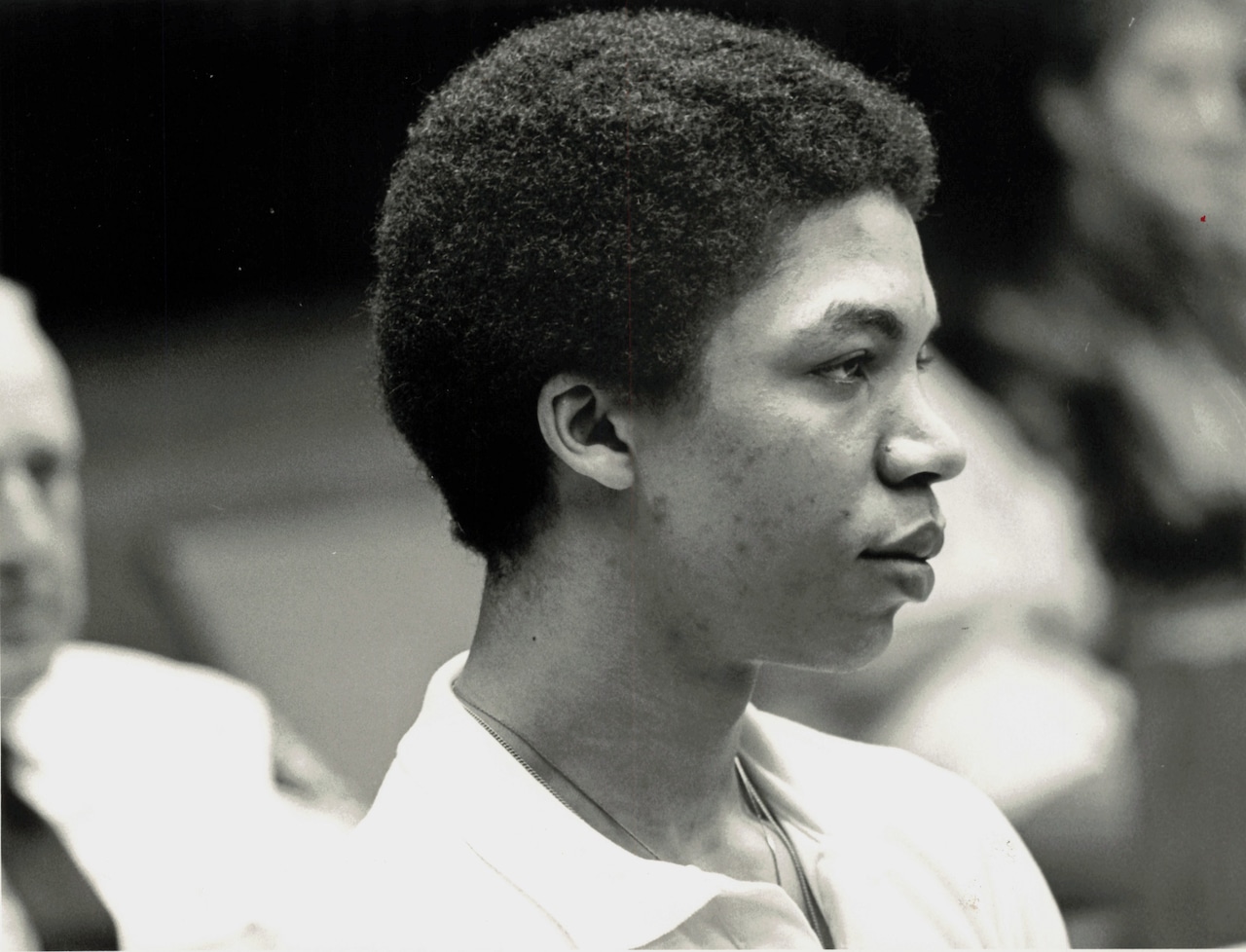
SPRINGFIELD ― Edward Wright has spent four decades behind bars, dreaming of the day he might walk free.
On Friday, that dream edged closer to reality as Hampden Superior Court Judge Jeremy Bucci overturned Wright’s conviction, citing hidden evidence and new DNA tests proving Wright’s innocence, the New England Innocence Project shared on Wednesday. However, the Hampden District Attorney’s Office said it has filed an appeal and is ready to defend the integrity of the original conviction.
Dancing in a cell
At 22, Wright was convicted by an all-white jury and sentenced to life without parole for the first-degree murder of his friend Penny Anderson on April 11, 1985.
“There is bitterness for all the years I’ve lost in prison, but also sweetness in the possibility of freedom,” Wright said in a statement Wednesday.
Wright, who turned 63 in November, at first was stunned by the judge’s decision, said Radha Natarajan, executive director of the New England Innocence Project and one of Wright’s attorneys.
Her office received the decision by email on Friday and delivered the news to Wright, marking the 40th anniversary of his wrongful conviction.
“He has tried five other times to overturn his conviction, and there was evidence before that someone else committed the crime,” Natarajan said.
While the legal agency had faith in its recent motion to the court, Natarajan noted that Wright didn’t want to get his hopes up. “What he was feeling is ‘I felt good about it before,” she said.
By the end of the conversation, Wright told the legal team he would read the decision again with his glasses and dance about the good news when he returned to his cell.
“To imagine him, having for the first time something to dance about, was pretty profound,” she said.
A press conference on Thursday will outline the next steps to bring Wright home to his family.
Natarajan said it will begin with filing a motion for Wright’s release, which might take weeks to go before a judge.
In a statement, Hampden District Attorney Anthony D. Gulluni expressed strong disagreement with the judge’s decision, and announced that his office has filed an appeal. He emphasized his office’s commitment to upholding the conviction.
“We stand by the integrity of the original prosecution and the many judicial reviews that this case has already received over the past four decades,” he said. “The murder of Penny Anderson in 1984 was a senseless and tragic act of violence that tore a family apart and shook a community.”
Wright got a fair trial in 1985, Gulluni said. He noted that Wright’s conviction was upheld repeatedly by the Trial Court and the Supreme Judicial Court.
Wright has pursued numerous motions, petitions and appeals, all denied, Gulluni said. The Supreme Judicial Court has rejected his arguments multiple times, he said.
“Despite this, a Trial Court judge has now granted a new trial, based largely on the same arguments that have been examined and rejected by courts with appropriate appellate jurisdiction,” Gulluni said.
Gulluni said his “office remains committed to ensuring justice is both served and preserved.”
The night Anderson died
Anderson, 24, was found on May 14, 1984, inside her Dwight Street Extension apartment, bound and stabbed more than 60 times, while her 1-year-old son was crying in a crib in the next room, according to evidence presented in court.
Prosecutors claimed that Wright and Anderson, an exotic dancer at Club 418 on Worthington Street, left the club and returned to her apartment. They alleged that during the evening, Wright tied her up and stabbed her multiple times.
Evidence at the time indicated that Wright’s shoes matched bloody footprints found in Anderson’s apartment. Additionally, blood was discovered inside a car he drove to Wilmington, Delaware, where he was picked up five days later.
A witness during the trial said they saw Wright entering the apartment building with Anderson. A neighbor who testified said they heard someone screaming “please don’t do this anymore” and asking someone to call the police the night of the murder.
Another witness, Arthur Turner, who knew Wright, said during a phone call that Wright said he “killed a white girl.”
During the trial, Wright testified that Anderson was alive when he left her apartment that morning. He said they left the club together after she got into an argument with an unidentified man.
New trial denial
For the last 40 years, Wright maintained his innocence and filed five motions to request a new trial — in 1985, 1992, 1997, 2003 and 2014. All were denied.
Wright’s sixth request for a new trial was filed on Oct. 2, 2023, International Wrongful Conviction Day.
At that time, court papers said DNA from neither Anderson nor Wright was found in a hair on Anderson’s shirt when her body was recovered. There also was DNA from someone else on Anderson’s pants and on a pillow found at the scene.
Lawyers argued that Anderson had stabbed her child’s father during an argument less than two weeks before her murder, giving him motive and opportunity. However, police did not check his alibi the morning after the murder.
Wright’s attorneys didn’t learn of the earlier stabbing until 2021, and it was never presented to the jury.
In 1986, when Wright requested a new trial, his lawyer introduced a statement from a West Springfield mother, claiming her son, Allen G. Smalls, had confessed to the murder. Smalls, who was the victim’s ex-boyfriend, is now deceased.
Wright sought a new trial in April 2014. In a brief filed in June 2013, Wright’s lawyers argued there was credible testimony from a witness that Smalls killed Anderson in a fit of jealousy.
Evidence also showed that Smalls had threatened Anderson, lied about his alibi, attempted to sell a knife the day after the murder and confessed to the crime twice.
Then, former District Attorney Mark G. Mastroianni argued the basis for Wright’s seeking a new trial was not new, and there was no reason to grant a new trial.
“The legal system failed Wright when he was wrongfully convicted in 1985. Then it failed him again and again, over many decades,” said Nigel Tamton, Wright’s lawyer, in a statement.
Tamton said that while the system is imperfect, it requires allies, legal advocates, and especially committed individuals like Wright who relentlessly seek justice despite the obstacles.
In Wright’s latest request for a new trial, he introduced previously unheard evidence revealing that the commonwealth had withheld crucial information from him for 36 years.
One piece of evidence was a police report about a break-in at the victim’s apartment while it was still an active crime scene. This break-in led to the contamination of key evidence used against Wright.
New DNA testing showed that Wright was not connected to several pieces of evidence from the scene, including a bloody washcloth and a partial bloody Nike shoe print on a tile.
The shoe print wasn’t noticed or collected until after the break-in, Natarajan said.
Forensic experts have since confirmed the evidence used against Wright at his trial was unreliable.
The police officer who testified about collecting the evidence also gave false testimony, she said.
“That police officer blatantly lied to the court, because he knew there had been a break-in, but he testified there were only police officers there,” she said.
Lawyers only discovered this after receiving the police file for the case in 2021, she said.
Additionally, every Black male juror was excluded from the jury, and the prosecution used racial stereotypes during the trial. These factors are known to increase the risk of wrongful conviction, the Innocence Project said Wednesday.
For over 40 years, the state concealed key evidence and falsely informed the Supreme Judicial Court there was no evidence of a break-in, said Wright’s attorney from the New England Innocence Project, Stephanie Hartung.
On Friday, Bucci acknowledged that there was “no credible evidence” of Wright having a motive and that the case against him was “circumstantial and not overwhelming.”
Wright, who has been married since 2009, looks forward to living freely with his wife and family, with whom he remains in close contact.
Wright is the youngest of eight siblings in a close-knit family. At least three of his siblings and his mother have passed away and will not be present to see him exonerated one day, Natarajan said.
While in prison, Wright learned the legal system in prison and used his knowledge to help others challenge their convictions and improve prison conditions, including access to mail and medical food, Natarajan said.
After winning a judgment against the Department of Correction for civil rights violations, Wright used the money to pay for his own DNA testing to help prove his innocence.
“Eddie is an inspiration. For 40 years, he has endured unimaginable injustice. He has responded with positivity and humanity. Through it all, he lifted others, stood firm in his truth, and never gave up the fight. That fight is not yet over, but today we celebrate a victory — hard-fought and long-overdue,” said Isaac Saidel-Goley, Wright’s pro bono attorney.




