HAMPDEN — A proposal to bring municipal fiber to the town failed by four votes, following a months-long lobbying effort by a firm funded by Charter Communications and Spectrum, which provides cable and internet services to the town.
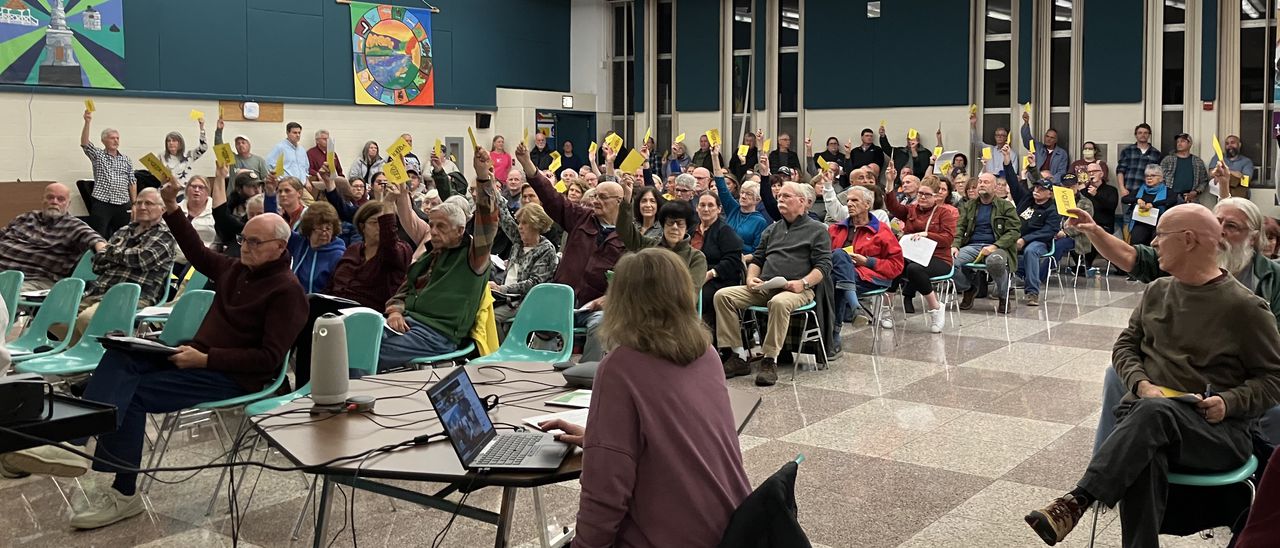
The Town Meeting vote asked residents if they were willing to bond up to $8.5 million to create a fiber optic infrastructure in town through the nonprofit Westfield Gas & Electric. The issue brought a standing-room-only crowd to the Thorton Burgess School Monday night.
More than half the people who spoke said they felt the proposal was a good deal that would create competition to Spectrum, a division of Charter Communications. But others said they felt it was not worth the risk of saddling the town with a hefty bill taxpayers may be left to pay if the venture fails to pay for itself.
Two-thirds, or 137, of the 205 Town Meeting members who attended had to approve a bond. The vote was 133 in favor and 72 against. Those attending the meeting via Zoom were not allowed to cast ballots.
The issue can be returned to Town Meeting in the future, the moderator said.
“I want to be cautious,” said Jacqueline Fournier, who said she had no complaints with Charter. “I want a good system that won’t go up every year.”
Nonprofit utility’s role
After bringing fiber optic internet access to its own city, Westfield Gas & Electric started branching out, first offering the same service to small towns in the Berkshires and Hilltowns that had little or no residential internet service.
Using the name Whip City Fiber, it has expanded to some 20 communities and is now venturing into others, such as West Springfield, that already have cable and broadband service but want an alternative to the large companies frequently criticized for poor customer service, said Thomas Flaherty, general manager of Westfield Gas & Electric.
In each case, the community pays to wire the city with fiber optic cable and owns the infrastructure. Westfield Gas & Electric provides the staffing to wire the community, connects it to individual homes and then serves as the internet service provider, including doing the billing, system maintenance and making service calls, he said.
The vote to bond up to $8.5 million was to build the infrastructure. Hampden Selectman Craig Rivest explained that the town is eligible for federal and state grants to defray the costs. The process to study if it was possible to bring Whip City Fiber to Hampden was entirely paid for with a grant of about $200,000.
“I understand [that] when you listen to it, $8.5 million is a scary number. But the concept of this is to run municipal fiber … paid for by subscribers with an enterprise account where revenues collected will be used to pay off the bond for the maintenance and upgrades to the system,” he said.
The town had no plan to borrow the money all at once. It may not need all of it, since plans call for the fiber to be laid in stages over three to five years. As the first fiber neighborhood is built, and residents start subscribing, proceeds from the fees would be used to defray costs in the next stage, he said.
The project would have made the town eligible to apply for grants, including through the Massachusetts Municipal Fiber Program which is accepting applications in March, Rivest said.
The numbers
Under the proposal, it would cost Hampden $631,121 a year to pay for the full bond and the service charge to Whip City Fiber. If 50% of the 1,980 potential households sign up for fiber services, the estimated annual income would be $677,160.
Because Whip City Fiber is a nonprofit, the remaining proceeds of about $25,600 would be returned to the Hampden general fund, Rivest said.
Town Treasurer Richard Patullo, who called himself the local curmudgeon, said even when doing calculations conservatively, he figured residents would save money with the nonprofit Whip City Fiber.
Now, the town’s roughly 2,000 households pay about $4 million a year in fees to Spectrum, Patullo estimated. When that is considered, an $8.5 million buildout doesn’t seem as expensive, he said.
Patullo said he now pays about $200 a month for cable services through Spectrum and would pay an estimated $85 for fiber, plus a fee for a television streaming service. Even if 40% of residents signed up for the new service, instead of 50%, and the town added about $49 a year to people’s tax bills, Patullo said he figured he would still come out ahead.
“I think there is enough margin for error even if you are a pessimist like me and the grants don’t come in and the ‘take rate’ is a little low,” he said. “I think this is the only way we are going to keep the monopoly from charging whatever they can.”
Dave Hayward, who served on the town’s fiber optic committee, said he was shocked to see how many fliers and postcards he received urging him to vote no.
Then one day, someone from the Alliance for Broadband, the lobbying group for Charter, knocked on the door of his home, which is so far from the street he has never seen a trick-or-treater.
“I realized, holy cow, this is really a hot issue,” he said. “There is a possibility we will not have any cost at all. There is plenty of state money here and I would hate to see that pot go away.”