

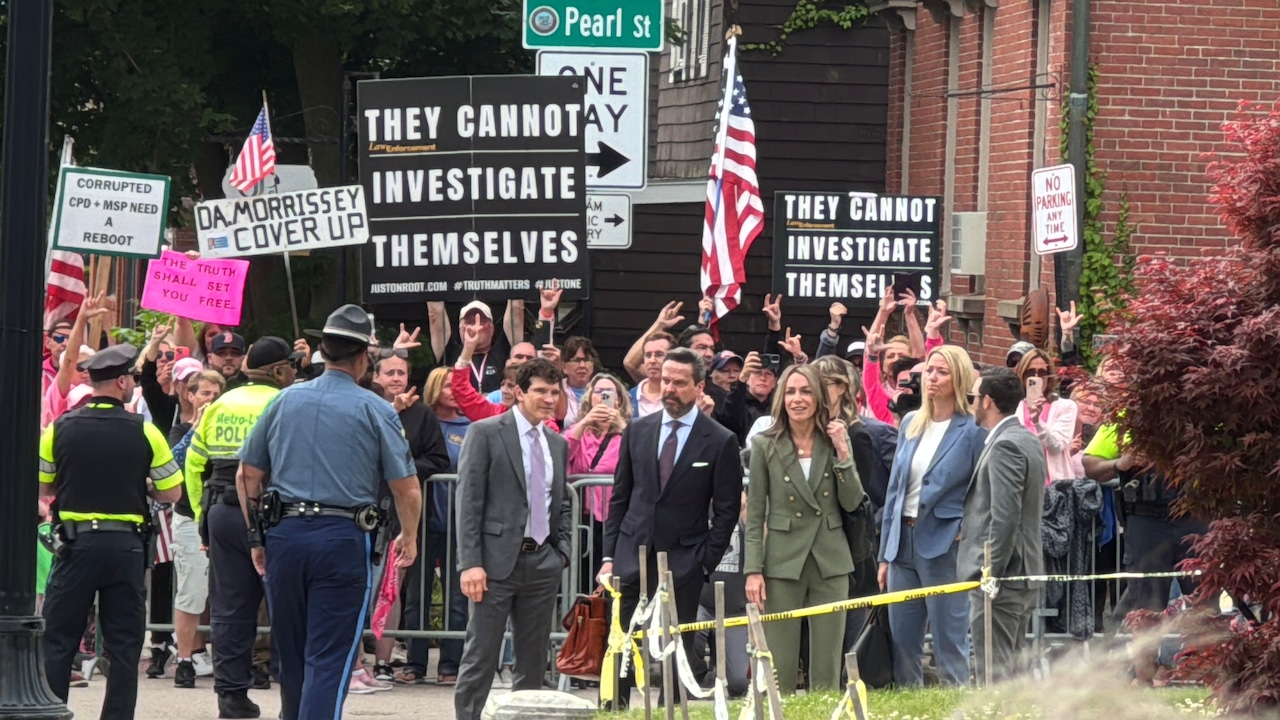
At a series of pretrial hearings, Karen Read’s defense team fought bitterly to be able to pursue a theory it had suggested for years: that her boyfriend, John O’Keefe, was beaten up inside a Canton home before his body was placed on the front lawn.
But when Read’s retrial arrived, her defense largely abandoned the third-party culprit strategy that was at the center of her first trial. Instead, her lawyers cast blame toward investigators for failing to look at whether anyone other than Read could be responsible.
The shift was most evident in the closing argument delivered by Alan Jackson, who was Read’s lead defense attorney. And it may well have been the key difference that led to Read’s acquittal on the three most serious charges she faced.
During the first trial, he returned over and over again to the theme of “look the other way.” He argued that the series of witnesses called by the commonwealth were asking jurors to disregard some of their own suspicious conduct, like destroying cell phones or “butt dials” in the middle of the night.
But at the second trial, Jackson’s opening salvo struck a different tone: “There was no collision.”
Daniel Medwed, a law professor at Northeastern University, called it a “classic reasonable doubt defense.”
“In the first trial … the defense probably went for a home run,” he explained. “It’s a good example for lawyers to look at … sometimes less is more, and sometimes throwing everything in, including the kitchen sink, doesn’t help.”
Jackson’s hour-long closing argument at the first trial focused less on the evidence that Read didn’t hit O’Keefe with her car, and instead on the evidence the defense said showed O’Keefe went inside the Canton home he was found dead outside of. But this time, 34 Fairview Road, and its occupants, were more supporting characters in his closing argument.
Instead, Jackson literally stacked cards of reasonable doubt for the jury on the in-court televisions. He told the panel that unanswered questions they may have about the case represented the reasonable doubt that prosecutors could not overcome.
The defense may have benefited, in some regard, from the decision by the prosecution not to call any of the people it suggested could have been responsible for Read’s death. Read’s defense could have called any of them, or the lead investigator, Michael Proctor, but opted not to.
Instead, they served as “elephants in the courtroom,” said Medwed.
That left the jury with enough evidence to create enough doubt to lead to an acquittal, but not so much that they may have been overwhelmed.
Shira Diner, a professor at Boston University and the president of the Massachusetts Association of Criminal Defense Lawyers, said Read’s defense was very effective at laying out for jurors that they had no obligation to prove to them how O’Keefe died.
“The Commonwealth and only the Commonwealth have the burden of proving that the death occurred in the manner they claim. In trial 2, they were unable to meet that burden and that means [the] defendant is not guilty,” she wrote.
Indeed, Medwed said the defense strategy at the first trial may have been trying to offer some explanation to jurors whose first instinct may be to determine who, exactly, was responsible for O’Keefe’s death if not Read.
Retrials are generally seen as beneficial for the prosecution, which can alter its strategy based on what did and didn’t work the first time around. And to be sure, prosecutors altered their strategy: the district attorney hired a special prosecutor who brought on new experts and called far fewer witnesses.
But Read’s defense likely benefited even more.
“The defense just kept coming back to those basic questions. It’s almost like a simple equation: if you’re not sure the car hit him and you’re concerned about the police missing things, then [she’s] not guilty,” Medwed said.
And it was Read’s lawyers, not the prosecution, who asked for the inclusion of lesser included charges for the charge of manslaughter while operating under the influence, which included the simple misdemeanor OUI charge Read was ultimately convicted of.
Medwed said the decision to include the OUI charge was “genius,” even though it led to a conviction. He called it a “mercy verdict” for situations where jurors are split on the most serious crimes, but still feel they should hold the defendant accountable for something.
“If you feel like Karen Reed did something wrong that night, here’s the perfect charge,” he said.




