

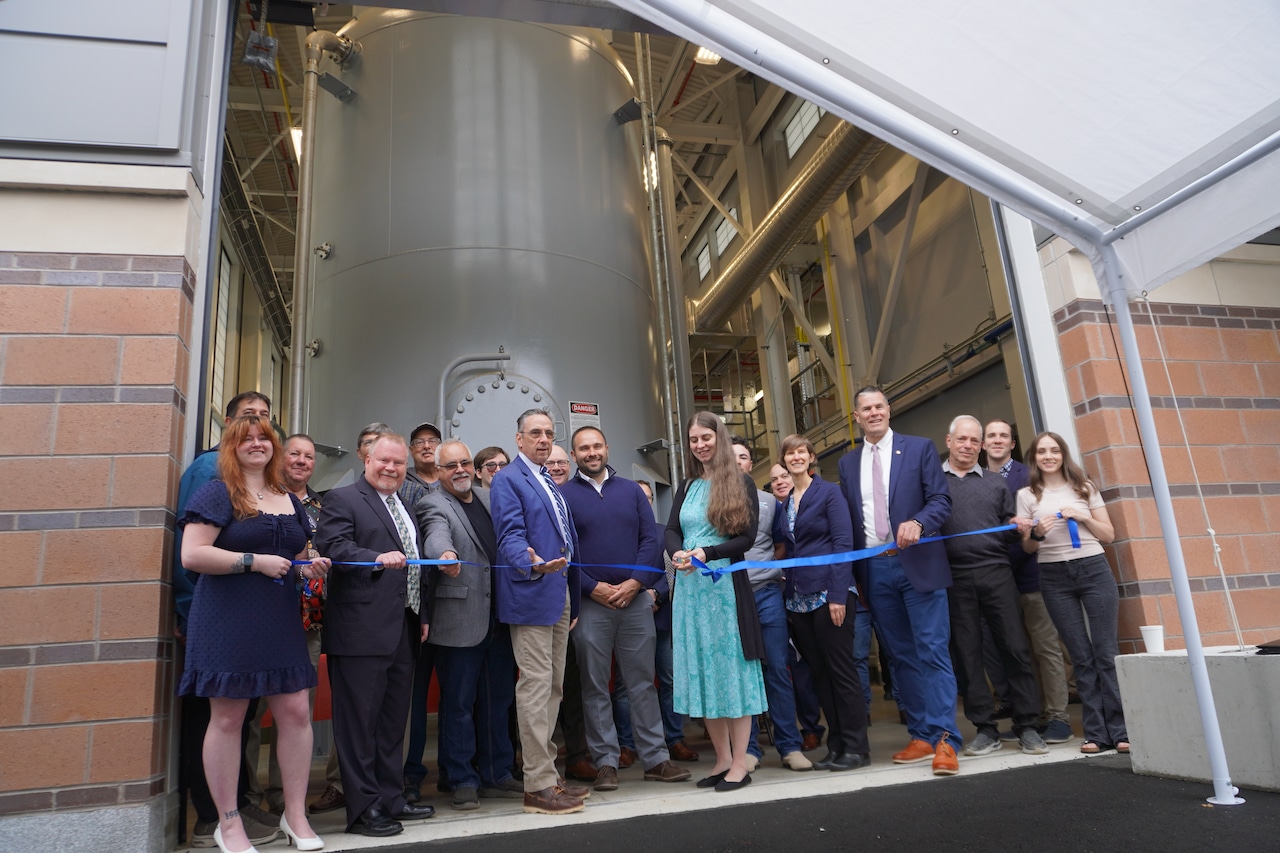
WESTFIELD — While the Dry Bridge Road Water Treatment Plant has been operational for nearly a year, on Friday, city and state officials joined the representatives of firms that designed and built the plant to formally dedicate what the mayor called a “state-of-the-art” facility.
“This is state-of-the-art and has been recognized nationally and on the state level as the model for the nation,” Mayor Michael McCabe said before a ribbon-cutting ceremony to dedicate the facility.
The treatment plant at 99 Dry Bridge Rd. was built to filter water from Wells 1 and 2 to response to the discovery of PFAS in the groundwater of the Barnes Aquifer.
With a capacity of 3.75 million gallons per day, it can treat up to 2,600 gallons per minute to ensure the quality and reliability of the city’s drinking water, especially on the city’s north side, according to information provided by the city.
The plant uses Granular Activated Carbon — 40,000 pounds of it contained in four tanks — to provide disinfection, corrosion control, and pH adjustment needed to meet or exceed all local, state, and federal guidelines for drinking water. The project was funded through the State Revolving Fund loan process administered by the Clean Water Trust, according to the city.
During the ceremony, McCabe recognized the city’s interim DPW Director Francis Cain for his leadership over the last several years.
“Thank you, Fran,” McCabe said, adding that it was Cain’s “foresight and vision” that made the treatment plant a reality.
McCabe also recognized the city’s Water Systems Engineer Heather Stayton for her efforts on the project.
“[She] also had her hand in it,” McCabe said.
Cain said the ceremony was to acknowledge “all we’ve accomplished over these many years in trying to solve some of our problems … I think we’ve done a great job at that,” Cain said.
He also recognized the city’s Water Commissioners, Ronald Cole, John Niedzielski, and Joseph Popielarczyk, McCabe, state Rep. Kelly Pease, and the City Council.
After the ceremony, City Councilor Ralph Figy said the water treatment plant construction projects “began with the easiest vote I ever took … the $30 million was a no-brainer”
He also said that there should never be any “politicization of a health issue.”
Cain also recognized the efforts of the engineering firm Tighe & Bond for designing the facility and Daniel O’Connell’s Sons for building it.
Tighe & Bond Vice President and Design Manager Christopher Bone spoke briefly during the ceremony.
“The city has been a great partner,” Bone said about the “hugely important project” and the proximity to its headquarters to the treatment plant.
“We drink the water from these wells,” Bone said.
After PFAS was first discovered in 2013, Wells 7 and 8 were closed in late 2015 and early 2016, though they have since reopened when the Owen District Water Treatment Plant became operational in 2020. The Dry Bridge plant uses the same filtration technology.
PFAS contamination has only been found in four wells — 1, 2, 7, and 8 — north of the Westfield River, It has not been detected in water supplies south of the river.
With the filtration systems in place, Westfield’s drinking water is safe, the federal report concluded. Water samples collected in 2019 were within the public health guidelines set by the federal Environmental Protection Agency and state Department of Environmental Protection, according to the city.




