
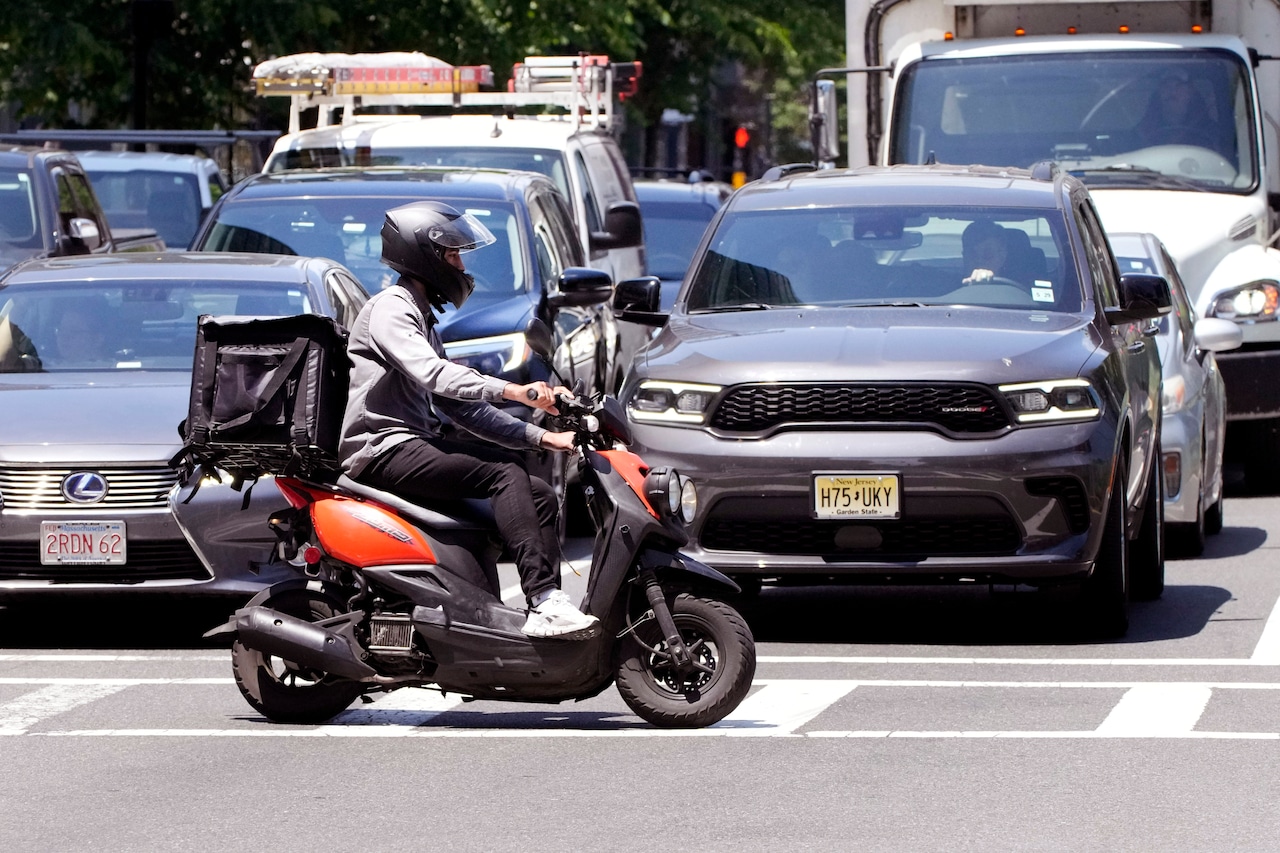
Nearly a third of DoorDash orders in Boston are delivered by drivers riding on scooters, bikes and other two-wheel vehicles, according to data released by the company as Boston weighs firm new regulations on food delivery operators.
At 32%, Boston ranked 14th among American and Canadian cities in its share of food deliveries carried out on two wheels, the data showed.
From one perspective, Boston trailed cities such as New York City, Washington, D.C., Philadelphia and Toronto in its share of two-wheel deliveries. But from another, Boston led many other comparable metros. Excluding California, home to nine of the top eleven cities on DoorDash’s list, Boston placed fifth in the country by frequency of two-wheel deliveries.
However, the data may be skewed by when it was sampled: over four weeks in late summer last year. In Boston and other cities with variable seasons, the share of drivers on scooters or bikes may fall as winter sets in. San Francisco led DoorDash’s list, with 76% of orders delivered on two wheels.
In Boston, delivery drivers have come under increasing scrutiny from city officials and police over what they describe as rampant motor vehicle violations, from ignoring traffic signals to double parking and blocking city streets.
Last month, in announcing an effort to more strictly regulate delivery companies, Boston Mayor Michelle Wu said the city had fielded complaints of drivers on mopeds skipping through red lights, riding on sidewalks, weaving around other cars, and traveling against the flow of traffic.
An ordinance filed by the mayor with the Boston City Council would require delivery services like DoorDash, Uber Eats and GrubHub to obtain permits to operate in Boston.
Doing so would require the companies to hold liability insurance for their drivers and provide the city with data on the types of vehicles drivers operate and the speeds at which they travel.
“The price of convenience cannot be fear, injury and chaos on our streets,” Boston Chief of Streets Jascha Franklin-Hodge said at a February press conference announcing the ordinance.
Perhaps unsurprisingly, the delivery companies have opposed efforts to stiffen regulations.
DoorDash released its report on two-wheeled vehicle deliveries in late February, arguing that mopeds, bikes and other car alternatives help curb carbon emissions and street congestion and are more affordable for drivers.
Since 2022, DoorDash said it has tripled the share of deliveries using two-wheel vehicles in the United States and Canada.
Uber said on Tuesday that it had urged thousands of Uber Eats drivers in Boston to contact their city councilors ahead of a discussion planned for Wednesday on the mayor’s proposal.
“If it passes, Uber may have to stop sharing delivery offers with couriers that use bikes, e-bikes, and motorized scooters — pushing all delivery offers to only couriers in cars,” the company warned in a statement.
“It was just a few years ago that the City of Boston asked Uber to encourage the use of two-wheeled delivery vehicles to decrease the number of cars on the road in response to an increase in demand for food delivery,” Uber added in its statement, accusing the city of “pulling the rug out from under” delivery drivers.
Uber also said it was “eager” to work with city officials on “realistic, actionable steps to improve road safety.”
In its report, DoorDash said that along with reminding drivers of local road regulations, it was committed to working with cities to improve safety in the busiest neighborhoods as its presence there grows.