

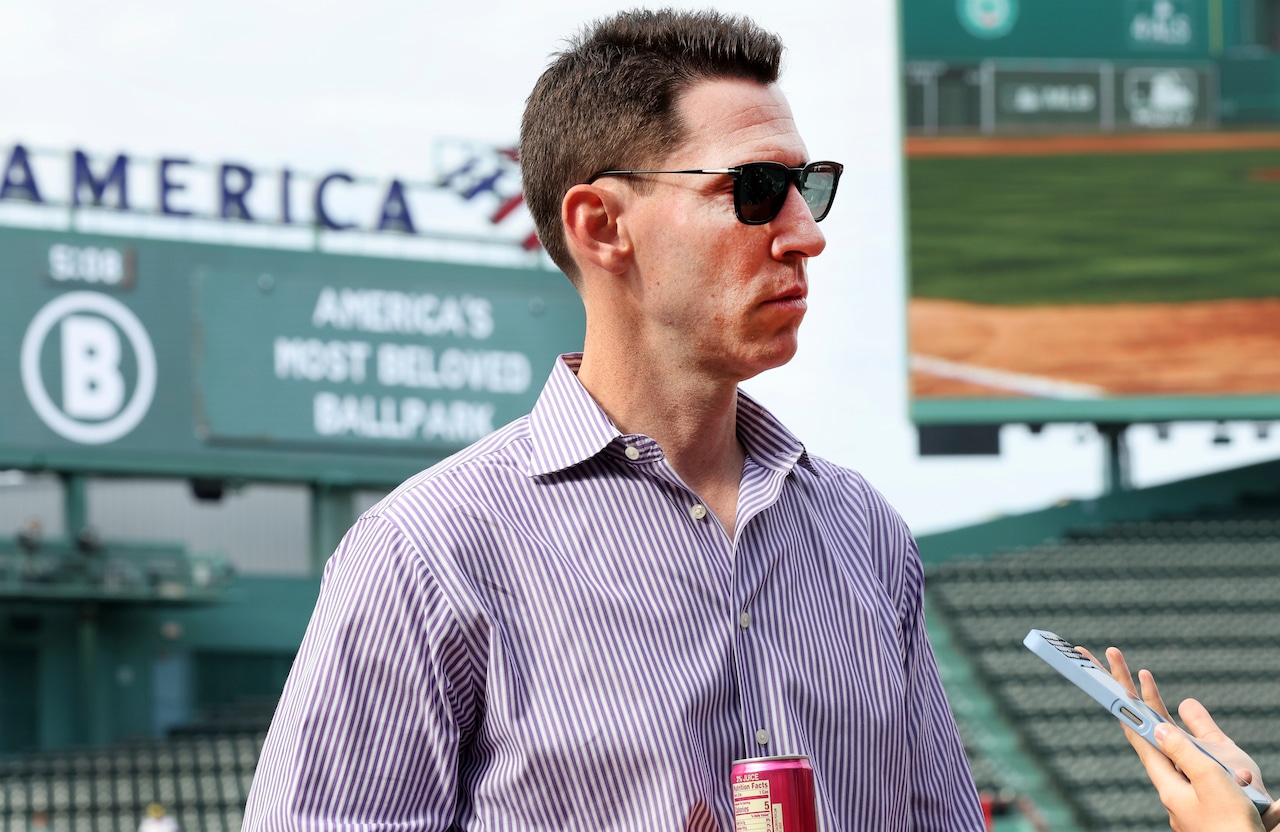
BOSTON — As he approached his first trade deadline as chief baseball officer of the Red Sox a year ago, Craig Breslow preached the importance of “picking a lane” and not straddling the fence between buying and selling.
What about this year, with a club that has soared to a 50-45 record thanks to a seven-game winning streak?
“I think that’s still the clearest way to approach a deadline,” Breslow said. “I’ve obviously learned a lot over the last year. We’ll continue to learn. But we came into this season and we’re approaching this deadline as looking for opportunities to improve the club.
“We still have to understand what happens over the next three weeks, but that is how we’re approaching this deadline. We want to improve the team. We want to find ways to bolster the group. The play on the field exemplifies that. We’ve obviously put ourselves in a pretty good spot here with the way that we’ve been playing over the last few weeks and have reason to believe that we can continue that.”
Barring an unexpected collapse over the next few weeks, the Red Sox intend on being buyers ahead of the July 31 deadline. The blockbuster Rafael Devers trade, while weakening the current roster, was much more about improving the team’s culture than signaling a direction from the front office. Now, the focus is on adding to a club that is in sole possession of a wild card spot and five games back in the division with three games to go before the All-Star break.
Breslow will consider additions to the front end of his rotation, the bullpen and potentially, first base, he said.
“Some of that (your needs) often depends on what moment in time you ask the question,“ he said. “I think if we’re going to boost the rotation, trying to find impact starting pitching, not just, starting pitching that can take a spot in the rotation. We do feel really good about the depth that we have. At one point, we would have said, ‘Our first baseman is out for the year.’ But then you look at what (Abraham) Toro and Romy (Gonzalez) have been able to do platooning over there and that’s the equivalent of a really good first baseman. We’ll be open-minded but based on the performance we’re getting right now, I don’t think it’s a massive, glaring hole.”
The Red Sox could use a high-leverage arm or two to set up closer Aroldis Chapman but Breslow hinted that some relief help could come from within as the Red Sox consider shifting starters to a bullpen role. Doing that with Tanner Houck, who is nearing the end of his minor league rehab assignment, remains possible.
“You can never have too much pitching,“ Breslow said. ”Some of this is, as guys get healthy, talking about Tanner and (Hunter) Dobbins and (Richard) Fitts and (Kyle) Harrison, and how do we figure out who we want to keep built out as starting pitching depth and who we think might be a weapon in a multi-inning role out of the ‘pen.”
In 2024, after committing to buying, Breslow made four measured trades to add to his big league group by acquiring pitchers James Paxton, Lucas Sims and Luis García and catcher Danny Jansen in exchange for minor leaguers (while also making an outlier, long-term move by flipping Nick Yorke for Quinn Priester). Breslow made a point of not moving anyone off his major league roster in an effort to improve. This time around, the roster — with too many outfielders for spots — suggests a deal in which Breslow moves a big league piece in order to improve another area of the roster is more likely than it was a year ago. But it’s far from a fait accompli that a young outfielder like Jarren Duran or Wilyer Abreu is moved for pitching, especially with the Red Sox beginning to mix in Ceddanne Rafaela at second base in an effort to maximize their lineup.
“When you have four guys that are capable of playing every night in three outfield spots, it just means that you’ve got a weapon on your bench,” Breslow said. “It’s an opportunity to keep guys fresh and shift and cycle through getting guys in and getting guys rest. Alex (Cora) manages games very aggressively and finds opportunities to pinch-hit and find great matchups. I’ve said this every time I’ve been asked: There’s no such thing as having too many good players. That’s not actually a problem.”
The recent seven-game run, which has moved Boston’s chances of making the playoffs to 40.5%, according to FanGraphs, has only made Breslow more convicted in his want to add.
“I think you could see, at various moments, glimpses of what we’re capable of doing, but we hadn’t been able to put it together for a stretch,” he said. “Now, these wins are starting to compound… and we’ve actually put together a solid run. We’re going to see coming out of the deadline how we stack up against the best teams in the NL. I think that’ll be important for us to go out and prove to ourselves, ‘Hey, we can compete with these guys.”
After a busy — yet largely unsuccessful — first deadline at the helm, Breslow is excited to enter his second go-around with a more experienced perspective.
“What I learned is you spend a lot of time working on ideas and concepts that never actually get across the finish line,“ he said. ”Approaching this deadline, we need to narrow the lens a little bit and focus on the things that make us better and have a realistic chance of getting done, not spend all of our time chasing these pie-in-the-sky type ideas.”
If you purchase a product or register for an account through a link on our site, we may receive compensation. By using this site, you consent to our User Agreement and agree that your clicks, interactions, and personal information may be collected, recorded, and/or stored by us and social media and other third-party partners in accordance with our Privacy Policy.




