

Improving the struggling Boston Public Schools system will be among the tallest of tasks for whoever is elected mayor in November.
The district spent three years on an improvement plan after state officials in 2022 found persistent patterns of dysfunction in the district’s management, from unreliable buses to lagging facilities upgrades to inaccurate graduation and dropout data.
The agreement expired at the end of the past school year, with some issues still unresolved, the Boston Globe reported in April.
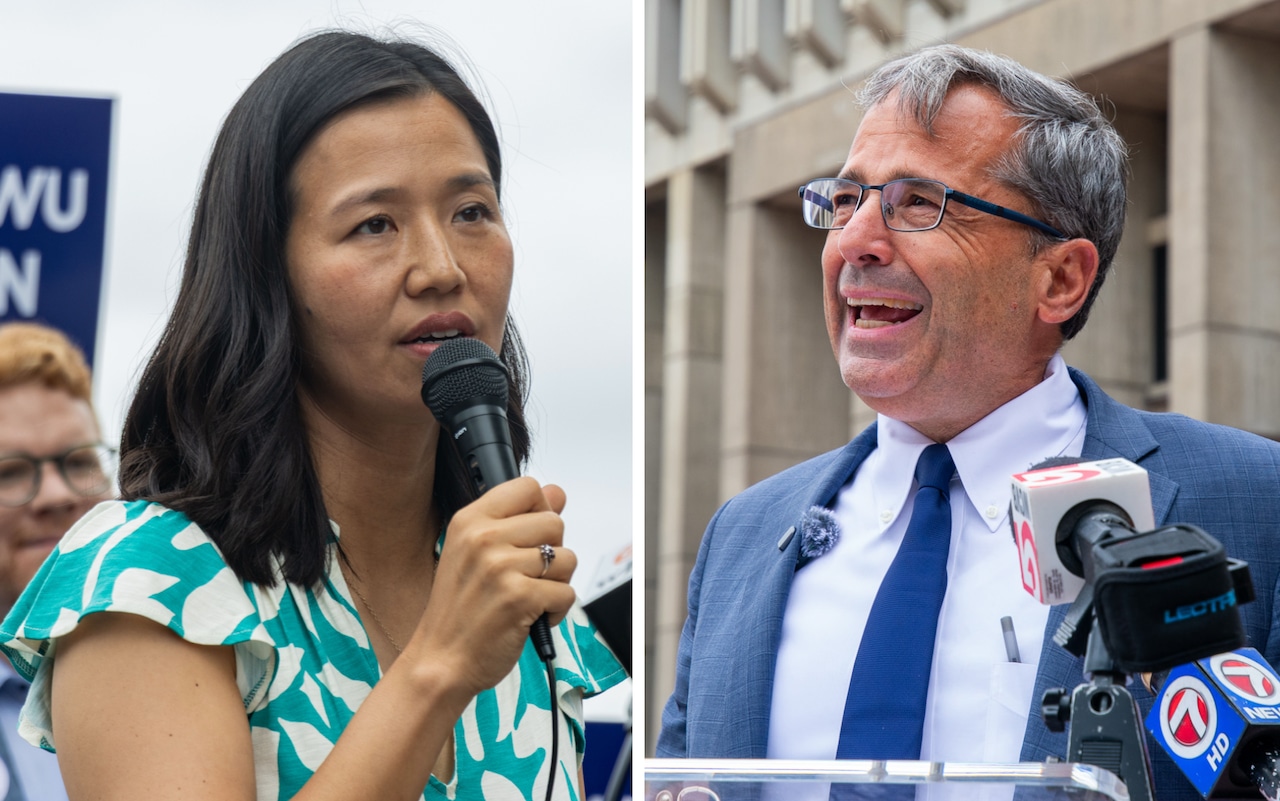
Mayoral challenger Josh Kraft’s plan to reform the school system, titled “A Vision for BPS that Boston Students & Families Deserve,” promises that he can do better to manage the district than incumbent Mayor Michelle Wu, who was elected in November 2021.
Kraft’s plan called for structural reforms to the district — including a partially elected school committee and a reimagined senior leadership — as well as changes to Boston’s competitive exam school admissions and commitment to make school bus transportation more efficient.
“BPS lacks both academic excellence and the basic support families need to ensure their children will learn and thrive, let alone arrive at school on time,” the Kraft campaign said. “Without an achievable plan and the ability to execute it, BPS will continue to remain substandard.”
Wu, while touting her improvements to the public schools as mayor, dismissed Kraft’s plan as lacking in substance and out of touch with the district’s challenges.
“This is nothing new from a candidate who has no prior involvement with the work of our school district and doesn’t seem to understand the details,” she said.
Kraft’s plan for Boston Public Schools
If elected, Kraft said he would transition the Boston School Committee from its current structure, in which members are appointed by the mayor (a practice initiated in 1991 by then-Mayor Ray Flynn), to a hybrid model in which some members are elected.
Nearly 80% of city voters supported a 2021 ballot measure seeking to return the school board to an elected system. City councilors also supported legislation for an elected school committee in 2023, but Wu vetoed the proposal, saying it would “compromise our ability to stabilize and support” the district at a critical juncture.
Kraft also plans to restructure the district’s management by splitting the superintendent’s job into two. One superintendent would handle the nuts and bolts of operating the district, while a second would focus on academics.
He said his administration would reevaluate Boston’s exam school policy to ensure any student who meets the requirements to enter one of the city’s top schools can do so. Kraft said he would open more seats at the highly competitive schools — Boston Latin School, Boston Latin Academy and the John D. O’Bryant School of Mathematics and Science — and consider adding satellite campuses to expand their capacity.
Calling third-grade reading proficiency a key benchmark for future academic success, Kraft’s plan calls for a district-wide push to increase literacy rates by at least 10% “through a combination of high-dosage tutoring and community-driven partnerships.”
For students interested in careers in the trades, Kraft said he would work with labor unions and businesses to expand vocational education.
Kraft also pledged to develop a long-term plan for BPS facilities within his first year in office, assessing the condition and needs of each school building, so families can plan well in advance for the possibilities of their child’s school closing.
He specifically called for renovating Madison Park Technical Vocational High School “through a community-oriented, efficient process.”
Kraft said he would push to increase funding for athletics and extracurricular activities, and more closely integrate community organizations, such as the YMCA and Boys and Girls Club, with the district to help them deliver programming to students.
Kraft also said he would ensure students are reliably transported to sporting events, a commitment paired with his broader plan to overhaul the district’s transportation system to ensure buses arrive on time.
The district struggled in recent years to keep buses running efficiently and opened last school year with more than two-thirds of them arriving late. The early challenges were attributed to a new bus-tracking app that took drivers time to get used to, officials said. By year’s end, 94% of buses were arriving on time.
Kraft also criticized the growing price tag of school transportation and claimed that Boston spends “more per student on bus transportation than any comparably-sized district in the country.”
He said he would also improve communication with district families and pledged to revive a BPS department formerly known as the “Office of Parents.”
Kraft would also order an audit of the district’s mental health resources and increase student support and counselor staffing districtwide.
During roughly the last decade, Boston lost 8,500 students but gained 130 new employees in the district’s administrative central office, Kraft said, citing a report in Education Next, an education policy journal. His administration would look to trim redundant jobs from the central office to better allocate resources, he said.
Wu responds to Kraft plan: ‘Easy to throw rocks’
In a statement to MassLive, Wu positioned herself — a BPS parent — as the candidate better suited to understand and tackle the district’s challenges.
“Just as we’ve seen in his other campaign proposals, it’s easy to throw rocks without taking the time to learn how budgets, contracts, facilities and community needs all fit together,” Wu said.
She criticized Kraft’s plan for not mentioning bilingual education, students with disabilities, students without stable housing and district staff diversity initiatives.
“At a time when public education is under attack, we’ve made historic strides over the last three years,” Wu said.
She touted her administration’s push to tackle absenteeism. Last school year, chronic absenteeism — students missing 10% or more of school days — was 30.9% in Boston, down from 34.6% the school year prior, 39% in the 2022-2023 school year and 42.2% in 2021-2022, the school year during which Wu took office, according to state data.
Wu also said the district has expanded high-quality pre-K seats and early college access.
In 2023, Wu launched the city’s Task Force to Address Literacy Rates to study the issue, improve access to education and municipal services for residents who can’t read and write, and make recommendations for policies and programs to increase literacy among students and adults.
Wu also said that more construction or renovation is underway at school facilities than at any point in the last four decades, though her office and campaign did not offer figures to support the claim.
She added that the school district is retaining top leaders and that it has implemented “an academic plan to raise achievement for all students.”
As mayor, Wu established Boston Family Days, which gave Boston Public Schools students and their families free entry to several museums and cultural institutions, including the Museum of Fine Arts, the Franklin Park Zoo and the Museum of Science.
“We’re proud to share that over 44,000 students and family members have been able to visit Boston’s cultural institutions free of charge through this program,” Mayor Michelle Wu said in an April statement on the city’s website. “Through exploration in these world-class cultural institutions, we hope to nurture curiosity and encourage lifelong learning in our city.”
If you purchase a product or register for an account through a link on our site, we may receive compensation. By using this site, you consent to our User Agreement and agree that your clicks, interactions, and personal information may be collected, recorded, and/or stored by us and social media and other third-party partners in accordance with our Privacy Policy.




