
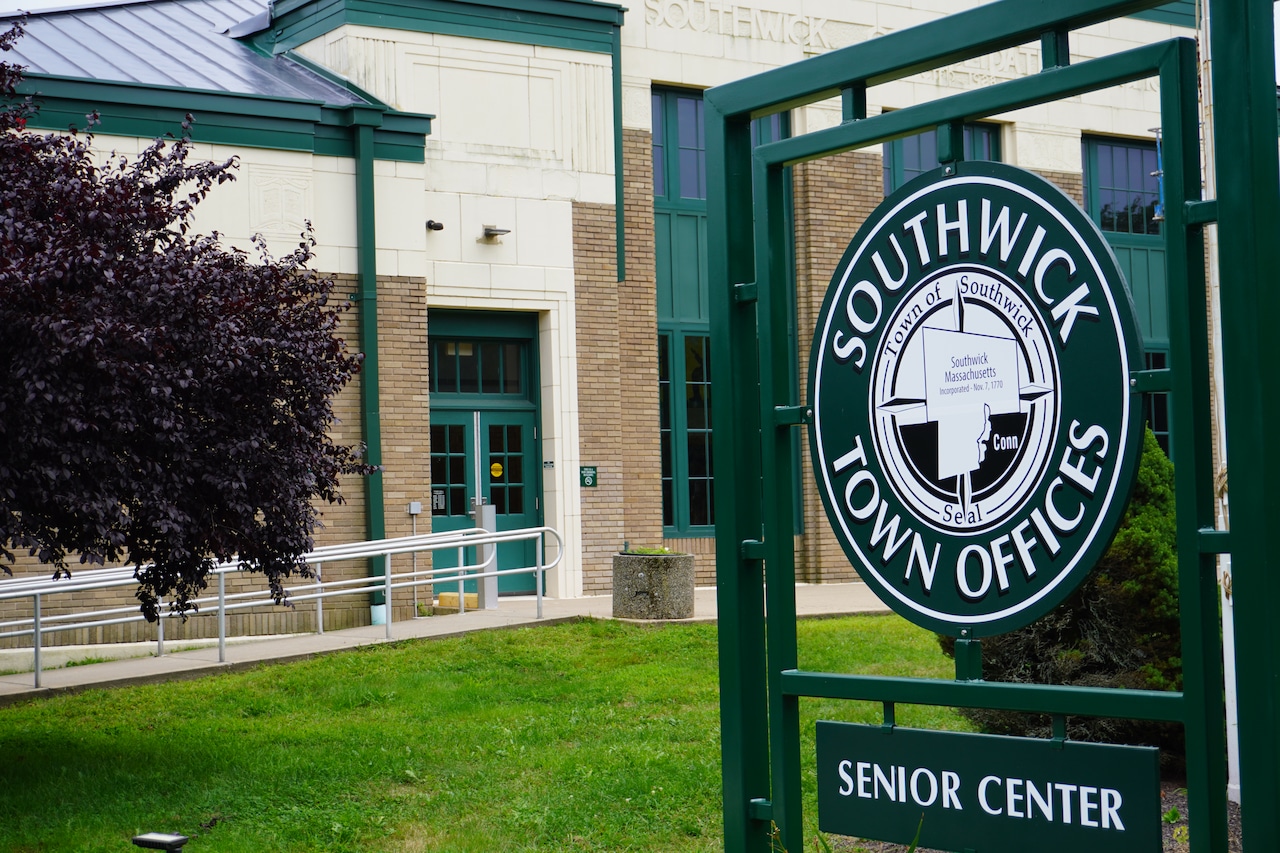
SOUTHWICK — For the first time in recent memory, a small group of property owners attended the monthly Board of Assessors meeting to vent about their property’s recent revaluation.
“This is a great hardship for me, and my question is: Is anyone keeping track of where all our tax dollars are going?” asked Linda Hadley, who said her property tax increased by $250 a quarter from last year.
Hadley, who filed for an abatement, which was granted by the board, was one of three property owners who spoke during Wednesday’s meeting.
She spoke of how much she worries about the increase in her property tax rate while also having to pay insurance for her car and house, energy and home maintenance.
“I think this is an awful burden for a senior,” she said.
While Town Assessor Randy Austin didn’t address her concerns during the meeting on Thursday, he recognized that it’s “tough” for seniors on a fixed income.
During the board’s meeting in December, its members voted to start the process of reducing the age to qualify for the $1,000 senior exemption from 70 to 65, which Austin supports and could provide some relief.
To change the age, it will have to be approved by Town Meeting.
Also at the meeting was William Jenkins, the principal of one of the properties in town that had perhaps the largest tax increase from last year to this year: 10 cottages on Lake Shore Drive owned by Lace Twins LLC.
Lace Twins’ valuation in 2025 for the property was $804,800, but it increased to $1.515 million for 2026.
“So, I’m a little concerned about that,” he said.
He explained that the cottages, which the company rents out, are between 500 to 600 square feet in size, have essentially no yard, and no lake view or access.
“Even if I bought it for $1.5 million, I can’t build a house there because there’s no lake access and really no lake view, except through all the other houses around me,” he said.
Jenkins said he’d have to raise the monthly rental of a cottage to $200 to cover the increase.
The company has filed for an abatement, but the board has yet to make a final decision on it, Austin said.
The application period for abatements ends on Monday, Feb. 2. The Board of Assessors has 90 days to decide on the application.
Austin said Thursday that the assessor’s office has gotten 52 applications since the period opened on Jan. 1.
Beth Lalli was the last property owner to speak.
She spoke about property tax inequality and how property data errors affect the valuations.
“The property taxes in Southwick are only as fair as the data that’s used to calculate them,” she said.
She questioned whether the Computer-Assisted Mass Appraisal software used by the assessor was correct. CAMA is used to determine fair, equitable property values. It is designed to increase accuracy and reduce human error.
“It’s not like I’m challenging changing the tax rate — which was dropped to $14.42 from $15.57 by the Select Board in December to reflect the property valuation increase — it’s whether the underlying data is clean and consistent enough for the mass appraisal to work fairly,” Lalli said.
As an example, Lalli said after analyzing data from 2025 to 2026, she found that in 2025, there were only 78 homes built in 1995 or later. In 2026, that number jumped to 1,510.
Austin explained later that the way the CAMA system works is partly based on a depreciation schedule of a home and the effective date of the year it was built — not the actual date when built.
That is because a house built in the 1800s cannot be depreciated down to 1% because it’s so old, he said.
Lalli also used her own home as an example of some of the incorrect data, saying that her property card had an incorrect square footage for her home, the wrong number of floors, that there was a fireplace and there wasn’t, and included a storage shed and above-ground pool that had been removed by one of the former owners.
She also said that a home near hers had been vacant for seven years, but it still increased $22,000 in value.
“I feel like there’s so much incorrect data that I’ve come across, it’s just not a fair playing field,” she said.
Despite that, she commended Austin for being responsive to her concerns.
“I had Randy out, and, you know, it was great,” Lalli said.
Board Chair John Cain acknowledged that many of Lalli’s points were correct.
“I understand what you’re stating. The data is inaccurate. We have seen that through some of these things that we’ve talked about,” Cain said.
He said Austin has been going through the data since he started in September.
“He’s getting things in line, we’re figuring out what we have going on … but the idea is that we’re trying to get all the data correct,” Cain said.
He then said the process is “never going to be fair in everyone’s eyes … so it has to be equally unfair, maybe, to an extent.”
He added it’s the responsibility of the property owner to look at their property card and if there are inaccuracies, contact the assessor’s office.
Austin said he didn’t disagree that some of the property data was inaccurate.
“That’s why I had been suggesting that we have someone come in and let’s get that fresh starting point, and have a data collection company come in and inspect every home that hasn’t been inspected in the last two years. We have to move on to that,” Austin said, adding that the board had been discussing appropriating the $150,000 to $200,000 needed for the effort.
He said that conducting a thorough inspection of the town’s properties would allow the town to “capture that tax growth dollars and new growth from things that were not accurate.”
“Well, respectfully, I think you’re helping to do that,” Lalli said, which Austin responded to.
“[It’s] something that we can do to address this and hopefully restore the public confidence in this office.”