Editor’s note: This story reflects the updated vote tallies as they stood at 8 a.m. Wednesday, Sept. 10.
A nearly 50-percentage-point second-place finish in Tuesday’s preliminary election for mayor of Boston was not enough to dampen Josh Kraft’s spirit, as Mayor Michelle Wu’s top challenger pledged he would work to overcome her wide lead by the November general election.
Unofficial results showed Wu with 72% of the vote to Kraft’s 23% around 8 a.m. Wednesday, pushing both candidates forward to the final stage of the race, but with Wu holding an unmistakable edge.
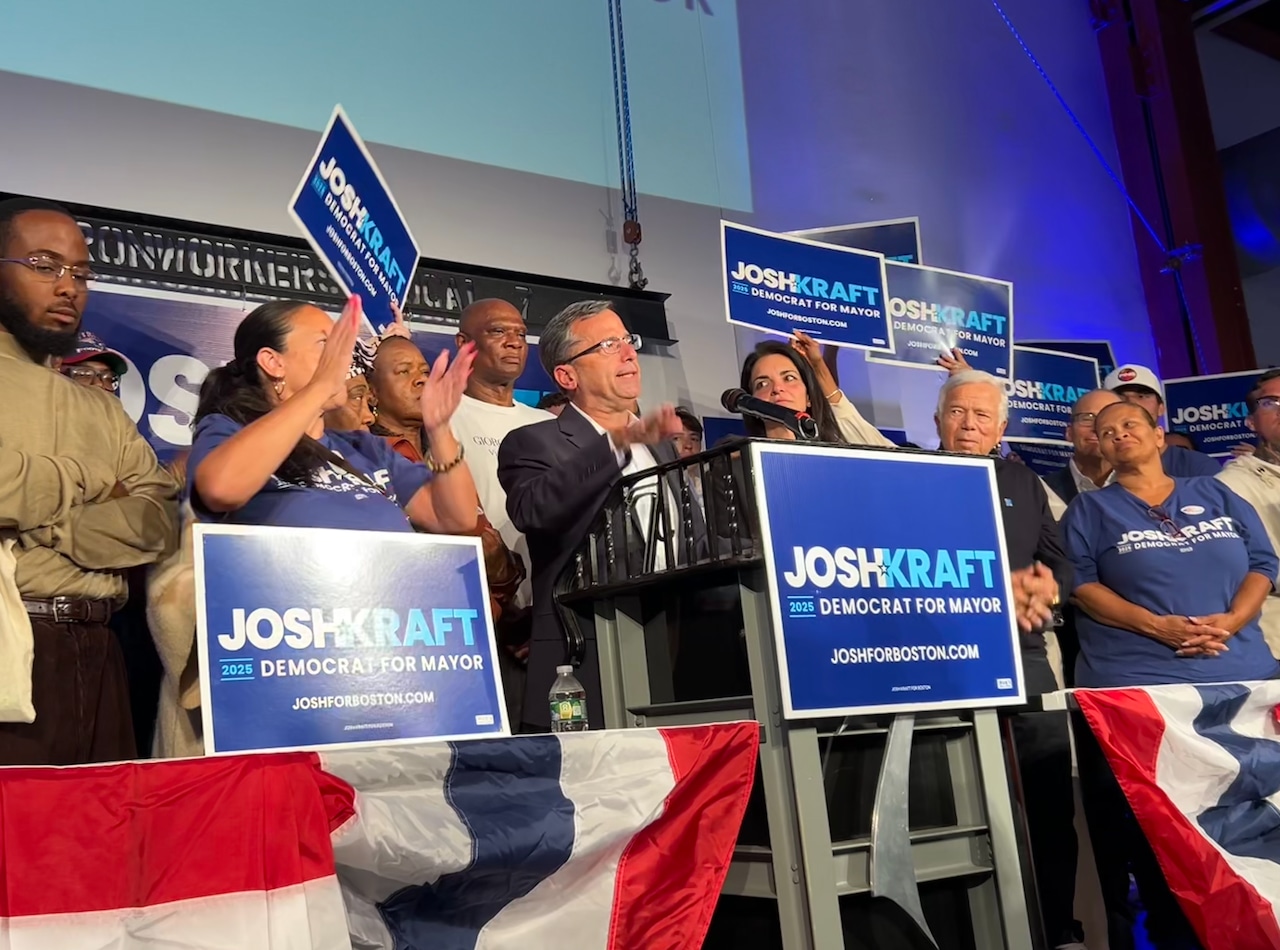
While Wu celebrated the results with supporters at a park in her home neighborhood of Roslindale, Kraft rallied his side at a union headquarters in South Boston and committed to redoubling his campaign efforts over the coming two months.
“Let me be clear — we are still in this race,” he told a crowd of supporters at the Iron Workers Local 7 Union hall. “We know the road ahead is not going to be easy. But neither is life in Boston right now for too many families.”
But Kraft left unclear how he planned to close such a significant margin over the coming weeks.
Asked by a reporter how he could win in November if more than 50% of voters already appeared to back Wu, Kraft responded: “Just keep working, grinding, sweat equity, never quit.”
Tuesday’s preliminary election eliminated two other candidates from competition: Domingos DaRosa, a community activist from Hyde Park, and Robert Cappucci, a retired Boston police officer and former School Committee member from East Boston, who each earned under 3%, according to initial results.
Public polling in the race had been limited. A July poll by the Boston Globe and Suffolk University had placed Wu’s lead at 30 percentage points.
The race was thus shaken Friday by a new poll from Emerson College that showed Wu with a commanding 72% to 22% lead over Kraft. DaRosa and Cappucci polled at 2% and 1%, respectively.
With both Wu and Kraft already expected to advance to the general election, eyes were trained Tuesday night on Wu’s margin of victory. A smaller loss than the Emerson poll suggested could breathe new life into the Kraft campaign, some theorized.
Though the early results showed Kraft down by a wide margin consistent with the polling, his supporters stayed upbeat at the union hall as their candidate greeted them Tuesday night.
Attendees of the Election Night party said they believed in Kraft’s ability to turn the race around, and remained critical of Wu’s performance as mayor.
“We’re going to keep this race going, til the wheels fall off,” Anthony Seymour, a longtime friend of Kraft’s, said as he fired up the crowd ahead of the candidate’s arrival.
“This is what we’ve got to do to change and affect the way our city is going,” he’d told the supporters a few minutes earlier. “Things in Boston are really taking a deep dive for the worst reasons, and we’re here right now to take it up.”
Taking the stage alongside his partner Michelle Perez Vichot, his father Robert and his brother Jonathan, Josh Kraft brushed off last week’s Emerson poll, insisting that “the only poll that matters is in November.”
He said he would review the results on Wednesday with his campaign team and work from there.
Asked by one reporter if a Patriots Super Bowl championship or Kraft victory in the mayoral race was more likely in the next six months, Kraft shot back: “I don’t know. What do you think?”
As polls opened Tuesday, Kraft zipped across the city’s neighborhoods, meeting voters in the North End and Charlestown, Roxbury and Dorchester, Jamaica Plain and West Roxbury and everywhere in between.
“We’re encouraged and we’re in for a fight,” said Ronia Stewart, of West Roxbury, a Kraft friend and supporter who met him when he was running the Boys & Girls Clubs of Boston.
In his first campaign for public office, Kraft has drilled Wu on a wide variety of issues.
He has pledged to pause construction of new bus and bike lanes. which Wu has championed, to study their impact and map out a cohesive plan for their development.
Kraft has argued the city cannot afford the mounting costs of renovating White Stadium in Franklin Park into a new home for a women’s soccer team and an athletic field for city students. Wu has defended the project as a way to expand opportunities for student athletes and create a new state-of-the-art stadium with vital help from a private professional team.
The common threads through many of his critiques are his claim that Wu has mismanaged key issues — whether housing development or the persistence of homelessness and public drug use — and has tuned out the input of her constituents.
“It’s been disappointing to see what [Wu] has done, and what she hasn’t done,” Catherine Zhou, of West Roxbury, said as she waited with other Kraft supporters for the candidate to arrive at his election night party Tuesday night.
Zhou, a green card holder, cannot vote. But her partner, Andrew Stuckey, cast a ballot for Kraft. They cited Wu’s inability to solve the homelessness and public drug use crises at Mass and Cass as primary reasons for turning to Kraft.
At Mass and Cass, Stuckey said, Wu “had her shot at it.”
”Yes, there should be bike lanes, but to eliminate two driving lanes for one bike lane doesn’t make sense,” Zhou added. “It’s bottlenecking the traffic flow.”
Kraft moved to the North End from Chestnut Hill in 2023 and registered to vote in Boston.
Despite his family’s ownership of the New England Patriots and New England Revolution, Kraft turned to a career in nonprofit work.
He spent three decades working for the Boys & Girls Clubs of Boston, serving as its president and CEO for 12 years.
He also served as president of the New England Patriots Foundation, his family’s charitable organization, and sat on the board of the Urban League of Eastern Massachusetts, which he chaired, the board of Brigham and Women’s Hospital, and the state’s Hate Crimes Task Force, which he co-chairs.
Though he has long worked in Boston, Kraft’s semi-recent arrival as a resident of the city and his deep financial means have been frequent targets of the Wu campaign.
Kraft has poured $5.5 million of his own money into the effort. He made $6.3 million last year, which he said came from “the family business,” though he has declined to release his complete tax returns.
Even with the massive influx of cash, Kraft’s campaign has struggled.
Last week, days before the release of the Emerson poll, Kraft parted ways with two top advisors from the early days of his campaign.
If you purchase a product or register for an account through a link on our site, we may receive compensation. By using this site, you consent to our User Agreement and agree that your clicks, interactions, and personal information may be collected, recorded, and/or stored by us and social media and other third-party partners in accordance with our Privacy Policy.