
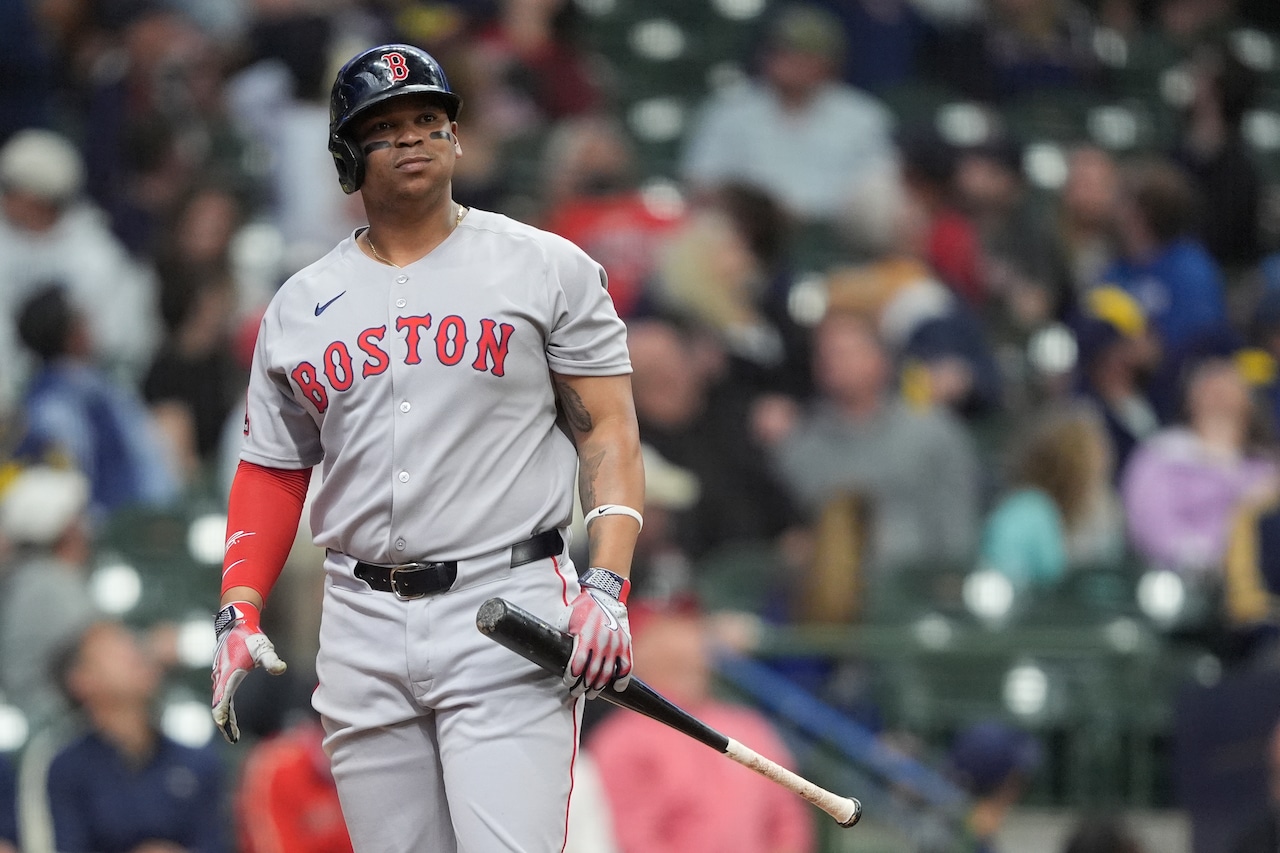
Red Sox brass claimed Monday night that the blockbuster deal that sent Rafael Devers to the Giants on Sunday night was a baseball trade. But nearly an hour’s worth of comments on a Zoom call with reporters cast a different light.
If things between Boston and its star slugger had been hunky-dory away from the field, he’d have been in the middle of the club’s lineup in Seattle on Monday. But tensions over repeated requests from the Red Sox for Devers to switch positions — and his reactions to those requests — heightened to a point a source described as “unsalvageable.”
“In the end, it’s pretty clear we couldn’t find alignment with Raffy,” said team president/CEO Sam Kennedy. “It’s the truth. We all worked at it over the last several months going back to the offseason, starting with Alex Cora and Craig (Breslow) and the staff, then up to me and all the way up to John Henry.
“We had a different vision from him, moving forward, than he did. We couldn’t get there. We couldn’t find alignment. We reached that inflection point and made the decision to make a big move.”
Devers, the team’s star third baseman who debuted in 2017, arrived in Fort Myers for spring training believing he’d be back at the hot corner this season. Then, after the Red Sox signed free agent Alex Bregman to a big contract, team decision-makers told Devers he’d likely move to designated hitter. He initially bristled — and went public with his displeasure during a press conference on February 17.
By the time May rolled around and the Red Sox asked him to work out at first base after Triston Casas’ season-ending knee injury, Devers was even more irritated. Devers publicly ripping Breslow and questioning the organization’s motives represented a turning point. The wheels were set in motion for a potential trade.
“In terms of what was missing, it just was that alignment in terms of what we felt we needed from him that would be in the absolute best interest of the ball-club,” Kennedy said. “That’s a non-starter for us. We have to have that. We couldn’t get there. And as Bres said, maybe we need to look back at things we could handle better. But it’s definitely a two-way street. We didn’t get to the alignment we needed in the best interest of the Boston Red Sox, so we made the decision that we made.”
On May 9, in a rare show of urgency, principal owner John Henry (along with Kennedy and Breslow) made an unplanned trip to Kansas City to meet with Devers in the visiting manager’s office at Kauffman Stadium in an effort to reiterate the hallmarks of being a good teammate. The exact details of that meeting remain unclear. But the Red Sox walked away from it feeling like Devers was more dug in than ever.
“That meeting was full of candor, openness, honesty between both John and Raffy,” Kennedy said. “Bres has had many discussions with Raffy. I’ve had discussions with Raffy. A.C. has had discussions with Raffy that have been candid, honest and direct. We just weren’t able to get there on a shared vision for his role going forward.”
Just over a month later, Devers was gone in a shocking trade. And while the Red Sox didn’t actively shop him to clubs, they were open to exploring possibilities. Devers never demanded a trade but his camp, led by Klutch Baseball’s Nelson Montes de Oca, made it clear Devers wasn’t opposed to one, either.
“There were times during the course of conversations with Raffy’s camp where they had indicated that perhaps a fresh start would be best for both sides,” Breslow said. “We were committed to trying to get through this and like Sam said, ultimately we weren’t able to achieve that alignment. This does represent that chance to reset on our end and for Raffy to get a fresh start with a historic franchise.”
On Monday, just over 24 hours since the deal got done, both Breslow and Kennedy were careful not to rip Devers, who played 1,053 games in a Red Sox uniform, on the way out. There was a clear message, though, that the disagreement between the sides was not to be tolerated. Kennedy spoke of the move being in the best interest, both “on and off the field” and said, in no uncertain terms, that the club is trying to pursue a certain culture they want “everyone to embody.” Breslow wouldn’t discuss Devers’ issues specifically but — like he did in Kansas City last month — insinuated that Devers’ behavior as a teammate did not reach Red Sox standards.
“Being great teammates and sacrificing and stepping up for each other and embodying this shared vision, we believe those are principles we need to be faithful to…,” Breslow said. “It’s the willingness to step up and sacrifice at times of need and essentially, do whatever is necessary to help the team win. I think that’s the identity, this relentless pursuit of winning we’re looking for.
“As we think about the identity, culture and environment that is created by great teams, there was something amiss here. It was something we needed to act decisively to course-correct.”
Devers, 28, was in the second year of a 10-year, $313.5 million contract he signed in January 2023. That remains the biggest contract, in terms of total value, in Red Sox history. At the time, the Red Sox billed Devers as the face of a franchise that Mookie Betts and Xander Bogaerts had both departed. Things changed fast.
“We had certain expectations that went with that contract. When we came to the conclusion that we did not have full alignment, we moved on,” Kennedy acknowledged.
Breslow admitted the first choice of the Red Sox was to keep Devers and that the timing of a rare mid-June blockbuster, on the heels of Boston’s best week of the season, was “not great.” But with San Francisco offering to take on the remainder of Devers’ contract and offering four players (including key pieces Kyle Harrison and James Tibbs III), he felt it was time to strike.
“Where we got to was believing that making this move made more sense for us than not making it,” Breslow said. “If we didn’t get the return we were holding out for, we wouldn’t have made it.”
Kennedy concurred.
“Obviously, this decision was not taken lightly nor did it come suddenly,” the team president said. “We obviously, over the last week or so, reached an inflection point. As difficult as that inflection point was, as the hallmark of this organization, I guess, over the last 24 years, we acted boldly and decisively. We came to the very difficult decision to make a deal that we think serves the best interest of the Boston Red Sox in the short-term and the long-term.”
Devers, a source said, was irritated with what he perceived to be mixed messaging from “different voices” in the organization since the beginning of camp. He believed the Red Sox were scapegoating him for a bad start. Breslow declined to go into specifics about his communication with the three-time All-Star but said he was in the process of self-auditing his strategy.
“I think about that question all of the time,” he said when asked if he had any regrets about how he communicated with Devers. “This is not the outcome we expected and it has forced me to reflect on the interactions I’ve had, not just with Raffy but with other players, and opportunities to communicate differently.
“I don’t know if this outcome would have played out any differently. I think there’s a decent chance it wouldn’t have. But I absolutely need to have the humility to look back at the interactions and figure out what I could have done better.”
Neither Breslow nor Kennedy pinned the entirety of the blame on Devers, who will be introduced as a member of the Giants on Tuesday afternoon at Oracle Park.
“It’s a shared responsibility… There’s blame to go around on all sides when you can’t get to alignment on what’s best for the team,” Kennedy said.
“I don’t think there’s a single event we would point to,” Breslow added. “I think it’s just more the totality and culmination of a bunch of these things where we felt like a fresh start for both sides was probably the right path forward.
Now, the Red Sox have no choice but to move on.
“It’s OK,” said Kennedy. “This sometimes happens in a long-term relationship. We hopefully did the absolute best thing in the best interest in the Boston Red Sox, and in this case, Raffy Devers. We really wish him well.”