
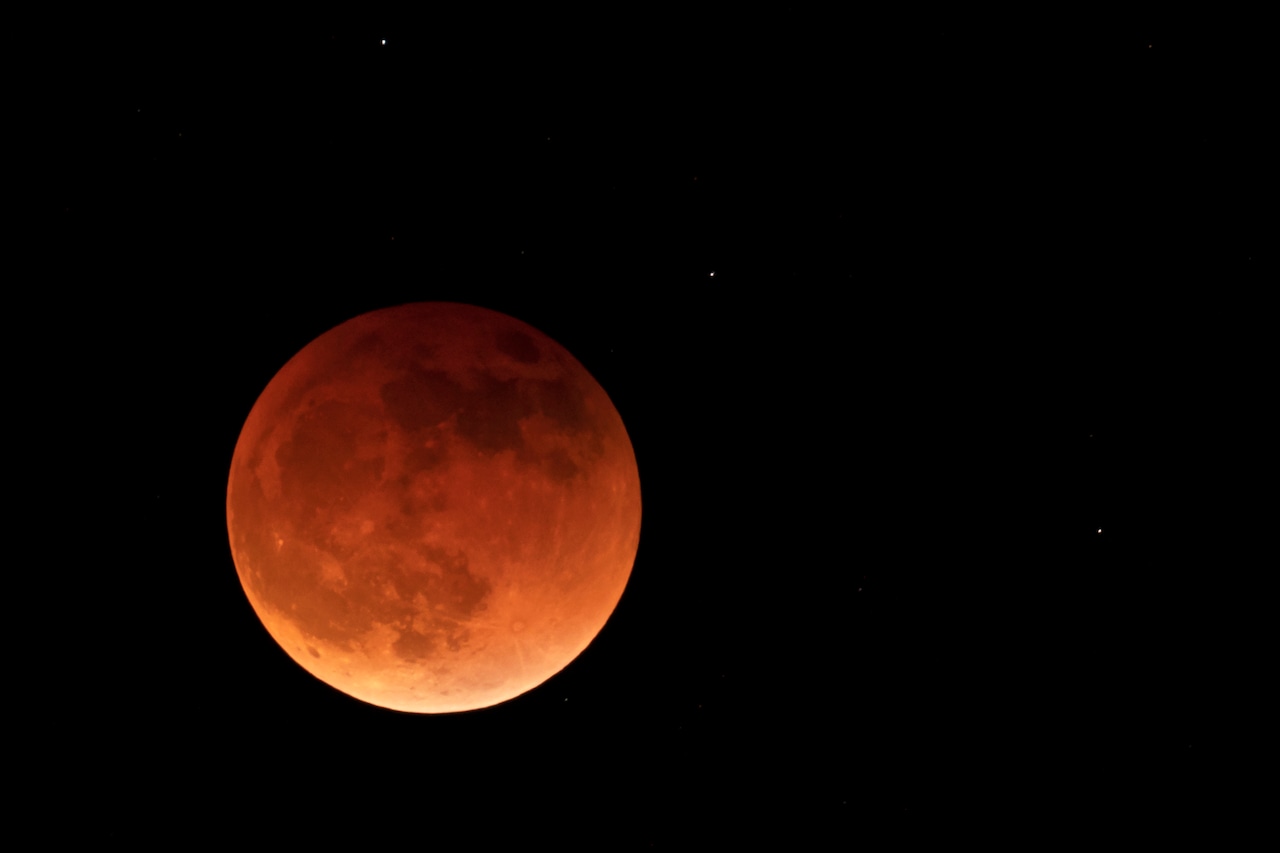
A total lunar eclipse is about to be visible in the night sky Thursday night into Friday morning, when the moon should transition from appearing bright white to orange-red.
Most of the Western Hemisphere should see the moon change color as it passes through the darkest part of Earth’s shadow, or umbra, according to NASA. When the moon passes through this part of Earth’s shadow, it is typically referred to as a Blood Moon.
This phenomenon is the same as what makes the sky blue and sunsets red, the space agency stated on its website. Sunlight contains a rainbow of colors that have unique properties, with blue light passing easily through Earth’s atmosphere. Reddish light travels through the air more directly.
When there is a lunar eclipse, sunlight not blocked by Earth filters through “a thick slice of Earth’s atmosphere on its way to the lunar surface,” NASA’s website states. “It’s as if all the world’s sunrises and sunsets projected onto the moon.”
At 11:57 p.m. EST Thursday, the moon passes through the outer edge of Earth’s shadow, called the penumbra, according to NASA. By 1:09 a.m. on Friday, there will be a partial eclipse until 2:26 a.m., when the eclipse reaches totality and the moon turns red.
Totality continues until 3:31 a.m., when the moon slowly returns to its natural color. A partial eclipse will appear until 6 a.m. Friday, when the eclipse is fully over.
While a solar eclipse can be safely seen with the use of specially made glasses, the total lunar eclipse and Blood Moon are safe to look directly at, NASA said. The event is best seen in a dark environment away from any bright lights. Binoculars or a telescope will help enhance viewing.
The last Blood Moon caused by a total lunar eclipse was seen in the night sky on Nov. 8, 2022.