

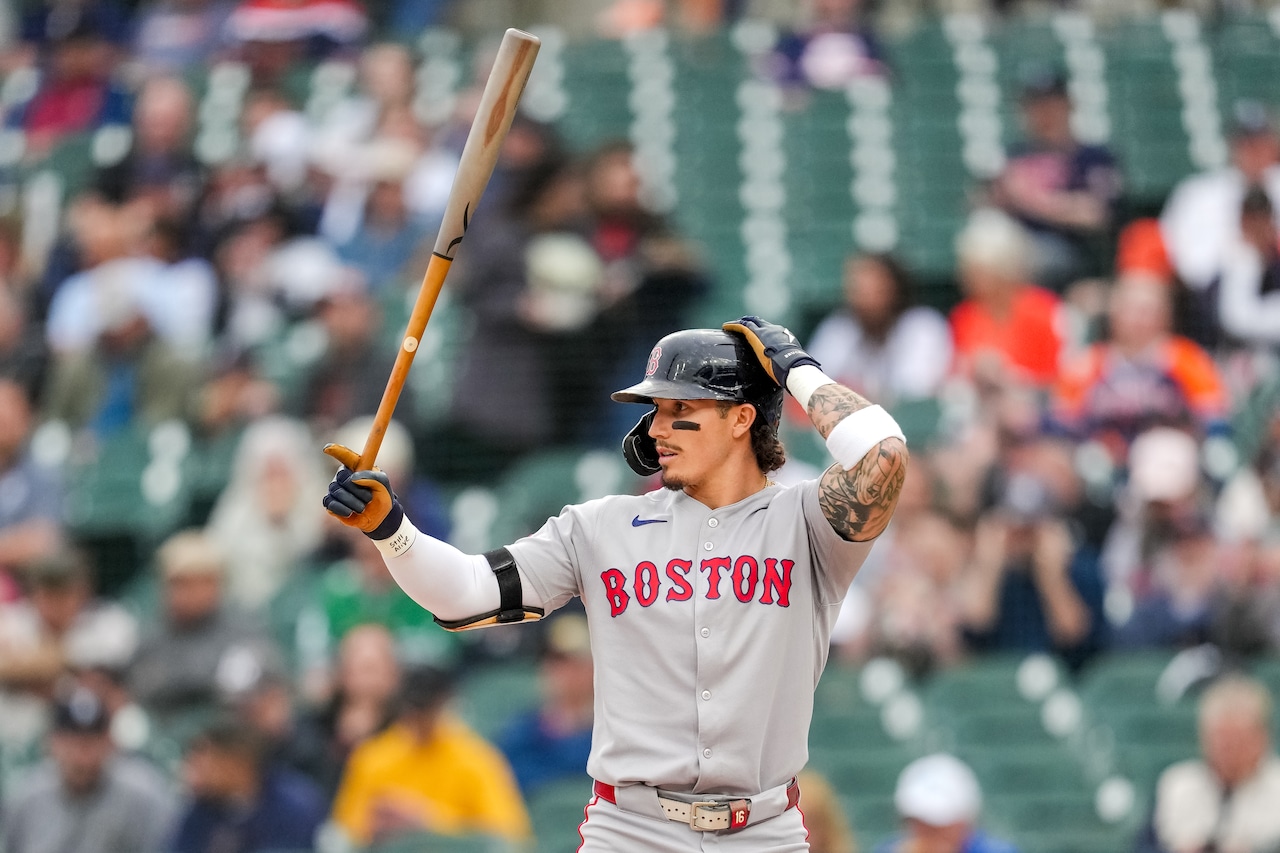
With a little more than a quarter of the season completed, the Red Sox, it can be fairly said, have significantly underachieved.
Their roster wasn’t perfect to start the season, but surely, they were supposed to be better than this
The odd thing, as many have pointed out, is that nearly all of their offseason upgrades have worked out as well — if not better than they could have hoped.
Were it not for Aaron Judge, a solid case could be made that Alex Bregman has been the AL MVP. Garrett Crochet has pitched well enough to be a contender for the Cy Young Award. Aroldis Chapman has yet to blow a save and his greatly improved on his walk rate. And Walker Buehler was trending in the right direction when he developed some shoulder soreness.
Adding those elements to a team that finished exactly at .500 last year should logically have produced a team well above the break-even mark when it comes to its won-loss record. And yet, the Sox somehow currently sit a game below .500.
How is that? Let’s examine the numbers that have them where they are:
1) .524 OPS
That’s the Red Sox’ OPS from the clean-up spot, which ranks 29th of the 30 MLB teams. Only to dismal Chicago White Sox are worse.
For much of the young season, the cleanup spot was occupied by Triston Casas, who had a brutal first month of the season before suffering his season-ending knee injury. In the interim, the Red Sox have experimented with Trevor Story, Kristian Campbell, Wilyer Abreu and others, but none has clicked in that role.
The two spots in front, occupied by Bregman and Devers, have been highly productive, especially if you subtract the first week for Devers.
But the fact that the Sox have yet to identify an everyday run producer for such an important part of their batting order has been a huge issue. The fact is that, by and large, the lineup production falls off a cliff after Bregman in the No. 3 hole. The Sox’ lineup is way too top-heavy.
2) .242 with RISP.
As a team, the Red Sox are third in the American League in runs scored and sixth overall in MLB. On paper, that should be plenty good enough.
But it could be much better. The team’s performance when it comes to situational hitting, however, is highly disappointing.
With runners in scoring position, the Sox are batting just .242, placing them 19th in MLB. Too often, the Sox are squandering opportunities to either add on in late innings, or race out to bigger leads early in games and get into opponents’ bullpens.
Need further evidence of that? The Red Sox have, by far, the most number of at-bats with runners in scoring position of any team in the league. But too often, they haven’t produced in those opportunities.
3) 27 unearned runs.
If this sounds like a familiar problem, it’s because it is. Last year, the Red Sox led all of baseball with unearned runs and this year, entering Thursday’s action, they’re close to doing it again. Only the historically putrid Colorado Rockies (38 unearned runs) are worse.
Errors are part of the game, of course, and every team makes them. But the Red Sox, for the last few seasons, seem to have a unique proclivity for making them at the worst possible time. Of course, a portion of the blame has to go to the pitching staff, which has too often been incapable of getting out of jams that their fielders have created.
It’s hard to know how to fix this. The team has, in each of the last few springs, spent plenty of additional time on defensive drills, only to have the same issue develop in the regular season. Changing infield instructors twice hasn’t solved the issue either.
It doesn’t help that the pitching staff is below-average when it comes to missing bats. More balls in play translates into more chances for errors, and eventually, unearned runs.
4) 11 blown saves.
Ordinarily, these many blown saves would suggest a team has a big problem with its closer.
But in this case, Chapman is a perfect 6-for-6 in save opportunities. No, the Red Sox are letting games get away in the seventh and eighth, before they can even get the ball in the hands of Chapman.
The biggest culprit has been Garrett Whitlock, who is responsible for four them — including two on the recent road trip and all four recorded since April 30. That total leads all major league relievers.
Too often, Whitlock hasn’t executed pitches, especially his sinker, which he’s thrown almost half the time (45.4 percent) and against which opponents have hit a robust .323 with a .452 slugging percentage. It’s easy to conclude that, too often, Whitlock has left his sinker up and over the plate rather than keeping the ball down.
5) .310 OBP.
That’s the on-base percentage out of the leadoff spot through the Red Sox’ first 45 games, with most of those at-bats coming from Jarren Duran. Duran’s personal on-base percentage is actually somewhat worse at .298.
Again, given that the Sox are third in the league in runs scored and sixth overall, the offense — RISP issues aside — isn’t the real culprit here.
But whereas a year ago Duran served as the team’s true catalyst, that’s not the case this year. And with Devers and Bregman enjoying big seasons directly behind Duran, every time he fails to get on base is a missed scoring opportunity.
____________
Even from beyond the grave, Pete Rose continues to haunt Major League Baseball.
When commissioner Rob Manfred announced earlier this week that he was removing Rose’s name from MLB’s ineligible list, he had to know that he’d be satisfying some and angering others. Some four decades after his last at-bat, Rose remains a highly divisive, controversial figure. Few are indifferent to him.
Manfred chose to focus on Rose’s passing as the end-around here, maintaining that his “lifetime” ban from the game should be rescinded once he died. That seems like some convoluted thinking on Manfred’s part — Shoeless Joe Jackson, who was removed from the same list along with some less-famous members of the notorious White Sox teammates, has been dead for more than three-quarters of a century and there was no movement to make him eligible again.
Manfred’s contention that “obviously, a person no longer with us cannot represent a threat to the integrity of the game,” is also highly debatable. Should Rose eventually gain election into the Hall of Fame, he would indeed represent a threat to the integrity of the game. Having violated the most obvious and necessary rule in his lifetime, having Rose celebrated, even posthumously, would be tantamount to Rose flipping off the game itself — all with the current commissioner’s tacit approval.
It’s been said, accurately, that modern-day commissioners are now little more than CEO’s of their sports, charged primarily with making revenue, and by extension, making their employers, the owners, happy.
But with all the focus on dollars and sponsorships and marketing and media rights fees, who’s protecting the sanctity of the game? Shouldn’t that, too, be a priority?
And it’s here that Manfred has failed miserably. While he deserves full credit to some on-field rule changes that have made the game more entertaining and appealing, he’s been lax in addressing issues of integrity.
When the Houston Astros used electronic sign stealing on their way to the 2017 title, Manfred provided full immunity to the players involved in exchange for their testimony. Beyond some fines and loss of draft picks, the penalties were minimal.
And this week, Manfred has paved the way for Rose to be celebrated as a hero – despite Rose’s (eventual) admission that he violated the sport’s cardinal rule and did irreparable harm to the game. (This doesn’t even begin to take into account the credible accusations of Rose committing statutory rape).
Rose’s accomplishments are many and his career was legendary. Many of those feats are currently recognized in Cooperstown. The official name, by the way, is the National Baseball Hall of Fame and Museum. As such, Rose is already cited for his achievements. There’s no need to also promote him with a plaque, an honor that should be reserved for the very best who chose not to sully the game.
Rose liked to say that no one loved or promoted the game more than he did. But by his own actions and deeds, Rose was always principally about him himself. He desired induction for his own ego and annually sought ways to enrich himself. On Hall of Fame Weekend each year, he would set up shop on memorabilia shops on Main Street to line his own pocket and take attention away from the deserving honorees.
What’s noble or selfless about that? Rose’s No. 1 priority was self-promotion.
As for those who insist that baseball’s partnership with gambling interests is the ultimate in hypocrisy, think again. Just because baseball has business interests with sports gambling companies doesn’t change that it remains patently forbidden for anyone involved with the game to bet.
Using the same logic, baseball should be OK with having players take part in games while drunk, since beer companies are among the game’s biggest corporate partners?
Just because something is legal and accessible to the general public does not mean it should be permitted for those competing on the field.
It’s true that it’s easier than ever to bet on games. But baseball’s vigilance should not and has not changed — in the past two years, MLB has placed both a player (Tucupita Marcano) and an umpire (Pat Hoberg) — on the lifetime suspension list for their association with gambling.
It’s uncertain what fate awaits Rose when his name will be first eligible for Hall of Fame consideration in December of 2027. We don’t know the makeup of that Era committee — Rose will not ever be on the traditional BBWAA ballot, his eligibility having long expired — will be, and thus handicapping his chances is impossible.
But here’s hoping that that mix of former players, executives and writers think long and hard about what signal they’ll be sending should they turn a blind eye to Rose’s inexcusable behavior.