

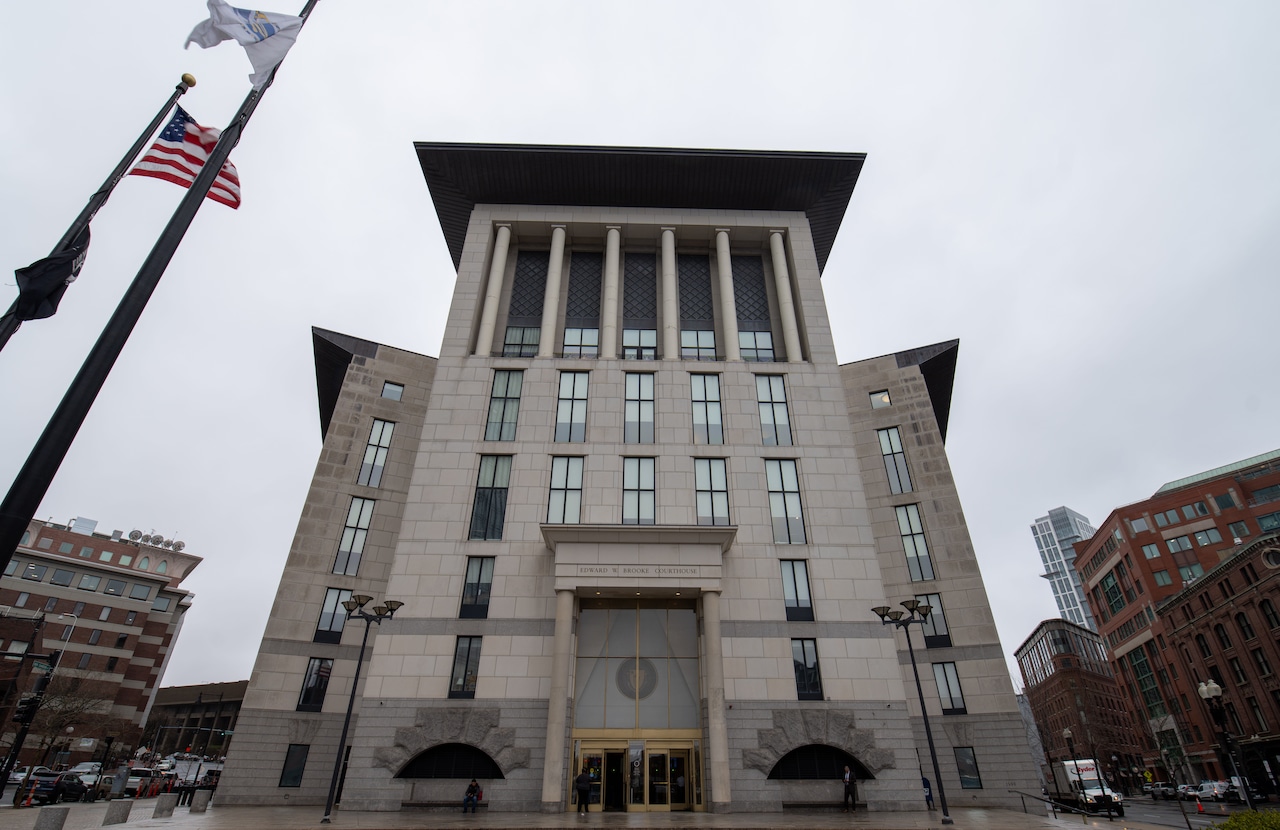
Massachusetts residents who face criminal charges and have been held without an attorney for more than a week were released Monday afternoon — some still without legal counsel — amidst a major defense attorney work stoppage that started in late May that triggered a rare courtroom protocol last week.
At least two Bostonians who faced lower-level felonies — such as various drug possession and distribution charges — were released on personal recognizance by Judge Tracy-Lee Lyons in the Edward W. Brooke Courthouse in Boston Monday. One person charged with motor-vehicle offenses remained held on a separate warrant.
“It’s really awful for everybody … it is an absolute crisis,” Rebecca Jacobstein, chief of strategic litigation for the state’s public defender agency, Committee for Public Counsel Services (CPCS), told reporters outside the courthouse on Monday.
About 80% of criminal cases in courtrooms are handled by attorneys called bar advocates, who are private lawyers overseen by CPCS who represent indigent defendants — or a person who cannot afford a lawyer.
Bar advocates across the state began refusing cases the day after Memorial Day due to decades of low pay. This has left more than 1,200 people in Suffolk and Middlesex counties without a lawyer, with nearly 30 held in custody for more than seven days and a heavy strain on courtrooms.
“Our staff attorneys are working so hard all the time — a good portion, now, of their clients are incarcerated — and our Roxbury defenders’ unit is past their capacity,” Jacobstein told reporters.
“Everything we do is about providing counselors … providing effective assistance, representation and a voice to people who have no voice,” she said.
“And right now, these people have no voice,” Jacobstein said.
The Lavallee protocol imposed Thursday requires cases against any indigent defendant to be dismissed after 45 days if no bar advocates file for an appearance, which generally happens immediately at a defendant’s arraignment. The charges will be dismissed until an attorney is appointed to the defendant.
Under the protocol, defendants who have been held for more than seven days without an attorney must also be ordered released on personal recognizance by a judge.
Lyons asked the CPCS lawyers on Monday about any possible ways for the defendants being arraigned to receive counsel — be it from lawyers in another part of the state or other methods. Representative Holly Smith told the judge that CPCS had tried everything to contact lawyers, even calling attorneys who’d taken cases for the defendants before.
“Mr. Lawrence represents an attorney who represents him from day one,” Smith told Lyons, as she gestured toward defendant DaiShaun Lawrence. He has been accused of trying to sell drugs while also on probation for drug possession, and has prior conditions of assault and battery with a dangerous weapon and other drug offenses.
“He has been held without an attorney, and he should be released,“ said Peter O’Karma, a private attorney who showed up for the emergency hearings on Monday.
Lyons ordered Lawrence released on the conditions that he checks with probation weekly and does not loiter at MBTA stations. His next court date is scheduled for July 16.
Lawrence was seen almost skipping in the metal cuffs around his ankles out of the courtroom, a grin on his face.
A handful of defendants also went before the judge Monday after having finally been appointed an attorney from the meager few that remain and their cases will proceed as usual. Specialty hearings are also expected to continue throughout the coming days and weeks, Lyon said.
Some bar advocates fear for public safety as a result of the Lavallee protocol, especially given the size of the work stoppage.
“I think floodgates are going to open [with the Lavallee protocol] … potentially dangerous criminals are going to get released, and that’s a huge concern for the public,” Suffolk County defense attorney Elyse Hershon told MassLive.
CPCS, however, declined to comment Monday on any dangers posed to the public because of the criminal defendants’ release.
“These are our clients, and they are charged with crimes and they are presumed innocent,” Jacobstein said.
If you purchase a product or register for an account through a link on our site, we may receive compensation. By using this site, you consent to our User Agreement and agree that your clicks, interactions, and personal information may be collected, recorded, and/or stored by us and social media and other third-party partners in accordance with our Privacy Policy.