Editor’s note: This article was produced by a University of Massachusetts Amherst journalism student, in collaboration with MassLive, as part of a project in professor Steve Fox’s Introduction to Multimedia class.
The University of Massachusetts Amherst can potentially save more than $1 million in its dining and waste management processes through partnerships with two AI-based companies, according to a university official.
Contaminated waste — when food compost, trash, recycling and other waste elements are mixed together — is a significant problem for the university because, as UMass Dining Director of Sustainability Kathy Wicks described, much of the recycling that gets collected is so contaminated, it ends up not actually being recycled.
By employing AI technologies — with partners MetaFoodX and rStream — on campus, the university prevents and helps recover materials from contaminated waste streams, saving UMass money in the long run, according to university officials.
How MetaFoodX saves UMass money
MetaFoodX, an AI food operations company, helps minimize waste overproduction before food is even served up on plates at the university dining halls.
The California-based company developed AI scanners that weigh trays of food before and after students eat. Through the process, the scanner tracks how much food has been consumed and when specific food lines and dishes are in high demand.
Using that data, Wicked explained, UMass Dining determines exactly how much food needs to be made and what times the dining staff needs to make more or less food, ultimately reducing food overproduction on campus.
“After [MetaFoodX’s] system has been in place for enough time and covers enough of the service, we can start applying that information to our procurement, meaning we will order less food, knowing that we will have what we need,” said Wicks. “Once we get into more of a rhythm with this, it should become a standard of practice, and the savings should level out over time.”
Because the exact savings remain uncertain, the dining department can’t yet pinpoint how much money MetaFoodX’s food scanners will save the university, but Wicks estimates that $1 million, maybe even more, could be saved by purchasing and making less food if that plan is operated at full capacity.
UMass Dining began piloting MetaFoodX’s scanners during the fall of 2024 before fully implementing the technology at the Harvest Market and at all four Amherst campus dining halls this past fall. It will take time for the dining department to develop a procurement plan to full capacity.
What does rStream do?
As MetaFoodX targets waste before the food is served to students, another company, rStream, deals with the waste left after students eat.
rStream co-founder Ian Goodine and his business partner, Ethan Galko — both UMass Class of 2021 alumni — developed an AI system that uses minimal human involvement to sort contaminated waste into clean streams.
“Nobody’s doing what we’re doing exactly,” Goodine said. “There are people who do elements of these things … There’s nobody who’s making something that can exist by itself in a non-industrial setting to sort thousands of tons of materials a year the way we are.”
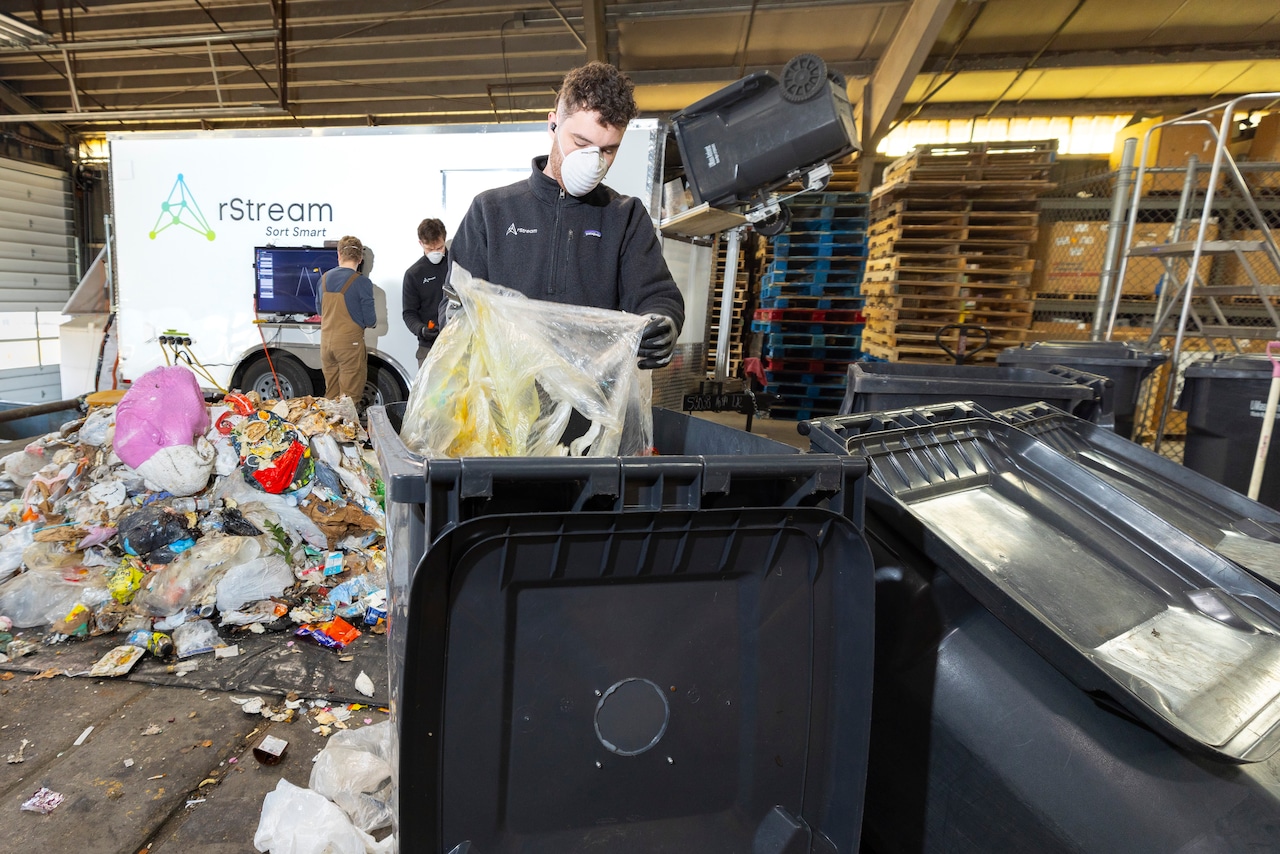
Using rStream’s technology, UMass staff bring waste barrels from various campus locations to the Office of Waste Management, where the contents are unloaded from the barrels into a mobile sorting machine hauled by trailer between locations.
A camera and AI vision system then identify each item in the waste stream and sort them into a category — such as recycling, trash, or compost — based on a continuous memory that updates with every experience.
How rStream can save UMass money
“If we install the system that worked fast enough for our campus system … I think it could be really impactful because we [would] have essentially guaranteed zero contamination in our waste streams if, theoretically, it is sorted out ideally,” said Ezra Small, the campus sustainability manager.
“Our contamination rates are really high. We’ve been told over 50% in the past,” Small said.
Through UMass’ waste-hauling partners, the university currently pays $126.79 per ton to dispose of trash, compared to $94.64 per ton for recycling — a $32.15 difference per ton. When recyclable materials are incorrectly disposed into trash streams, UMass pays that higher rate because those recyclables add to the total trash quantity.
rStream’s technology helps the university sort those recyclables into the correct waste stream, adding to the lower-fee pile.
UMass hopes to address the contamination issue by permanently installing rStream’s technology on campus.
According to Small, if a system were to sort 500 tons of recyclable material out of trash streams from several residential halls, the university would save approximately $16,075 from that fraction of campus waste, based on the $32.15 per-ton cost difference. Those materials would then be disposed of under the lower recycling tipping fee, rather than the more expensive trash rate.
For context, UMass produced about 1,442 tons of recyclable waste and about 3,073 tons of trash during the 2024–2025 reporting year, which resets in June.
UMass Amherst Assistant Campus Sustainability Manager Laurie Simmons added that, above all cost savings, the primary solution is to generate less waste to begin with — the central goal of MetaFoodX’s scanners.
rStream’s technology remains in the experimental phase, currently limiting both its availability and outreach of performance. Goodine and Walko test the system on campus only once or twice a semester, and each visit allows the company to sort waste from several buildings.
According to Wicks, the cost of each visit varies, but UMass Dining and Facilities Management each paid rStream $5,000 for the most recent sorting visit.
Goodine added that it will be “one or two loops around the sun” before the company has all the information it needs to begin the engineering process of a permanent system, which also signals that UMass implementing enough machines to sort all of the campus waste will be a continued wait.
However, Goodine noted that rStream’s system is developing quickly.
“It’s improving extremely fast,” Goodine said. “The university is a weird setting because it’s not just a building; it’s a collection of buildings over a broad campus … We don’t know exactly what to do to satisfy the goals that the campus has in the most elegant way. So we are incrementally growing, and the path to deploying it on campus is still unclear.”
Wicks added that the university could also create an additional source of revenue by reusing its sorted plastic waste to be create recycled materials, such as clothing, to potentially sell at the campus store.
“We could also say, ‘We want to separate out all of the [UMass-branded] water bottles,’ or we could separate out whatever there might be a market for,” Wicks explained. “Not only would it be cost savings in regard to the fines, but it could be that we can be more targeted with our waste stream, and the possibility exists that eventually it could be a source of revenue.”
Despite the remaining challenges for permanent implementation, UMass Dining and Facilities Management officials remain optimistic about the technology’s long-term impact.
“The work that [rStream] is doing could revolutionize the waste industry in terms of this combination of robotic and AI technology, where the AI is learning all the time about the items going into the waste,” said Wicks.