
The problem has vexed Boston leaders, public health officials and police for years: How best to address the interwoven issues of homelessness and public drug use that collide near the intersection of Massachusetts Avenue and Melnea Cass Boulevard.
Two years after the city cleared a nearby tent encampment where officials said drug use, drug dealing and sex trafficking ran rampant, the troubled area known as Mass and Cass remains a hotbed of drug activity and a congregation point for people who are homeless.
South End residents say many of the former occupants of Mass and Cass have since dispersed into the surrounding areas. In recent months, they say visible substance use, drug dealing and discarded needles have increased in their neighborhoods.
“It’s not okay,” Mayor Michelle Wu said in an interview with WBUR that aired Tuesday. “I have three kids. No parent should ever have in the back of their minds even that it could be a concern that one of their children just walking around in the city or in any area might experience something like this.”
Wu’s main challenger for reelection, philanthropist Josh Kraft, said the mayor has failed to address the conditions near Mass and Cass and needs to do more to guide people off the streets and into addiction programs.
Both acknowledged the tremendous difficulty of addressing the nationwide opioid epidemic and growing homelessness crisis at the local level.
Here is what the mayor says her administration is already doing, and what Kraft proposes doing differently.
Mayor Michelle Wu’s plan
Wu’s plan calls for using “all levers” of city government, in partnership with the state and nonprofits, “to end congregate substance use in Boston and the criminal activity that supports it,” she wrote to South End residents in a letter in June.
A key part of that plan was dismantling the tent encampment on Atkinson Street, a side street near Mass and Cass, in November 2023. With drug use and violence festering in and around the tents, the site had become a public health crisis, city officials said. Breaking up the encampment allowed social workers to guide people living there into housing and recovery services.
Equally important were dedicated efforts to prevent the tents from reemerging, officials said.
In the year after authorities removed the tents from Atkinson Street, police did not log a homicide in the area of Mass and Cass. Violent crime — rapes, attempted rapes, robberies and assaults — all dropped, according to a seven-page memo the Wu administration sent Boston City Councilors in February.
Today, the city’s approach is continuously adapting to meet the ongoing issues of group outdoor drug use that has spread to the South End, Downtown Boston and Boston Common, Roxbury, and parts of Dorchester and South Boston, the memo said.
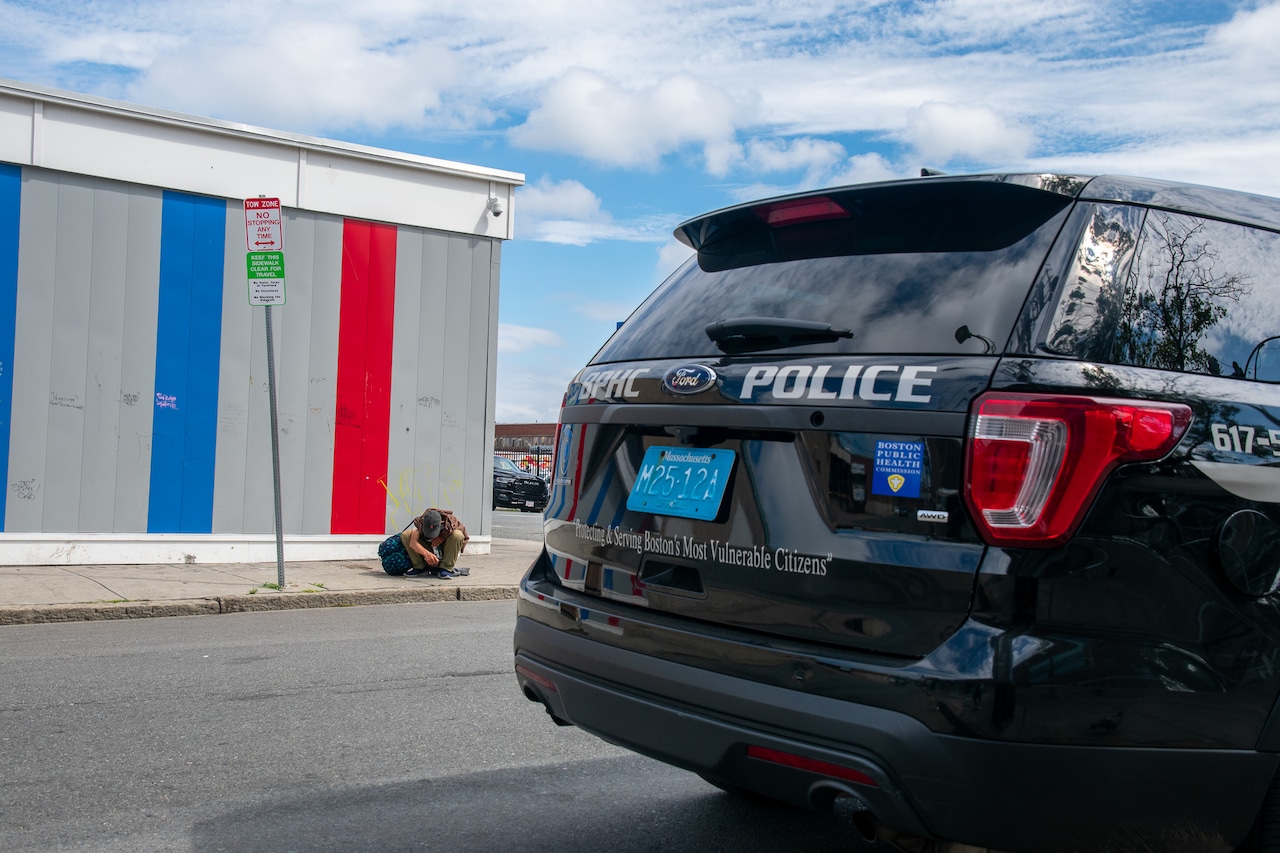
Boston’s Coordinated Response Team is a key part of the strategy, coordinating city agencies to enforce laws preventing outdoor encampments and responding to constituent calls reporting congregate public drug use and related issues.
Alongside Boston Police, the team works to connect people dealing with addiction to residential recovery services and treatment programs offered by the Boston Public Health Commission and partner organizations.
For certain people facing nonviolent drug charges, the Suffolk County District Attorney’s Office offers programs that direct people into treatment rather than the traditional criminal justice system.
Last month, Wu announced $200,000 in new grant funding to expand the Coordinated Response Team.
Those measures have also come alongside an ongoing surge in police presence around Mass and Cass and other hotspots of congregate drug use, with a focus on enforcing drug-related crimes.
Police also increased the availability of specially trained outreach officers to respond to people dealing with mental health and substance use disorders in the Mass and Cass area.

Josh Kraft’s plan
Kraft says the prevalence of outdoor living, trespassing and discarded needles “have reached intolerable levels in many neighborhoods,” and that Wu’s plan has “failed to solve — and often exacerbated — the problems at Mass and Cass.”
Under his plan, police would increase enforcement of public drug consumption, trespassing, tent camping and other quality-of-life crimes. Prosecutions would be handled in specialty courts, aiming to drive people into recovery programs rather than prison.
Kraft would also revive the Community Syringe Redemption Program, a needle collection program supported by pandemic relief money that encouraged people to return used needles for a monetary refund.
Funding for the program ended last year.
The city’s needle collection efforts are now focused elsewhere.
The Boston Public Health Commission’s Mobile Sharps Team continues to operate at least 12 hours a day, seven days a week, cleaning up needles around the city, according to the Wu administration. Another program hires individuals in early recovery to clean the streets and collect syringes.
Still, Kraft has upped his calls to increase the clean-up efforts this week after reports that a 4-year-old child stepped on a discarded needle at a South Boston park and now has to enter a prolonged HIV prevention regimen.
“This is something that no mother, or any 4-year-old child, should ever have to endure,” Kraft said Monday.
Under Kraft, authorities would also establish a dedicated recovery campus in or near Boston to provide housing and support services while people work to overcome addiction. The campus could fill the gap left by the closure of the Long Island facility in Boston Harbor more than a decade ago, where the city offered shelter and social services to hundreds of homeless people, Kraft said.
Authorities closed the facility after determining that the bridge connecting Long Island with the mainland had become structurally unsafe.
The campus proposed by Kraft would be funded and managed jointly with the state, part of an effort to deepen the local-state partnership on public health issues that Kraft said deteriorated under Wu.
The Kraft plan also calls for a surge in shelter beds to house every person living on the street, also in partnership with the state.
One South End neighborhood leader called for National Guard troops to be deployed in the Mass and Cass area to bolster the city’s response to homelessness and public drug use, only to later back off the suggestion, according to the Boston Herald.
Wu rejected that idea, saying Monday that she didn’t think “we need or should have a military deployment in our city.”
Asked whether Kraft supported deploying Guard troops, a Kraft campaign spokesperson did not directly answer. Instead, he referred a reporter to the candidate’s Mass and Cass policy and recent comments surrounding discarded needles, which included a call for the mayor “to commit to taking emergency measures to pick up all discarded needles throughout Boston.”
If you purchase a product or register for an account through a link on our site, we may receive compensation. By using this site, you consent to our User Agreement and agree that your clicks, interactions, and personal information may be collected, recorded, and/or stored by us and social media and other third-party partners in accordance with our Privacy Policy.